Controls Ease Startup
Systems integrator’s work simplifies startup, customer operations, and upfront programming.
Staff -- Control Engineering, 9/1/2007
|
Smooth project startup, despite a large ongoing investment, can require starting from scratch to realign the automation system closer to the original vision, according to a system integrator that worked on such a project.
Graphical software tools can augment automation system implementation, including:
- Focus on simple start-up, screen navigation, and operations as a goal;
- Ability to create libraries of reusable code;
- Integration of programming and configuration for human-machine interfaces (HMIs) and programmable logic controllers (PLCs);
- Full, onscreen view of plant operations, emphasizing graphics rather than text; and
- Pull-down recipe menus so authorized operators can make changes more easily, on the fly.
Drivex Inc., based in Livermore, CA, specializes in web tension control for the pharmaceutical, converting, and vacuum coating industries. The company’s experience includes projects integrating SSD Drives (formerly Eurotherm Drives), Wonderware advanced SQL server data aquisition/distribution/report generation on the web, Ormec Servowire (FireWire) networked servo systems for the vacuum coating industry, and Rockwell Automation Allen-Bradley ControlLogix, SLC 500, and PLC 5 platforms.
But the project that Leo Willis, founder, and his engineering associates will long remember is the development of a replacement automation and control system that far exceeded a leading superconductor maker’s expectations and opened the door to vast new business growth for Drivex.
“Operators at the superconductor plant were finding it virtually impossible to manage and monitor their extremely complex manufacturing processes using literally hundreds of interface screens that were tough to navigate and understand,” noted Eric Tischer, the Drivex engineer who took on what would quickly become the most challenging and rewarding assignment in the five years he’s been with the company.
“A full team of integrators from another company had originally programmed the three-year-old system, spending 18 months writing code and generating more than a thousand screens,” Tischer said. “I had initially planned to develop the replacement system using the same software, but we realized it would take at least six months and decided the customer would be much better off if we just started from scratch.”
Tischer was initially concerned that he would have to learn a new program, but he received help from Siemens and its Simatic WinCC - HMI SCADA software, which helped him jumpstart learning at Drivex as well as simplify start-up and operations for customers.
Screen simplificationSiemens supplied a WinCC expert for a week to “bring Eric quickly up to speed and help him write much of the code that has enabled us to create a whole new level of operational simplicity and flexibility for our customers,” explained a smiling Willis, appreciating being able to “take on the increasingly complex and sophisticated customer applications we could never do before.”
For Tischer, the kind of guy who tinkers in robotics and car engines for the fun of it, the light bulb went off when he realized he could cut engineering time dramatically by leveraging the total integration between the Step 7 programming platform and WinCC to create libraries of reusable code, which may have saved them several months time. “Now we’ve got the ability to develop macro blocks of code that can be cut, pasted, and automatically integrated with the PLC [programmable logic controller]. It’s the difference between programming line by line, like I did before, and paragraphs at a time.”
For the superconductor producer, the real proof was in the screens. The windows into their complex production process had been foggy at best for more than three years, the Drivex team suggested. Tischer’s primary objective centered on the customer’s need for a simplified, crystal clear view into the full plant operation and pull down recipe menus so authorized operators could make changes on the fly.
“Their operators must be able to easily modify the sequence of precise steps taken to prepare the vacuum chambers for the production of superconductors – from turning pumps on and off, setting voltages, and introducing different gases and liquids based on triggers like temperatures, pressures, and time,” explained Tischer. “Normally these steps, hundreds of them, would be hard coded in the PLC, and we would have to fly out to make any modifications. It’s a whole new ballgame with WinCC.”
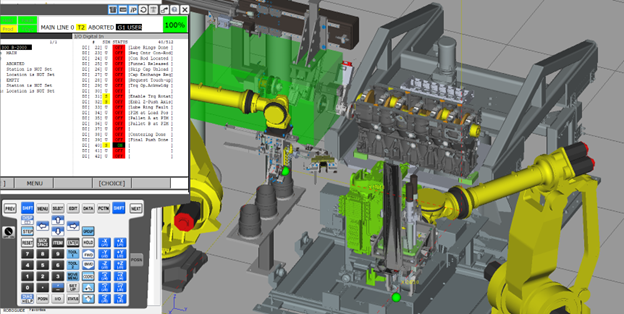
With little or no training, plant operators can rearrange, modify, add or delete steps in their process sequences simply by simply by pulling drop down boxes and clicking a few check boxes. Graphical pictures that are identical to control panels in the chambers are featured on the computer screens to help operators avoid errors and confusion that could disrupt the web handler. Simatic WinCC has even made traditionally tedious PID [proportional-integral-derivative] controller loop programming and tuning as easy as a click or two to set or reset automated parameters.
“We’ve duplicated the real-life machine control panels on the interface screens so the operators will know instantly how to use them,” Tischer said. “In this case, a picture is worth a thousand screens. In the end, the customer went from 1,050 static, text heavy status screens that made no sense to fewer than 25 intuitive graphical screens that keep operators tuned in to what’s happening at all times.”
Easier programmingDrivex customers who have made big dollar investments in state-of-the-art vacuum-chamber production facilities want as much flexibility as they can get from their web handling control. They want simple, intelligent visualization screens that turn complex applications into sophisticated models of operational excellence running on push button ease and material-saving accuracy.
The small systems integrator expects to work on several more WinCC-enabled control systems. “Now we can bid on just about any web handling project,” Willis noted, given the additional knowledge in graphical programming, integration with PLC programming, and experience with additional hardware and Profibus industrial networks.
Tischer expressed appreciation for “dedicated training and onsite support that helped me through the learning curve” toward a more integrated automation approach.
| For more information, visit: | ||
| www.drivex.com | ||
| www.sea.siemens.com | ||
|


View All Blogs