“If we know anything about data centers, it’s that they’re moving quickly,” said Marilyn Sedlak, Project Engineer at DMC.
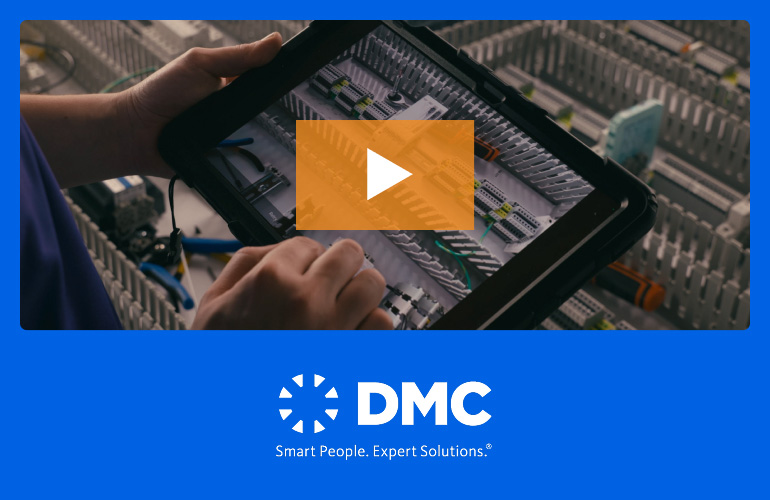
And DMC knows. With locations across the US, DMC Inc. is a project-based engineering firm focused on software development and control systems. DMC’s Manufacturing Center is across the street from their Chicago office, pairing custom-built control panels and bespoke integration solutions on a single city block.
Partnering with a data center customer, DMC needed to provide firmware engineering, electrical design, and panel fabrication for thousands of custom electrical systems, all on an expedited timeline. As a highly successful integration firm, DMC leveraged their expertise with Ignition — the enterprise industrial integration platform — to develop a custom application for guiding assembly, quality control, and shipping. Not only did the solution enable consistent, high‑quality production, it became the first large-scale Ignition application used internally in DMC’s production environment.
Efficiency at Scale
Delivering a high volume of custom‑built systems on an aggressive timeline is one thing, but DMC also needed to build multiple product variants, each with distinct assembly steps and quality requirements.
DMC’s prior approaches to increasing throughput had necessitated significant hands-on technician training. This made it difficult to adapt to changing configurations and limited visibility into build progress and quality data after shipment.
Not wasting any time, DMC began developing the Ignition application while the fabrication studio defined and refined the manufacturing work instructions. Fortunately, Ignition’s inherent flexibility made this type of parallel development easy. “We can go from making a mistake, catching a mistake, and fixing the work instructions almost immediately and seamlessly within the Ignition app,” said Leonard Wine, Shop Lead at DMC.
An All-in-One Solution
DMC implemented a custom Ignition Perspective application to serve as the backbone of the fabrication workflow. The application provides station‑based work instructions and integrated quality control checklists, dynamically adjusting steps for the specific product variant associated with each ERP work order.
The SQL backend allows DMC to manage and update the application centrally without UI rework. Built-in user roles ensure that only trained personnel can complete quality tasks, while modular workflows minimize downtime by allowing production to advance as far as possible even when certain parts are unavailable.
DMC designed the responsive, intuitive UI to work seamlessly on both desktops and tablets, enabling builders to reference instructions, upload photos, and scan barcodes directly at their stations. “Ignition, out-of-the-box, was compatible with the mobile tablets, which was critical for us to be able to navigate around the large panel and take the photos and keep those for our records,” said Sedlak. Ignition’s native integration with cloud storage enables long‑term retention for photos, inspection data, and build records collected throughout the construction process.
DMC’s application designers focused on making it seamless for builders to move from step to step, capturing critical information all the while. By integrating ERP data, Ignition acted as a single pane of glass, eliminating the need for builders and quality staff to switch between systems. “They could do it in one,” said Brandon Tanner, Senior Project Engineer at DMC.
Faster and Faster
The Ignition application not only allowed DMC to transition from individual to group training, it sped up the overall process as well. “What had previously taken maybe a couple of days of training, we could complete by lunchtime, with the same level of confidence that they were going to meet all their quality control needs,” said Wine.
Now, builders are confident that if they follow the work instructions and match the photo reference in the application, they will deliver accurate results. “The value of Ignition, to us, has been that we can more easily provide [builders] with a source of truth,” said Wine. This combination of standardized procedures, real‑time validation, and easy access to historical inspection photos has improved quality while reducing rework and simplifying issue containment.
This level of production visibility doesn’t just help DMC internally. The detailed traceability and record keeping foster long‑term equipment management and post‑shipment support, because as Sedlak put it, “Once the product is in the field, Ignition is the gateway to access all of the information that we’ve collected.” Ignition has helped DMC with proactive communication, better shipment planning, and faster response to supply chain constraints.
The Ignition application now serves as a reusable template that DMC can adapt for future fabrication efforts, supporting continued growth while maintaining high standards of quality, traceability, and efficiency.
Sponsored content by Inductive Automation