As automation amplifies the consequences of even small changes, simulation provides a zero-risk environment to understand cause and effect relationships, and to eliminate surprises before they impact safety or production.
Process simulation software insights
- Industrial simulation software is not too expensive nor does it take too long to implement.
- Simulation doesn’t have to be maintenance burden, abandoned after startup or require specialists and outside services.
- Simulation isn’t only for large enterprise, and adding more alarms may not be the answer to operational problems.
Process simulation software has not failed to deliver value. Rather, myths about what it is and how it should be used have held organizations back. By choosing the right software, teams can deliver value, lock in best practices, and drive operational excellence across the facility and enterprise.
For decades, industry experts have been predicting workforce shortages resulting in mass retirements. That long-discussed exodus is now a reality, leaving fewer experienced operators and engineers in industrial facilities around the globe. In parallel with workforce shortages, organizations are optimizing operations to compete in an increasingly complex marketplace. Process technologies are more automated, interconnected, and unforgiving of mistakes than ever before.
This shift creates a perfect storm of challenges, with new hires being asked to operate and modify complex systems with far less hands-on experience than their predecessors. Therefore, upskilling techniques must be fast, but more importantly, they must also be effective.
The optimal technology to accomplish both goals is industrial simulation software, but many organizations still view dynamic simulation software as optional, expensive, or limited in scope. However, the most effective modern simulation is none of those things, and it is time for many organizations to re-evaluate it as an option.
Simulation has expanded beyond the training room
When most people think of industrial simulation, they imagine operators sitting around a dedicated operator training simulator (OTS) in a training room. Yet while an OTS still delivers value, it is far from the only way top performing organizations are leveraging their simulation software.
Today, control engineers and process engineers—who like their operator counterparts are often less experienced than their predecessors—increasingly rely on simulation software to test ideas before applying them to live systems. New control engineers often do not know exactly how a logic change will impact processes, so dynamic simulation empowers them to explore a wide array of options, without risking production or safety.
For example, an inexperienced engineer may not have the years of practice on the facility’s control system necessary to know how a new control loop will affect overall operations. Rather than notifying all personnel and preparing for potential problems, the engineer can test deployment on the organization’s simulation to see exactly how it will impact operations.
High-risk environments meet zero-risk practices
The ability to test and experiment in a zero-stakes environment has become critical for successful operations because personnel can no longer afford to learn by trial and error. Competition, cost pressure, increased environmental scrutiny, and safety expectations leave little room for experimentation on live equipment.
Moreover, increased automation from complex control loops, advanced process control, and state-based control have amplified the effects of even the smallest changes to operations. A minor adjustment can easily propagate through the control system, units, and entire processes, potentially creating trips or even safety incidents.
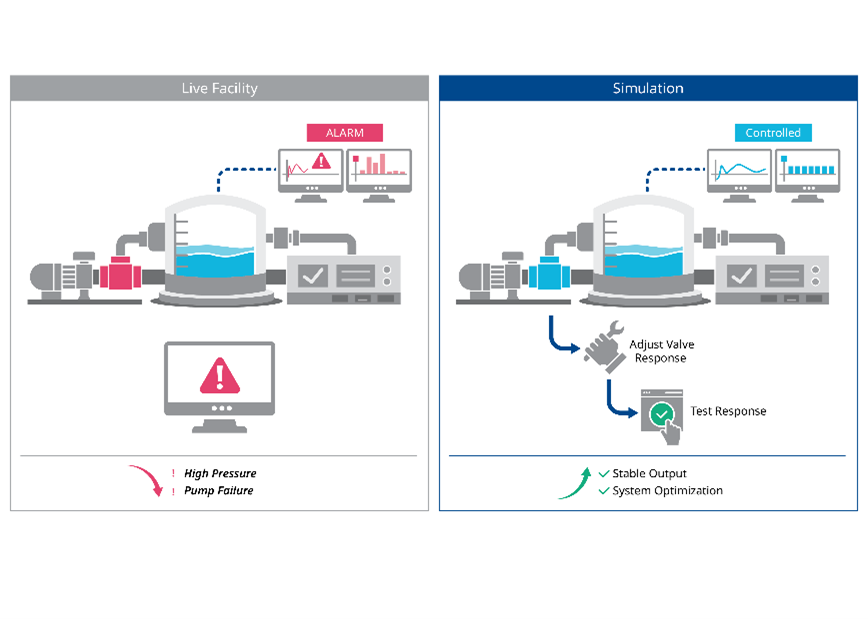
Simulation gives teams ways to see the cause-and-effect relationships between their actions and facility operations well before they impact the process. Users gain confidence before execution, instead of learning from recovery after a failure (Figure 1).
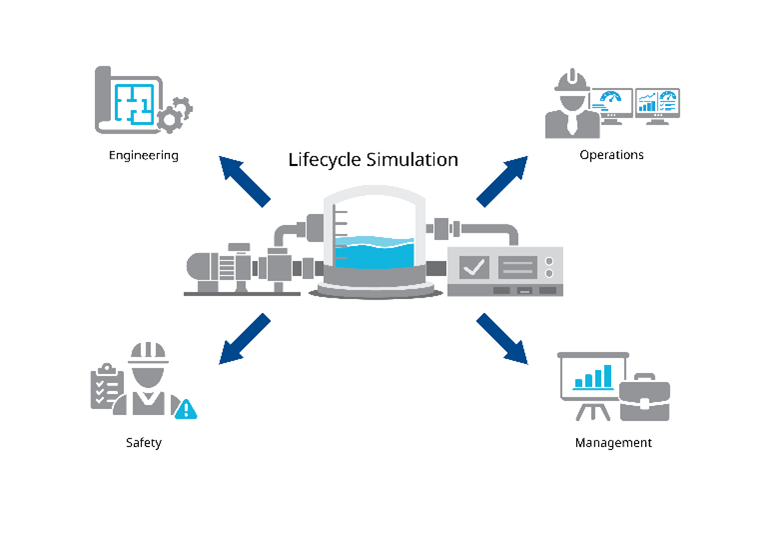
Figure 2: Modern lifecycle simulation supports operators, engineers, and facility teams across training, engineering, and operational decision-making. Courtesy: Emerson
Training beyond onboarding
Another common challenge to driving the most value from a simulation solution is viewing it only as an onboarding tool. Today, training is a continuous, adaptive process. As organizations run with leaner teams, individual personnel are expected to take on wider responsibilities. Therefore, it is important to ensure simulation software supports both initial qualification and ongoing skill refreshment.
To meet these goals, organizations are selecting lifecycle simulation solutions, software intentionally designed to be brought out of the training room and into the hands of personnel across the facility and enterprise. These tools are built with flexibility to deliver continually updatable training and an engineering sandbox to support teams through operations changes due to market shifts, sustainability initiatives, product changes, and more (Figure 2).
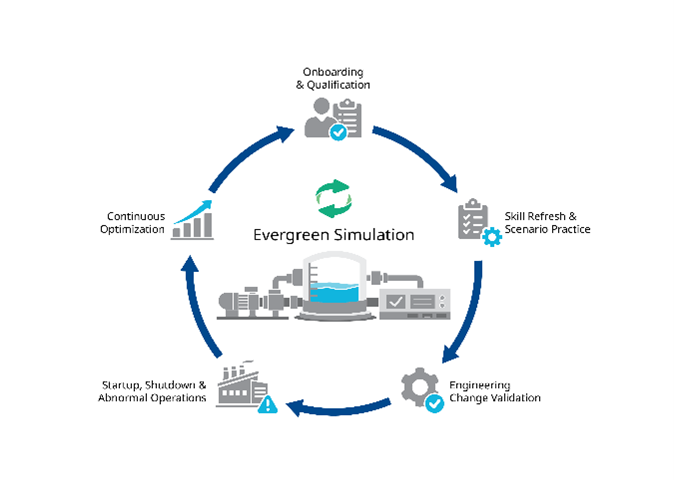
The most advanced simulation solutions are designed to be easily updated to stay evergreen. They integrate seamlessly with other applications and provide fast and intuitive synchronization features to ensure the process model stays aligned with the current reality of the facility (Figure 3).
Navigating the most dangerous process operations
One of the key reasons it is so important to bring simulation out of the training room is that non-routine operations are among the most dangerous in a facility. The Center for Chemical Process Safety reports that process safety incidents occur five times more often during startup than during normal operations. Operators routinely work with steady state operations and become accustomed to them. In contrast, transient operations are infrequent, and in many cases the procedures to perform the required steps are often poorly documented, and modifications only happen after the event is complete. This can lead operators to be under-prepared when something goes wrong.
Simulation allows teams to practice, repeat, and refine these less common scenarios regularly and safely. Engineers can first validate procedures in simulation to ensure the models match the current state of the facility. Operators can then undergo training on updated steps rather than outdated assumptions.
Understanding modern process simulation by dispelling 5 myths
Modern lifecycle simulation delivers countless benefits, yet there is often still resistance to implementing it in today’s industrial settings. Much of this resistance comes from outdated myths that are no longer relevant to modern, fit-for-purpose dynamic simulation software.
Myth #1: Industrial simulation is expensive and takes too long to implement.
Many teams assume simulation models must be extremely detailed and complex to be useful. However, while there are situations where extremely high-fidelity models can be useful, most organizations find better success with software that supports a mix of fidelity for different elements of the simulation.
The most effective models match fidelity to their training or learning objectives. Medium- or lower-fidelity models can effectively teach principles, responses, and workflows. This allows teams to quickly build usable models for training and engineering, without the need for external expertise or intensive resources for development.
Moreover, even when a team starts small with simpler models, the most advanced simulation software allows those teams to grow their models as value is determined. When a high-fidelity model matters, the team can evolve individual elements until they have what they need—but such a solution does not need to be the entry point for every organization.
Myth #2: Simulation is just a maintenance burden that will be abandoned after startup.
Traditional OTS environments often degrade because they are isolated in the training room and rarely used after project completion and facility startup. In contrast, modern simulation is no longer locked away; it is instead designed to be installed on systems around the facility and enterprise, and then used by engineers and operators as part of their daily work.
Greater visibility of the simulation models makes updates more frequent and practical, especially when teams select software allowing for hybrid fidelity models that make long-term maintenance more realistic. Moreover, as engineers and operators use the simulations on a daily basis, they evolve alongside the facility, not sit apart from it. This approach is made even more practical with built-in synchronization tools designed to make updating the simulation configuration seamless and intuitive.
Myth #3: Simulation requires specialists and outside services.
Modern tools have dramatically simplified the deployment, use, and maintenance of dynamic simulation software. Though traditional simulation software often required advanced academic expertise for configuration and operation, modern dynamic simulation tools resemble control system configuration environments, simplifying their use. Prebuilt objects, libraries, and function-block-style modeling significantly lower the barrier to entry. Engineers can now build, modify, and extend simulations incrementally, allowing organizations to stay in control of their models over time.
Myth #4: Simulation is only for large enterprises.
Because traditional simulation tools were complex and expensive, many organizations may think their facility is too small to warrant a simulation investment. However, even the smallest organizations must still prove operator readiness and manage risk. In fact, in many smaller organizations fewer people are responsible for a larger number of critical tasks. Those organizations can leverage modern simulation software to quickly and easily create new training scenarios to provide objective evaluation of operator performance. In addition, those same tools can be used to automatically record and track progress to ensure every operator has been trained to the company’s standards.
Myth #5: The best solution to operational problems is to add more alarms.
It is easy to assume that the fastest solution to a new operational problem is to set up an additional alarm to notify operators. However, operators already deal with significant alarm loads. Adding alarms does not ensure the operator will perform the correct response under pressure. Instead, in many cases alarm floods prevent operators from making the right choices.
Truly effective improvement instead stems from ensuring operators have practiced responding effectively. Modern dynamic simulation software allows teams to test alarm scenarios and response timing. Where effective responses are not achievable, simulation also exposes where automation or operational procedures must change.
Simulation is a lifecycle tool, not a training add-on
Modern industrial simulation software has evolved well beyond its original role in operator training rooms. Today’s most advanced software supports workforce development, improved engineering confidence, and safer change management.
In an environment of high workforce turnover, increased automation, and significant risk, learning on live processes is no longer an acceptable option. Teams must instead leverage sandbox tools to test and train new strategies for continual progress toward increased operational excellence.
Ultimately, for organizations looking to secure competitive advantage in an increasingly complex global marketplace, simulation can no longer be an afterthought. It has become a foundational capability – one for building confident, adaptable, highly responsive teams.
Dawn Marruchella is the vice president for Emerson’s Guardian Software and Solutions business. Edited by Mark T. Hoske, editor-in-chief, Control Engineering, Arrowfly, [email protected].
Keywords
Process simulation, simulation lifecycle
Consider This
Is simulation your afterthought or an integral part of your process lifecycle?
You also might like
https://www.controleng.com/process-instrumentation-sensors/simulators-optimizers