Traditional maintenance strategies, whether time-based or reactive, simply cannot keep pace with the complexity and risk tolerance of modern production environments. The shift toward predictive maintenance is well underway, and machine data is what makes it possible.
Machine data for predictive maintenance insights
- Why the data layer matters
- How to turn data streams into actionable intelligence
- The value of generated insights reaching the right people at the right time.
Food and beverage and pharmaceutical manufacturers know that unplanned downtime is more than an inconvenience. It threatens batch integrity, regulatory compliance, product quality, and customer commitments. Traditional maintenance strategies, whether time-based or reactive, simply cannot keep pace with the complexity and risk tolerance of modern production environments. The shift toward predictive maintenance is well underway, and machine data is what makes it possible.
From reactive to predictive: Why the data layer matters
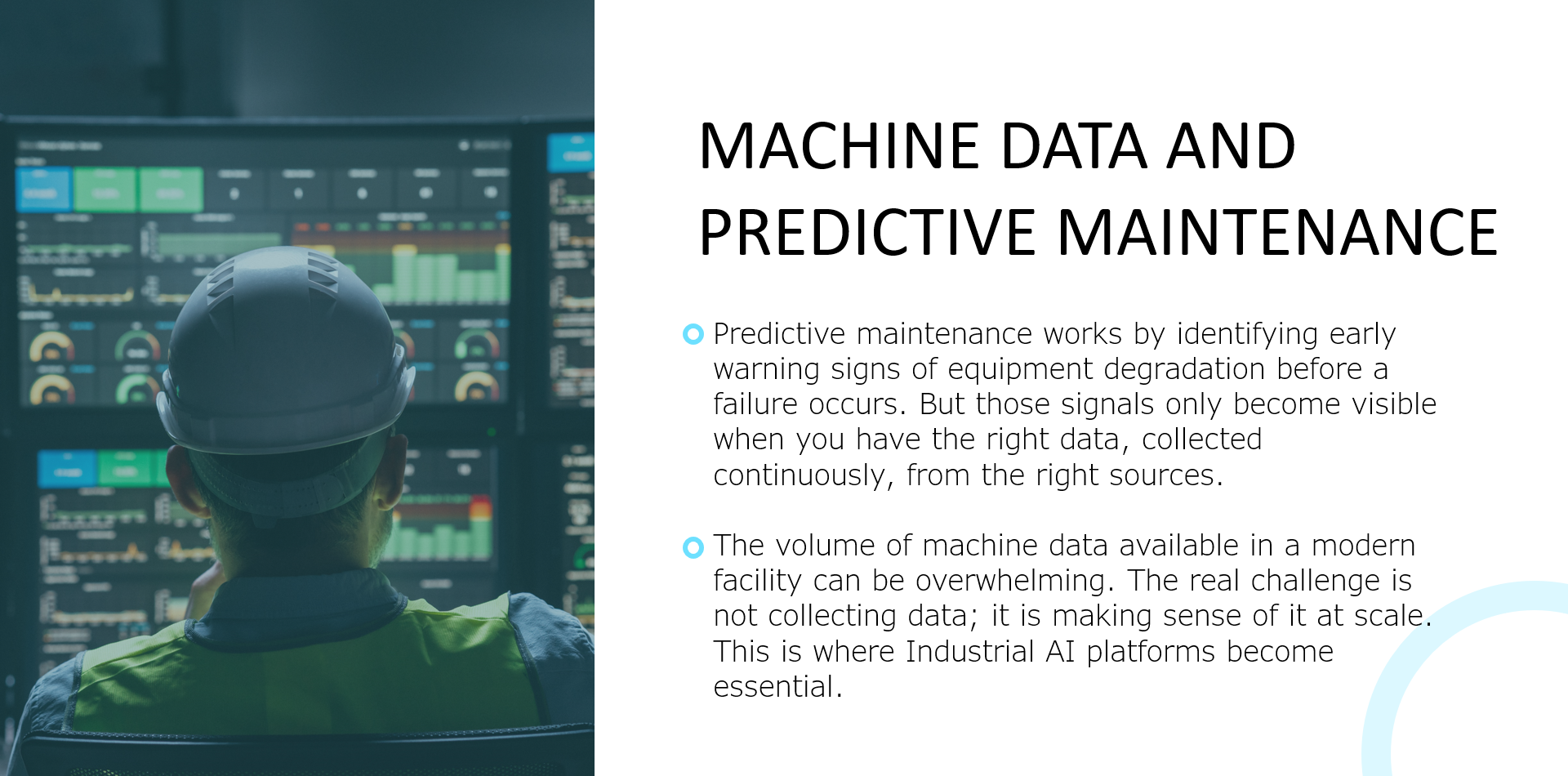
Predictive maintenance works by identifying early warning signs of equipment degradation before a failure occurs. But those signals only become visible when you have the right data, collected continuously, from the right sources. Sensors embedded in motors, pumps, conveyors, fillers and mixers generate a constant stream of information about temperature, vibration, pressure, speed and energy consumption. On their own, these readings are raw and noisy. Combined with historical patterns and contextual production data, they become a powerful diagnostic tool.
For food and beverage operations, this means catching a failing bearing on a packaging line before it causes a product recall event. For pharmaceutical manufacturers, it means maintaining the environmental and equipment conditions that are prerequisite to regulatory compliance, catching anomalies in controlled environments long before they affect batch records or audit trails.
Turning data streams into actionable intelligence
The volume of machine data available in a modern facility can be overwhelming. The real challenge is not collecting data, it is making sense of data at scale. This is where industrial AI platforms become essential.
Cloud-based industrial data analytic platforms that use artificial intelligence are purpose-built for this problem. By ingesting machine data from existing automation systems and applying AI-driven models, software can detect subtle performance deviations, predict failure modes and deliver prescriptive recommendations to operators and maintenance teams. Pre-built solutions offer capabilities to optimize uptime and examine reliability of assets allow manufacturers to move from insight to action quickly, without requiring deep data science expertise on the plant floor.
What good data strategy looks like in practice
A strong foundation for predictive maintenance starts with connectivity. Machines that are not instrumented or networked cannot contribute to a predictive program. This means ensuring PLCs, SCADA systems, and sensors are properly integrated and that data flows reliably from the plant floor to a centralized analytics layer.
From there, data quality matters as much as data quantity. Timestamps need to be accurate. Tags need to be consistently named and contextualized. Gaps in historian data or poorly calibrated sensors will undermine even the most sophisticated AI model.
Finally, the insights generated need to reach the right people at the right time. A predictive alert that sits in a dashboard no one monitors is no better than no alert at all. Building workflows that connect anomaly detection to maintenance scheduling systems closes the loop and ensures action follows insight.
Business case for machine data infrastructure
Manufacturers who invest in machine data infrastructure and predictive analytics consistently see measurable improvements in asset uptime, maintenance labor efficiency, and total cost of ownership for critical equipment. For industries where one unplanned stoppage can mean wasted batches, regulatory investigations or missed customer orders, the return on investment is not difficult to calculate. System integrators work with food and beverage and pharmaceutical manufacturers to build connectivity, data integrity and analytics foundations that make predictive maintenance a reality. The technology is mature, the tools are accessible, and the data your machines are generating today is ready to be put to work.
Jim Toman is MES functional consultant at Grantek. Florida Edited by Mark T. Hoske, editor-in-chief, Control Engineering, WTWH Media, [email protected].
Keywords
Data analytics, optimization
Consider this
Are your tools moving you from data to information to answers?
You also might like
https://www.controleng.com/digital-transformation/virtualization-cloud-analytics