Cloud robotics and physical artificial intelligence are making machine design and optimization more effective with smarter digital twins and virtualization, as explained at IMTS 2026.
IMTS 2026 physical AI insights
- In virtual commissioning and other industrial automation applications, digital twins can work with agentic AI software and physical artificial intelligence (AI) hardware, including machine design and motion control.
- Industrial automation application examples aid understanding of practical agentic AI and physical AI uses.
- Product announcements and a new AI lab advance AI use for industrial automation.
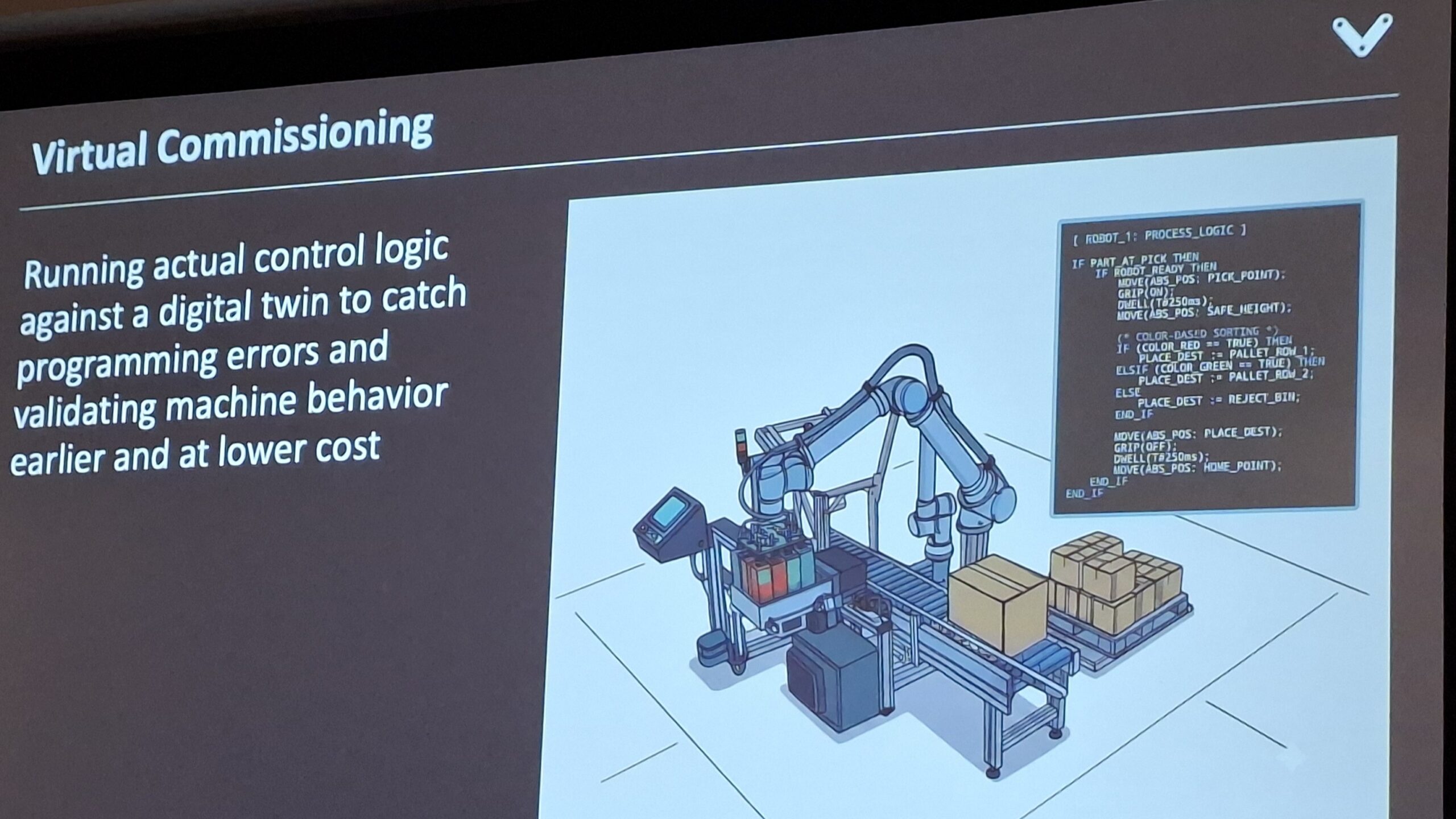
When used for virtual commissioning, digital twins can run actual control logic against a digital twin to catch programming errors and validating machine behavior earlier at a lower cost (Figure 1). This includes robotics and other motion control applications. Brendan Sterne, chief product officer, Vention (Figure 2), discussed applications for physical artificial intelligence (AI) in the presentation, “From code to concrete: How cloud robotics and physical AI are rewriting industrial automation,” at IMTS 2026, the International Manufacturing Technology Show in September, with 1788 exhibitors, according to show organizers AMT. Sterne gave Control Engineering a session preview of the presentation and answered questions.
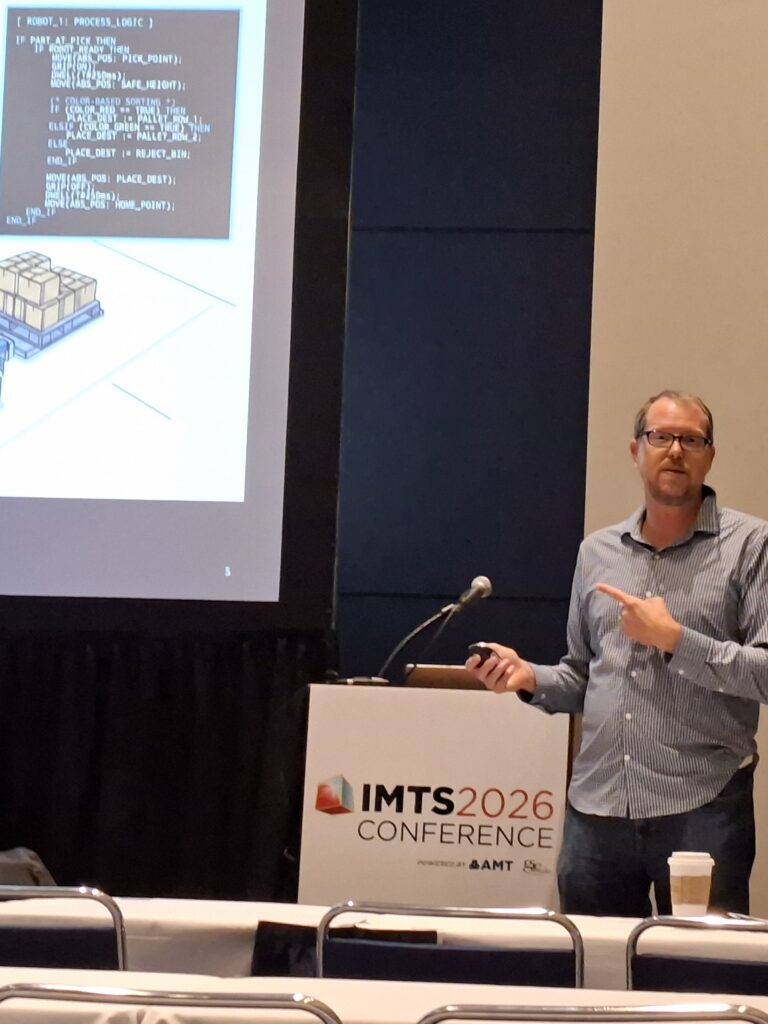
How digital twins help with machine, motion control
Challenges of machine design, motion control and robotics include:
- Dynamic and sensing – Friction, inertia, collisions, sensors, gripping, control system latency and accelerations and deceleration.
- Precise robot trajectories (paths and speeds): Reach, interference, cycle time.
Simulation is integrated into virtual robot controller software, and AI is used inside industrial co-pilots. Siemens Process Simulate and ABB Robot Studio are two examples.
AI agents, programs seeking to perform tasks or optimize processes, can be applied outside industrial automation using model context protocol (MCP) connectors. Sterne said that using MCP, AI agents can interact with simulations and code-writing software to go from design to plant-floor operation with the same editor, with realvirtual.io or with RoboDK software, for instance.
This can be helpful as robotic technologies are more widely used to fill in for too few workers in manufacturing jobs: 38% of manufacturing labor force moves parts between bins and manufacturing machines, Sterne noted.
Some software fully integrates AI tools and industrial programming. For instance, Vention MachineBuilder is a cloud-based design software allowing programming in the browser or use of a co-pilot for agentic AI design, Sterne said.
- The agentic AI and industrial design software can help create an efficient facility layout. It also can: Troubleshoot running machines:
- Find faulty connections.
- Design, program, monitor.
- Perform recursive self-improvement (RSI)
- Run in simulation and optimize parameters.
- Do bin picking. Successful first pick can be in the 80th percentile into the high 90th percentile. (Vention prepares the application in its application “sandbox” before customer use.)
Digital twins help with bin picking, an automation task often avoided because of a high level of difficulty, expense and physical space requirements. Foundational models can do printed circuit board (PCB) inspection and testing, bin-picking parts, assembly and serialization, machine tending.
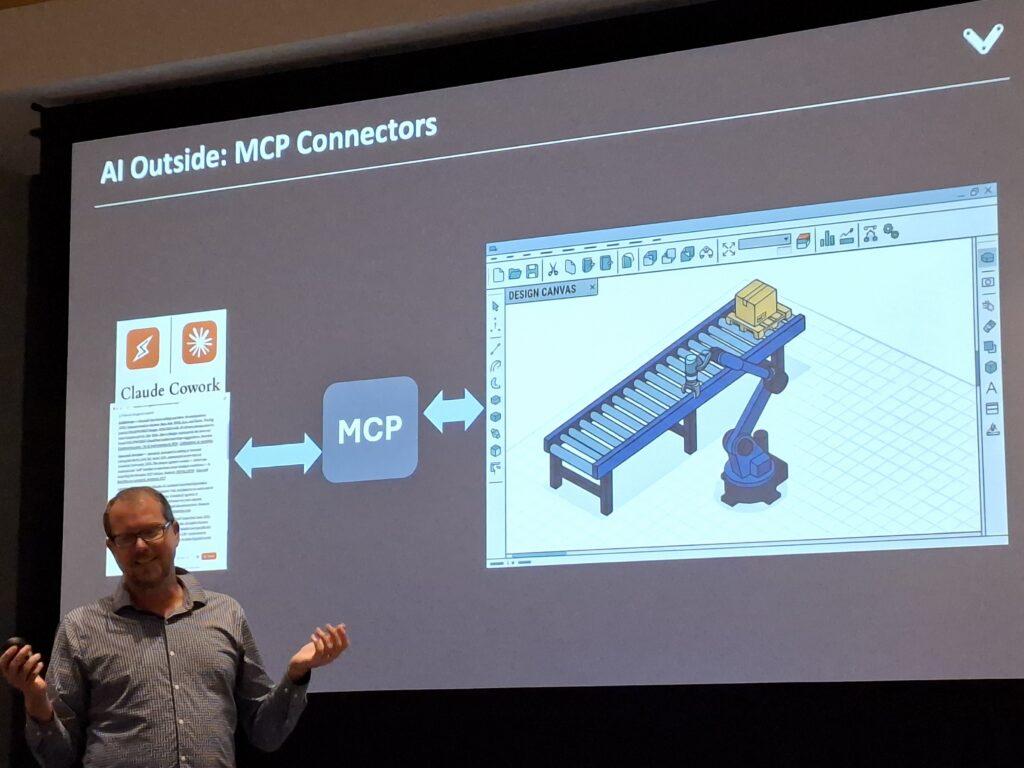
Intersection of software AI, physical AI
Software AI helps the physical world to become physical AI. Physical AI adds vision and edge computing to traditional robotic cells:
- Collaborative robot arms can be tailored to payload and the speed of the application.
- End-of-arm tooling: gripper and force, torque sensor
- Robot pedestal – fixed pedestal based on application needs
- MachineMotion AI software can be upgraded to “Pro” for added axes and power
- Teach pendant includes customize machine application.
- Robot safety module (RSM) to be added based on the application
- 2D stereo camera includes mounting on robot arm
- Nvidia Jetson Thor edge compute general processing unit (GPU) of the AI pipeline.
Foundational models are improving workpiece localization for smarter bin-picking and other applications, Sterne said, such as perception and segmentation, pose estimation (pre- and post-grip), grasp intelligence, scene digitalization and calibration, collision-free path planning and end-to-end robot cell design and workflow.
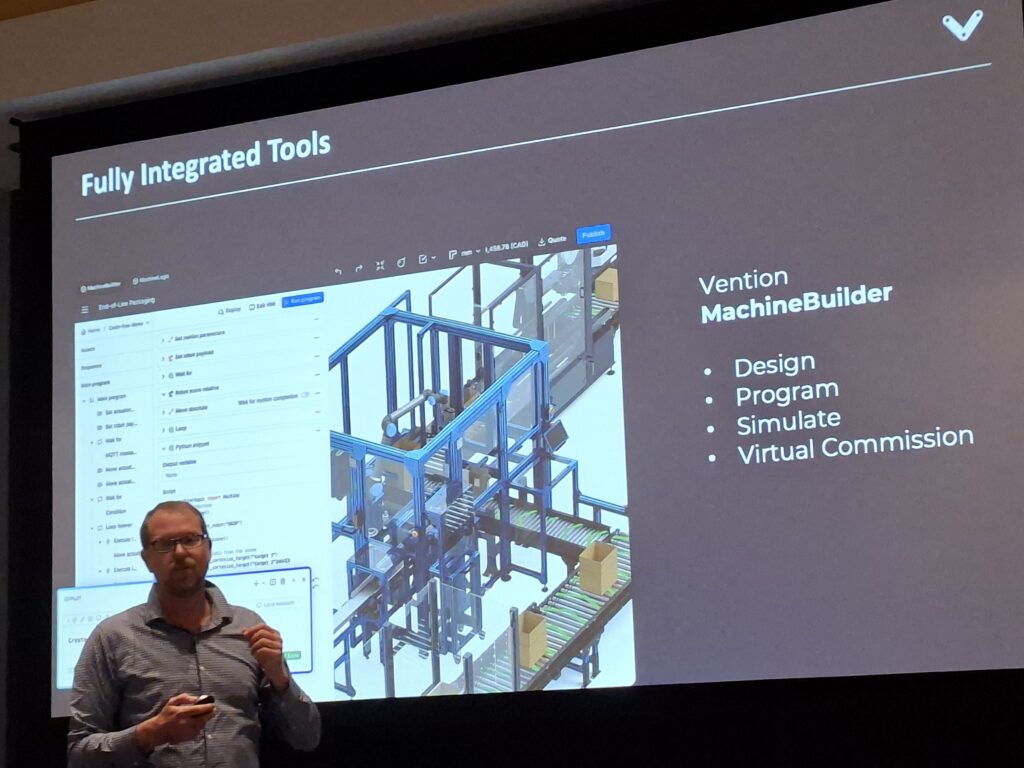
Why AI for manufacturing automation is increasing
Why is increased AI use important for end-user manufacturing applications, original equipment manufacturers and system integrators applying automation and controls? Sterne said:
- Digital twins are becoming more affordable
- AI agents are significantly more capable every 3 months. AI agents and co-pilots help with machine design, programming, simulation rigging and troubleshooting.
- AI agents can operate and help outside using MCP connectors.
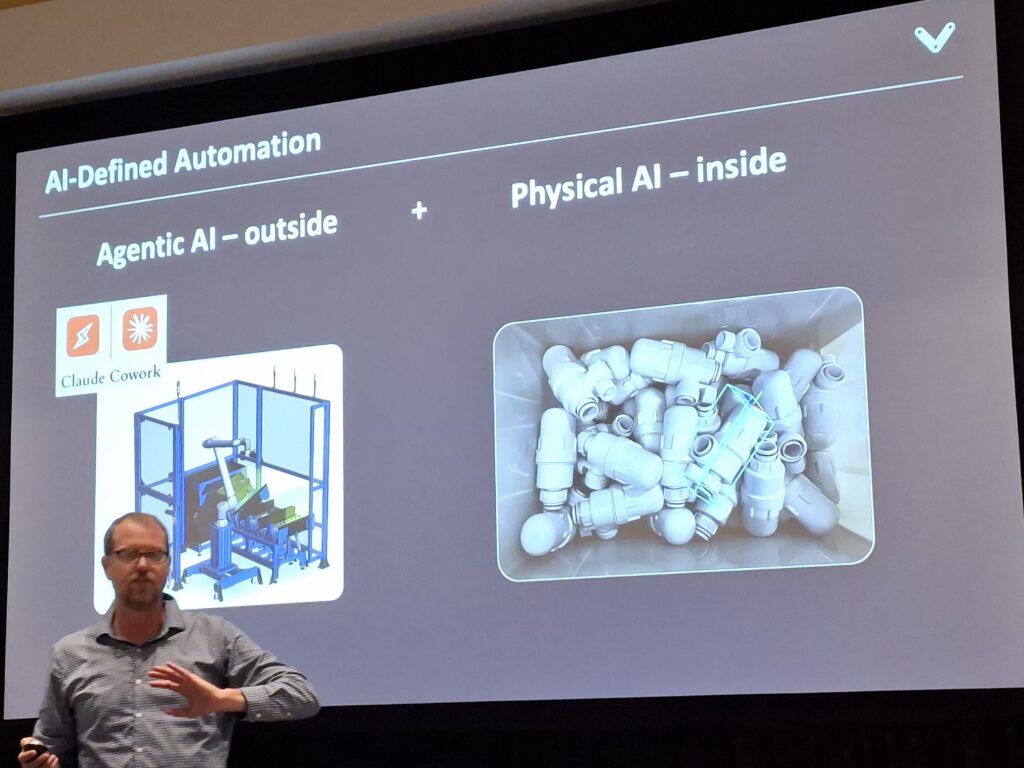
- AI-defined automation is helped with agentic software helping simulated and physical world applications, including integrated industrial workcell and motion design, programming and simulation tools (like Vention).
- Reliability and affordability are increasing for bin-picking, workpiece tracking, mixed depalletizing and palletizing and vision-based welding and surface treatment.
Responding to a Control Engineering question about AI cybersecurity, configuration matters, Sterne said. Let AI resolve static problems like improving motion control and trajectory planning, he said, but not run the machine; don’t let a large-language model (LLM) have access to motors, for example.
The Vention booth at IMTS included a physical cell with moving axes. Visitors can program candy movement and delivery on a digital twin, then deploy the program in the machine beside it, in a Vention MachineBuilder software demonstration. Vention MachineAgent agentic cell is said to deliver an interactive, end-to-end automated workflow for machine design, programming, deployment and troubleshooting. Live physical AI demonstrations included Vention Rapid Operator AI deep bin picking and goal-driven collision-free path planning, showcasing autonomous perception, grasping and robotic motion powered by Vention Griip technology.
Vention agentic AI and physical AI announcements at IMTS
Separate from Sterne’s presentation, Vention made the following announcements at IMTS on Sept. 10.
Vention introduced new physical AI and agentic AI capabilities included for the first time in one automation platform. Combining the two levels of artificial intelligence in one platform makes automation faster to deploy, easier to operate, and simpler to scale.
Introduced at IMTS, the agentic-AI-powered Vention MachineAgent, through plain-language prompts, generates automation layouts, creates industrial automation programs and analyzes operating data from deployed machines.
“AI is changing what manufacturers should expect from automation,” said Etienne Lacroix, founder and CEO of Vention. “Physical AI gives machines the ability to understand and adapt to the factory floor. Agentic AI brings that intelligence to the people designing, programming and operating automation. Bringing both together on one platform hasn’t been done before,” Lacroix said. Customers can “use these capabilities to more easily deploy, operate and scale their automation,” he said.
AI-defined automation will combine two layers of artificial intelligence: Agentic AI makes automation accessible and faster to deploy, while Physical AI makes the machines within that automated system increasingly autonomous, adaptable and efficient.
Vention’s AI-Defined Automation vision is a future in which AI is embedded at every level of the ecosystem. Today, Agentic AI operates at the system level, using natural language and AI agents to help manufacturers design automation cells, generate industrial programs and monitor and troubleshoot deployed systems. In parallel, Physical AI operates at the machine level. It powers robots to perceive, understand and act on the physical world through AI vision, intelligent motion planning and autonomous decision-making.
Physical AI helps manufacturers tackle automation hurdles like complexity, variability and the gap in specialized engineering expertise. The technology behind Physical AI allows robots to perceive objects, plan their movements and adjust to the unpredictability of the real world. This makes automation easier to adapt and deploy and opens accessibility to a wider range of manufacturers. With physical AI, companies can make production lines more efficient and flexible, which, in turn, means increased productivity and a competitive edge. Vention enables these software and hardware functions through its unified automation platform, connecting digital design, simulation, AI vision, programming, motion control, modular hardware, robotics and cloud connectivity.
Vention MachineMotion AI next-generation controller supports this new wave of automation. Powered by Nvidia Jetson and Nvidia Isaac, CUDA-accelerated libraries, and open models including NVIDIA FoundationPose, the technology is exclusive to Vention and power the Vention IMTS booth.
Vention Agentic-AI-powered MachineAgent, through plain-language prompts, can generate automation layouts, create industrial automation programs and analyze operating data from deployed machines. Visitors used Vention MachineLogic Copilot to program a physical UR3 robotic cell through Vention’s cloud platform, as well as an agentic developer workflow using Claude Code, Vention CLI and Developer Toolkit 2.0. Guests used AI to analyze equipment performance data and logs across a fleet of deployed machines, identify an underperforming system, diagnose operational issues and receive real-time guidance through remediation.
Industrial AI software, physical AI hardware demonstrated
Six Vention AI-defined automation demonstrations were:
- Rapid operator AI with UR12e: AI-powered deep bin picking using Vention Griip software and NVIDIA Isaac foundation models for real-time part detection, 6-degrees of freedom (DoF) pose estimation, collision-free path planning and adaptive retry logic, delivering up to 99% first-pick success rates.
- Collision-free path planning with Fanuc LR Mate: Goal-driven robotic motion using on-arm vision, a digital twin and AI motion planning to generate collision-free paths autonomously without manually programming intermediate waypoints.
- MachineAgent with UR3: Agentic AI across design, program and operate, including AI-generated cell designs, industrial programming, digital twin simulation, physical deployment, fleet analysis and troubleshooting.
- Overhead range extender with UR20: A seventh-axis system demonstrated in a live welding application, extending robot reach for applications including welding, machine tending, assembly and long conveyor lines.
- MachineMotion AI Daisy Chain: One MachineMotion AI controller powering multiple motors and actuators, with the functionality to daisy chain up to 20 motors through a cabinet-free architecture.
- Click and customize machine tending with Fanuc CRX-10iA: Configurable CNC loading and unloading programmed through MachineLogic.
Earlier in September, Vention opens a physical AI and industrial robotics lab in Montreal, Canada, focused on advancing robotic manipulation from cutting-edge AI research to reliable, scalable manufacturing deployment. The lab’s research agenda spans applied manufacturing use cases, industrial data collection, and post-training foundation models for robotics, building on intellectual property already generated and continuing to generate more as this work advances. The lab includes work on robotics control, motion planning, classical computer vision, vision foundation models, learning from demonstration and reinforcement learning. Vention said it operates in more than 6,000 factories.
Mark T. Hoske is editor-in-chief, Control Engineering, Arrowfly, [email protected].
Keywords
Agentic AI, industrial AI, physical AI
Consider this
Are you allowing software to optimize your processes?
You also might like
https://www.controleng.com/ai-and-machine-learning
https://www.controleng.com/arrowfly-new-ai-for-engineers-includes-year-round-resources/