By combining energy management, contextualized data, AI analytics and autonomous control, manufacturers can turn energy from an overhead cost into a lever for operational and financial performance.
AI and autonomous control insights
- Energy is a controllable business cost, not just a sustainability issue.
- A four-layer approach turns energy data into useful operational insights.
- AI and autonomous control convert those insights into savings, higher throughput and better quality.
For industrial companies, energy is no longer just an overhead line on the P&L. It is a volatile operating cost that erodes margins, exposes plants to tariff swings and amplifies existing production inefficiencies. In energy-intensive sectors such as cement, metals and chemicals, energy can account for as much as 20 to 40 percent of total production costs, making it a major controllable expense after raw materials and labor (IEA, 2020).
Even where energy represents a smaller percentage of total spend, it still has an outsized impact because it affects every hour of operation, every unit produced and every period of peak demand. As a result, energy is not just a sustainability issue, but a financial and operational one. In some sectors, it is a margin lever, and in almost every sector, it is a controllable source of waste.
When energy is discussed only through the lens of carbon or compliance, many projects struggle to compete for capital. But if it is discussed in terms of cost-to-serve, throughput, quality, asset performance and tariff exposure, the conversation changes. The business case becomes easier to defend because the value is not limited to a lower utility bill. It extends to better scheduling, fewer losses, more stable processes and improved use of existing assets.
Turning energy data into financial value
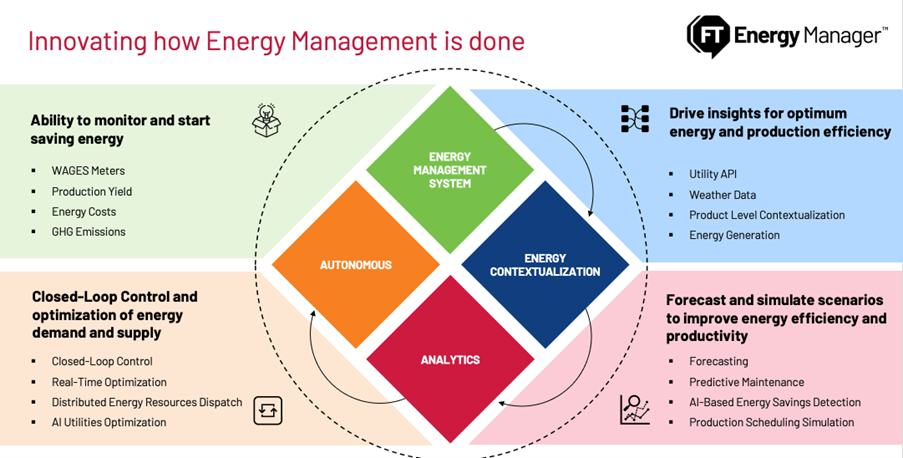
Artificial intelligence (AI), data and analytics are reshaping how manufacturers use energy data to improve efficiency, productivity and quality. In practice, unlocking sustained financial value – from AI-driven insights to autonomous control – often requires a more structured, layered approach to industrial energy optimization. One example is the four-layer framework comprising an energy management system (EMS), contextualization, analytics and autonomous control. This framework is simple enough to communicate to leadership, but robust enough to guide a serious transformation program by linking energy data to operational and financial outcomes (figure 1). Each layer warrants a closer look.
1. Energy management system: establish trusted visibility first
Before AI, optimization and analytics are applied, a plant needs an accurate and scalable way to collect and organize energy data. That means metering, historian or data platform connectivity, time alignment, data quality checks and a basic operating model for who owns what.
A new generation of EMS founded on data platforms (e.g., Rockwell Automation’s FactoryTalk Energy Manager, powered by FactoryTalk DataMosaix), is the foundation because it turns energy from a monthly invoice problem into an operational dataset. At this stage, the objective is not perfection. It is about having enough visibility to answer a few basic questions with confidence: Where is energy being consumed? On which lines, assets or utilities? Which areas look inefficient compared with their output?
Even at this first layer, the financial value is tangible. Better visibility can support demand-charge management, quicker identification of abnormal consumption and more disciplined accountability at plant level. This level of visibility helps shorten the time between an issue occurring and someone acting on it. In other words, EMS is not the end state; it is the first control layer.
2. Contextualization: connect energy to production and business reality
Raw energy data on its own is useful but limited. A plant does not make money by consuming fewer kilowatt-hours in isolation. It makes money by consuming the right amount of energy for the output, quality and service level required.
That is why the second layer is contextualization. Energy data must be combined with production data, product and raw materials information, machine states, setpoints, schedules, maintenance events, weather, utility tariffs and, where relevant, quality results. The goal is to move from “how much energy did we use?” to “why did we use it, was it worth it and what should we do differently?”
Energy is now a business variable rather than a utility metric. The same kilowatt-hour can have a different financial meaning. Its value depends on whether it supports peak production for different products, occurs during a high-tariff period or is wasted while a machine is idle, starved or producing off-spec material.
Contextualization also helps prevent one of the most common mistakes in industrial energy programs: rewarding low energy use even when it hurts the operation. The real question is not how to minimize energy at any cost. It is how to optimize energy per good unit produced, while respecting throughput, quality, equipment constraints and commercial priorities.
3. Analytics: find the opportunities humans cannot easily see
Once energy data is contextualized, analytics becomes far more powerful. This is where AI starts to create real value, not by replacing personnel, but by detecting patterns and opportunities that might otherwise stay buried in the data.
A strong use case is compressed air leakage detection. Compressed air systems are a persistent source of waste, yet leak detection in many plants is still periodic and manual. Contextualized AI models can learn what “normal” looks like under different operating conditions and flag deviations that indicate leakage, inappropriate pressure settings, poor sequencing or misuse of compressed air during non-productive periods. The value is not just the energy savings, but the ability to focus maintenance effort on the highest-value opportunities instead of relying on broad, labor-intensive inspection cycles.
Another high-value use case is production scheduling against variable tariffs. Utilities increasingly apply prices that change hourly and reflect real-time conditions on the grid. For energy-intensive operations, shifting production toward cheaper hours is a direct lever on unit cost. In many cases, this means that the economic value of a production schedule is shaped not only by labor availability, due dates and asset constraints but also by when electricity is expensive or cheap. A scheduling analytics layer can evaluate multiple production plans against tariff signals, demand charges, line constraints and inventory requirements, ranking them by margin impact rather than asking planners to optimize manually.
Energy data can also be used to help avoid unplanned downtime. Variables such as current draw and power demand indicate developing equipment issues before failure occurs, enabling predictive maintenance, improving asset reliability and helping to protect throughput.
4. Autonomous control: from insight to closed-loop action
The fourth layer is autonomous control, which applies AI-enabled models to tune machines in a closed-loop manner, driving optimum performance across energy efficiency, productivity and quality. Here, the value comes not only from responding to current process conditions, but from anticipating near-term process behavior and acting on it proactively. Unlike traditional reactive control strategies, autonomous control can predict future states, evaluate trade-offs across multiple variables and adjust operating parameters to keep the process closer to its optimum performance envelope while respecting production, quality and equipment constraints.
Advanced approaches such as model predictive control (MPC) are powerful because they are not confined to a single process variable or a narrow control objective. When integrated with richer plant context, MPC can optimize multiple interacting targets at once, such as energy consumption, throughput, quality variability, emissions constraints and equipment limits. In effect, it gives the control layer a better economic objective function.
An example is AI-supported chiller plant optimization. Sites can operate multiple chillers, pumps and cooling towers under changing production demand and ambient conditions. The challenge is not simply to maintain cooling capacity, but determine which assets operate, at what load and in what combination while balancing efficiency, equipment wear, resilience and cost. By continuously evaluating these trade-offs and dispatching the most suitable asset mix in real time, an autonomous optimization layer can significantly improve both energy performance and operating economics where cooling represents a major utility load.
From a financial perspective, this can shift consumption away from expensive periods, reduce variability that leads to scrap or rework, lower utility-system inefficiencies and stabilize processes in ways that improve overall equipment effectiveness. As a result, savings often appear across budget lines, including productivity and quality.
How value builds across the four layers
The framework’s value lies in the distinct business impact delivered at each layer. At the EMS layer, companies gain visibility into energy consumption and cost drivers. Contextualization then connects that data to production, asset and operational conditions so teams understand how and why energy is used. At the analytics layer, AI models identify inefficiencies, predict losses and prioritize actions for improvement. Finally, the autonomous control layer translates those insights into closed-loop action, enabling systems to adjust operating conditions continuously to improve energy efficiency, throughput and quality simultaneously.
In practice, this can take different forms depending on the industry and the maturity of the operation. In one food manufacturing application, advanced control was used to maximize line capacity while reducing energy usage. By applying model predictive control to balance process stability, production output and energy performance, the manufacturer achieved a 12% reduction in energy consumption, a 15% increase in throughput and a 60% reduction in quality variability. This is a good example of the fourth layer, where the value comes not just from identifying opportunities, but from acting on them automatically within process constraints.
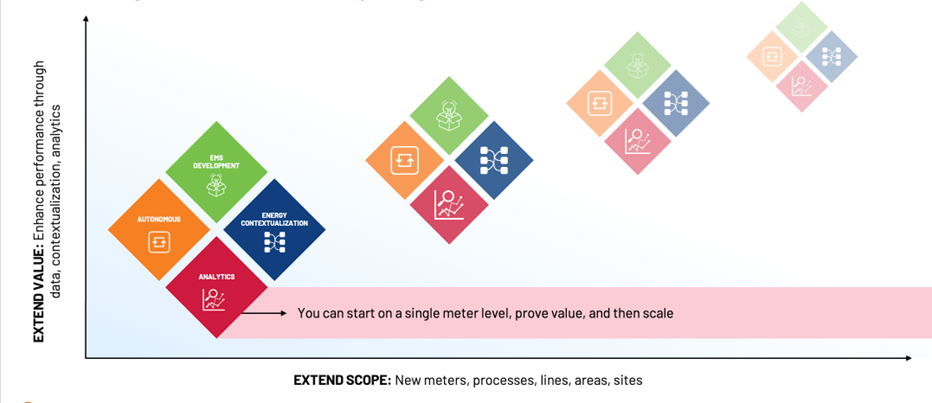
What makes this approach practical is that companies do not need to wait for a full-plant deployment to begin creating value. As results are proven at a meter level, the approach can be expanded iteratively across new equipment, lines, areas and sites, turning energy management from a reporting exercise into a scalable lever for margin improvement, operational performance and sustainability.
When energy is framed this way, AI and autonomous control help protect margins and improve performance. The business case shifts from reducing kilowatt-hours to improving throughput, stability, cost-to-serve and resilience. In doing so, energy moves from a volatile overhead line on the P&L to a controllable lever for sustained financial value.
AUTHOR
Rodrigo Alves is a certified energy manager and a senior manager at Kalypso, a Rockwell Automation business.
LEARNING OBJECTIVES
- Explain how energy data can improve financial and operational performance.
- Describe the four-layer framework for industrial energy optimization.
- Identify how AI and autonomous control can reduce waste and improve throughput, quality and efficiency.
CONSIDER THIS
How can your organization connect energy data to production and financial outcomes, starting with a focused use case that can be scaled?