Data and information management has become the backbone of modern automation. Are you turning industrial data into actionable intelligence?
Info management for automation insights
- Moving from industrial data to information to knowledge requires attention to the core components of industrial data and information management.
- Understand common industrial data pitfalls and how to avoid them by turning raw data into actionable information.
- Implementing industrial data governance is essential for reliable automation.
Industrial automation has entered a new era—one where data is no longer a byproduct of operations, but a core asset that determines competitiveness, efficiency and resilience. Manufacturing plants and utilities now generate more data in a single shift than they once produced in an entire year. Yet the value of that data is fully realized only when it is transformed into information, insight and, ultimately, better decisions.
Data and information management has become the backbone of modern automation. Without it, even the most advanced control systems struggle to deliver consistent performance. With it, organizations unlock predictive capabilities, optimize processes and equip their workforce with real-time intelligence.
At its core, data and information management are about how data becomes information, how information becomes knowledge and why that progression is essential to the future of automation.
From industrial data to information to knowledge
Automation environments are rich with data—temperatures, pressures, flows, speeds, alarms, events and thousands of other signals—but raw data alone has limited value. A single temperature reading means nothing without context: what asset it belongs to, what the expected range is, whether the value is trending up or down, or whether it violates a safety limit.
This is where the distinction between data, information and knowledge becomes critical.
- Data is raw, unprocessed and unstructured – the sensor value, the time stamp and the event code.
- Information is data with context – organized, validated and structured so it can be interpreted.
- Knowledge is the insight derived from information – the layer that enables decisions, automation logic and optimization.
Automation systems fail when these layers are blurred. A historian full of unstructured tags is not information. A dashboard built on inconsistent naming conventions is not knowledge. True value emerges only when data is intentionally shaped into something meaningful.
Core components of industrial data and information management
A robust data and information management strategy includes several interconnected components. Each plays a distinct role in enabling data to flow reliably from the plant floor to the people and systems that need it.
- Data acquisition is the foundation. Sensors, programmable logic controllers (PLCs), supervisory control and data acquisition (SCADA) systems and Internet of Things (IoT) devices continually capture operational data. The challenge lies in achieving accuracy, consistency and reliability. Poor sampling rates, communication gaps and inconsistent engineering units can undermine everything that follows.
- Data storage – Industrial historians serve as the central repository for time-series data. Increasingly, organizations are adopting hybrid architectures that combine on-site historians with cloud storage for scalability and advanced analytics.
- Data contextualization – This is where raw data becomes information. Tools like Asset Framework (AF) or ISA-95/ISA-88 models provide structure, naming standards, metadata and relationships. Contextualization enables meaningful calculations, event detection and asset-level insights that support advanced analytics and artificial intelligence (AI) applications.
- Data governance establishes trust in the data. It includes quality checks, lineage tracking, access control, cybersecurity and compliance. Without governance, even the best models collapse under the weight of inconsistent or inaccurate data.
- Data delivery – Finally, information must reach the right people and systems. Dashboards, APIs, reporting tools and integrations with manufacturing execution systems (MES) or enterprise resource planning (ERP) systems enable insights to flow across an organization. (Figure)
Together, these components form the backbone of a modern industrial data ecosystem.
Architecting a modern industrial data infrastructure
Today’s automation environments require architectures that are scalable, secure and flexible. Traditional on-site systems remain essential for real-time control, but cloud and edge technologies are expanding what’s possible.
- Historian systems – Historians remain the authoritative source of truth for time-series data. They provide high-resolution storage, compression and retrieval optimized for industrial workloads.
- Edge computing – Edge devices process data close to the source, reducing latency and bandwidth requirements. They enable local analytics, anomaly detection, and AI-driven insights, while buffering network outages.
- Cloud and hybrid models – Cloud platforms offer massive scalability, machine learning capabilities and enterprise-wide visibility. Hybrid models allow organizations to keep critical control data on-site while leveraging cloud analytics.
- Standardization – No architecture succeeds without standardization. Consistent tag naming, units of measure, asset hierarchies and metadata definitions make sure that data remains usable across systems and sites.
- OT/IT Integration – Bridging operational technology (OT) and information technology (IT) is essential. Secure, well-designed interfaces allow data to flow safely between plant systems and enterprise applications.
Common industrial data pitfalls and how to avoid them
Even with well-designed architecture, many organizations struggle to achieve consistent results. The gap is rarely in the technology itself, but in how it is implemented, standardized and maintained over time.
Common pitfalls include:
- Treating historians as unstructured data repositories
- Using inconsistent naming and metadata across sites
- Overengineering data models that are difficult to maintain
- Lacking alignment between OT and IT teams
- Ignoring data quality until it becomes a critical issue.
Avoiding these pitfalls requires intentional design, consistent standards, cross-functional collaboration and a culture that values data as a strategic asset. With these foundations in place, organizations can unlock greater value from their data and act on it.
Turning raw data into actionable information
Once data is contextualized, organizations can begin extracting meaningful insights. This is where automation becomes intelligent.
- Event frames and calculation – Event frames capture operational events; startup sequences, downtime, quality excursions and more, enabling analysis of duration, frequency and impact. Calculations and key performance indicators (KPIs) provide standardized metrics across assets and sites.
- Contextual models – Asset models define relationships between equipment, processes and data. They allow analytics tools to understand the structure of the plant, enabling more accurate predictions and comparisons.
- Analytics and machine learning – With clean, contextualized data, organizations can apply advanced analytics and AI techniques to solve real problems:
- Predictive maintenance reduces downtime.
- Energy optimization lowers utility costs.
- Production monitoring improves throughput and yield.
- Quality analytics identify root causes of variation.
These capabilities depend entirely on the quality of the underlying data.
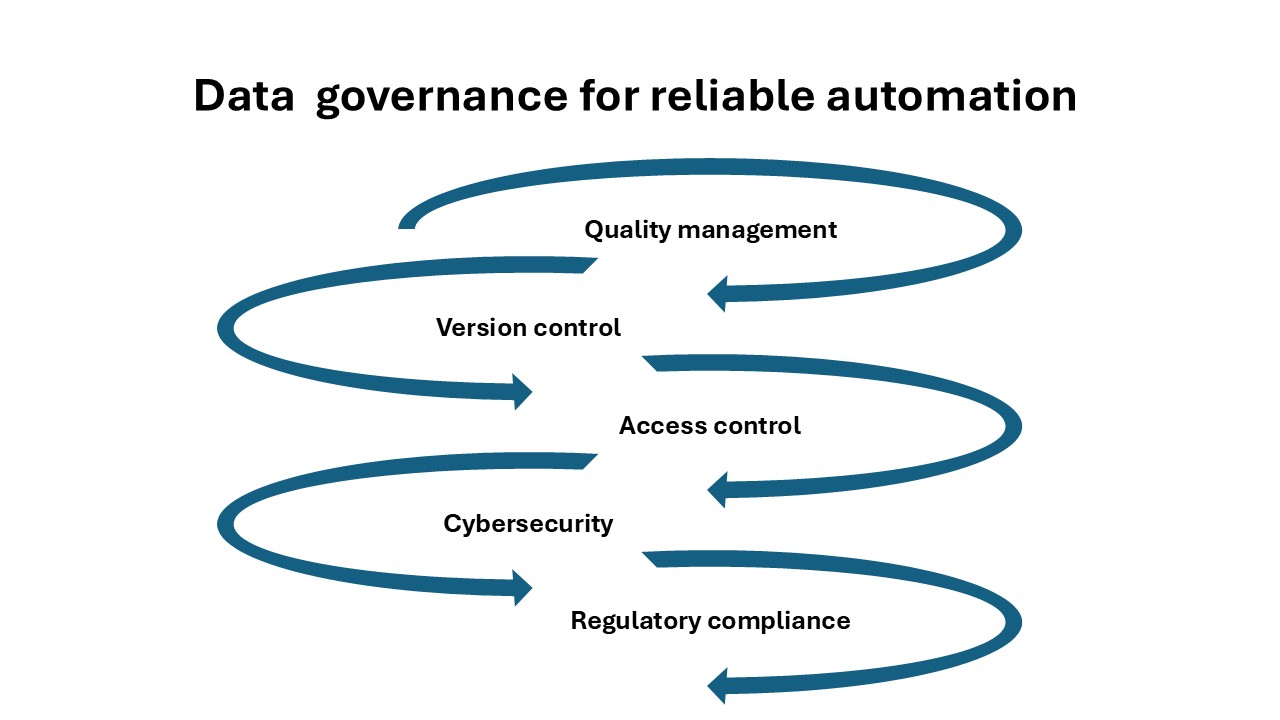
Data governance: The backbone of reliable automation
Governance makes sure that data remains accurate, secure and compliant. It includes:
- Quality management – detecting gaps, spikes, and anomalies
- Version control – tracking changes to models, calculations, and naming standards
- Access control – giving the right people have the right permissions
- Cybersecurity – helping protect data from unauthorized access or manipulation
- Compliance – meeting regulatory requirements such as FDA, EPA or ISO standards.
Without governance, automation systems become fragile. With it, they are resilient and trustworthy.
Deliver industrial information to the right people
Different roles within an organization require different levels of detail. Operators need real-time dashboards and alarms to monitor and react to manufacturing situations effectively. Engineers rely on trends, diagnostics and root-cause tools to influence decisions. Analysts need structured datasets for modeling. Leadership relies on KPIs and performance summaries to drive decision-making.
Effective data and information management enables each group to receive information tailored to their needs, reducing noise and improving decision-making.
The future of data and information management for automation
Automation is no longer just about controlling machines; it is about managing information. The organizations that succeed will be those that treat data as a strategic asset, invest in robust architecture, enforce strong governance and equip their workforce with meaningful insights.
AI-assisted automation is already helping operators make faster, more informed decisions, and its role will continue to expand. Digital twin environments will continue to grow, simulating processes and optimizing performance before changes are made. Unified data layers will connect enterprise systems with plant-floor operations, enabling improvements to propagate across the enterprise. Low code/no code tools will enable operators and engineers to build analytics and workflows more quickly.
Data and information management is not a technical project; it is a foundational capability. When done well, it transforms operations, enhances reliability and unlocks new levels of performance. The future of automation belongs to those who can turn data into knowledge and knowledge into action.
Brian E. Bolton, consultant, Rockwell Automation. Edited by Mark T. Hoske, editor-in-chief, Control Engineering, Arrowfly, [email protected].
Keywords
Industrial data management, info management
Consider this
Is your data in the right format for the right decisions at the right times?
You also might like
https://www.controleng.com/digital-transformation/info-management