Industrial control systems generate large amounts of data, but operational value depends on whether the data are reliable and traceable. Data quality and provenance, supported by data lineage, provide the foundation for trusted analytics, optimization, and (artificial intelligence) AI-enabled decisions.
Industrial data quality insights
- How data quality, provenance, and lineage work together to make industrial control system data trustworthy enough for predictive analysis, optimization, and AI-enabled decision-making.
- The most common points where data integrity degrades across a control system and the operational impacts of such data degradation.
- Practical steps to implement provenance-aware architecture and operating practices using metadata, quality flags, audit trails, validation, and clear ownership in a phased approach, from visibility to traceability to trusted operations.
Modern industrial control systems produce large amounts of data from various end devices, including sensors, programmable logic controllers (PLCs), supervisory control and data acquisition (SCADA) systems, historians, and other enterprise software systems. This data is increasingly being used not only for monitoring and control, but for predictive analysis, optimization, and decisions driven by industrial artificial intelligence (AI) (Figure 1).
However, despite the availability of enormous amounts of data, a basic issue remains: The data are not fully trusted. This lack of trust shows up in day-to-day operations in a variety of ways. For example, when alarm systems generate frequent nuisance or low-value alarms, engineers and operators lose confidence in the systems, manually verify values, or question the analytics because the underlying data appear unreliable. Sometimes, it is not the lack of data but the lack of trust in the quality of the data.
In practice, engineers and operators highlight the extent of the problem: Poor data quality is a primary reason for substantial operational losses. Therefore, building trust in plant data becomes important for smart industrial automation, which can be achieved using the fundamental concept of data quality and provenance supported by data lineage.
What are data quality, data provenance and data lineage?
Data quality refers to how well data, such as from sensor readings, controllers or operational records, meet their intended use. This can include:
- Accuracy – Do the value reflect the actual process condition?
- Completeness – Are there any missing or intermittent data?
- Timeliness – Are the data properly timestamped and synchronized?
- Precision – Do the data indicate minimal variation between samples?
These aspects of data quality are not independent; they collectively determine whether data can be reliably used for operations and analytics.
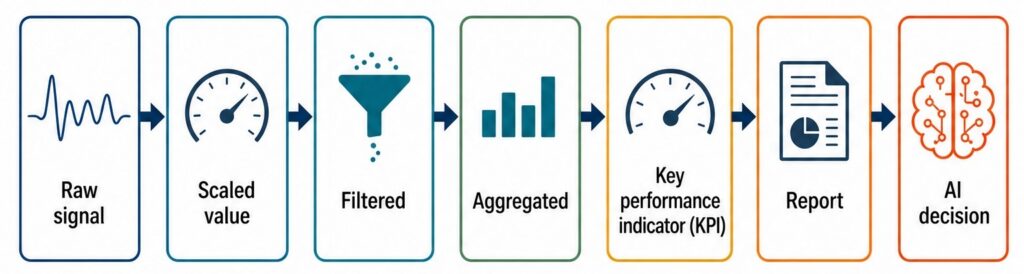
Data provenance refers to the documented history of a dataset, including its origins, the processes it has undergone and any modifications since its creation. In simple terms, it answers two questions: Where did the data come from, and what happened to it along the way?
Data provenance can include:
- Instrument identity
- Calibration status
- Device diagnostics
- Communication health
- Source timestamping.
While data quality relates to the data’s correctness, data provenance relates to the data’s origin and authenticity.
Data lineage, that where the data are going and what happens to it along the way, such as how data are transformed moving from sensors to control systems to historians. Figure 2 shows an example of data lineage. Without such lineage, tracing how a value was derived or verifying why a control or analytical decision was made can be difficult.
Trusted data for analog and discrete field signals
Data quality and provenance are often mistakenly assumed to apply only to digital signals. However, analog signals and other discrete filed signals also require careful consideration. These signals carry value but not meaning—without additional context, the system cannot determine whether values are valid, stale or unreliable.
Consider 4- to 20-milliamp analog loops, 0-to-10 V signals, or 24-volt direct current or 120-volt alternating current inputs. These signals transmit only a raw value or state; they do not inherently include instrument identity, calibration information, diagnostics date, timestamp or quality indicators.
For such signals, provenance is not inherently embedded but needs to be constructed at a higher level. In practice, this responsibility lies in the PLC layer, where these raw signals are associated with instrument tag and identity, engineering scaling, timestamp, and signal quality and communication status. Without this, the system cannot distinguish between a genuine process change and signal drifting, or a failing instrument—raw electrical signals become meaningful and trustworthy after context and traceability are engineered into the system data architecture.
Standards and frameworks for trusted industrial data
Data quality, provenance and lineage are all relatively simple concepts; however, their practical implementation within complex industrial systems requires a structured data management approach. Different frameworks offer guidance on data management approaches. Three key frameworks are summarized in Table 1. Although the frameworks have different applications, they offer a practical foundation for developing a trusted data architecture.
Table 1: Key frameworks for data quality, provenance in industrial automation
| Framework | Description | Strengths/focus | Limitations |
| International Organization for Standardization (ISO) 8000 (Data Quality) | International standard for data quality management across industries. | Defines standard quality dimensions (such as accuracy, completeness) and governance processes. | Broad, framework‑level guidance. Defines what to achieve but not a detailed how to achieve. |
| Data Quality Management Methodology for Sensor Data (DAQUA-MASS) | Methodology based on ISO 8000-61, tailored for sensor data in industrial and Internet of Things systems. | Provides a practical approach to real issues like sensor drift, noise, and outages. | Specialized for sensor data. Not a full enterprise framework. |
| Findable, Accessible, Interoperable, Reusable (FAIR) Principles | General set of principles for managing data across domains. | Emphasizes rich metadata, standardization, and interoperability. | Not a procedural framework. Provides guiding principles, not implementation steps. |
Table 1: Three key frameworks are available for data quality and provenance in industrial automation. Courtesy: CDM Smith
The frameworks complement each other. ISO 8000 defines what “good” data look like, DAQUA MASS provides a practical approach for sensor systems, and the FAIR Principles ensure long-term data usability and system interoperability.
Where data trust breaks down in industrial automation
In practice, recurring failure modes can degrade data quality. Across industries, the following failure modes are frequently encountered by engineers and operators:
- Sensor drift and calibration issues
- Timestamp and synchronization errors
- Communication dropouts and missing data
- Manual data entry errors
- Undocumented scaling or logic changes
- Environmental effects on instruments.
Failure modes are not isolated and often propagate across systems, amplifying their impact and making root cause analysis difficult. Failure modes have significant impact on industrial operations (Table 2).
Table 2: Common data quality failure modes and their impact on industrial operations
| Failure mode | Typical cause | Operational impact |
| Sensor drift and calibration issues | Aging sensors, fouling, missed calibration cycles | Gradual deviation from reality, false or missed alarms |
| Timestamp and Synchronization errors | Unsynchronized clocks across PLC, SCADA and historian systems | Incorrect event sequence, faulty root cause analysis |
| Communication dropouts and missing data | Network interruptions, device failures | Missing data, flat-line signals, unreliable analytics |
| Manual data entry errors | Manual inputs, mis-entry, incorrect tag mapping, inconsistent units | Data inconsistency, incorrect trends, misleading analysis |
| Undocumented scaling or logic changes | Changes to PLC logic, scaling, filtering, or calculations without version control | Loss of traceability, unexplained key performance indicator shifts, reduced trust |
| Environmental effects on instruments | Heat, humidity, vibration, electrical noise, corrosion | Sporadic signal errors, unstable readings |
Table 2: Six common data quality failure modes are shown, with their impacts on industrial operations. Courtesy: CDM Smith
Each of these failure modes can make bad data appear valid. Such data propagates silently through systems, affecting decisions at every level.
Designing a provenance-aware data architecture
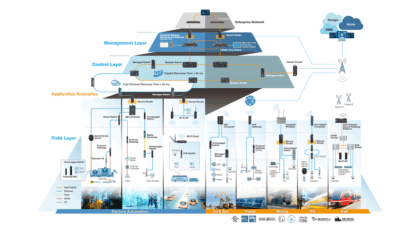
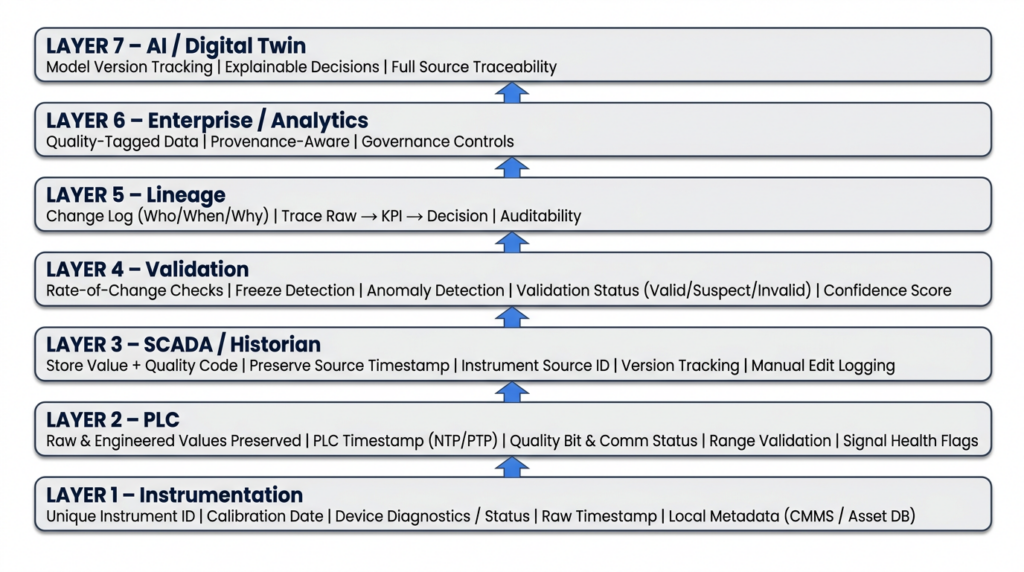
To move from conceptual understanding to implementation, data quality and provenance must be incorporated into the system design (Figure 3). The practical architecture should, at minimum, include the following layers:
Instrumentation
- Generates physical measurements and field signals
- Includes instrument metadata (e.g., tag details, calibration status, maintenance records) typically managed in asset management
- PLC
- Converts raw signals into meaningful engineering data
- Adds timestamps, scaling, and quality status
- Establishes provenance for traditional analog and discrete signals
SCADA/historian
- Stores process values along with context
- Maintains source timestamps, quality codes, and address mappings
- Logs manual edits and calculation versions
Validation
- Detects data gaps, anomalies, and inconsistencies
- Classifies data (such as valid, suspect, invalid)
- Preserves original data while applying validation rules
Lineage
- Tracks transformations and calculations
- Maintains version history and change logs
Enterprise and analytics
- Consumes structured, quality-tagged data
- Enables reporting, forecasting, and analytics
AI/digital twin
- Uses trusted data for decision-making
- Maintains model traceability and explainability.
In practice, this means even advanced analytics or AI recommendations can be traced back to their inputs, giving engineers confidence in how the results were generated. For example, engineers can see that the results were produced by AI model version 2.2, which used inputs from sensor X (whose last calibration was appropriately recent and is reporting good-quality data) and Laboratory Analyzer Y (whose last calibration was appropriately recent and is also reporting good quality data).
Embedding trust across the data architecture
Data trust is not achieved by structure alone. It requires controls embedded across all layers.
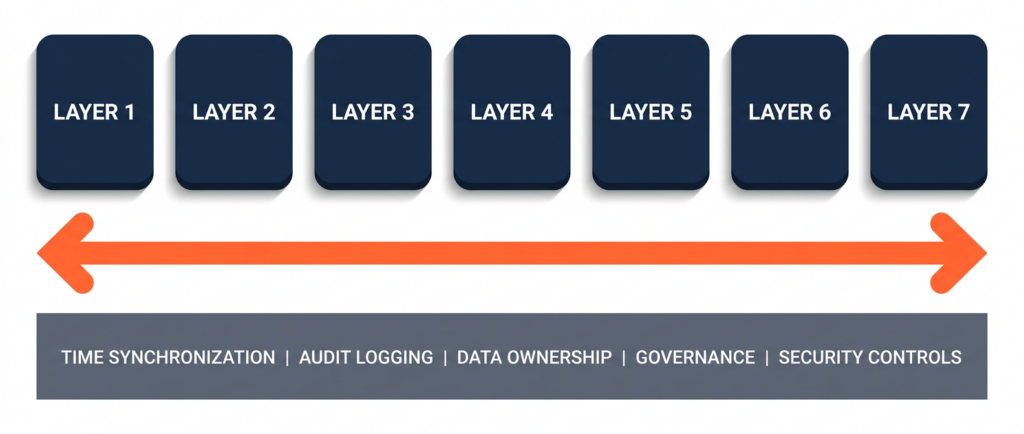
While Figure 3 illustrates the flow of data in a provenance-aware industrial data architecture, Figure 4 highlights the mechanisms that preserve the data’s integrity. These cross-layer controls ensure the data remains accurate, traceable and trustworthy throughout their lifecycle.
Key cross-layer controls include:
- Time synchronization using network time protocol
- Audit logging of all changes
- Defined data ownership per layer
- Governance policies for data handling
- Security controls for system integrity.
These controls are not stand-alone features. They must be systematically embedded across all layers of the architecture to maintain continuous data trust.
From architecture to operations: Making data work in practice
While provenance-aware data architecture provides a foundation for trustworthy data, the use of data in day-to-day operations creates an additional challenge. Data quality and provenance must move beyond system design and become part of routine engineering and operational practices.
Best operational practices include maintaining accurate instrument inventories, tracking calibration status, implementing validation checks and ensuring that data quality details are visible to engineers and operators. Similarly, any changes to control logic, scaling, and calculations must be documented and be made traceable. Such operational changes can prevent data quality from degrading over time. Without it, even well-designed systems gradually lose reliability as sensors drift, configurations change, and undocumented adjustments accumulate.
Implementing best operational practices also enables advanced use of the data. Analytics, optimization, and AI-driven applications depend on data that are accurate, traceable, and explainable. When provenance is maintained, engineers and operators can:
- Understand how results are generated
- Diagnose issues more quickly
- Build confidence in automated systems and AI output recommendations.
Data quality and provenance are the foundation that makes advanced analytics possible.
Three practical steps for building trusted industrial data
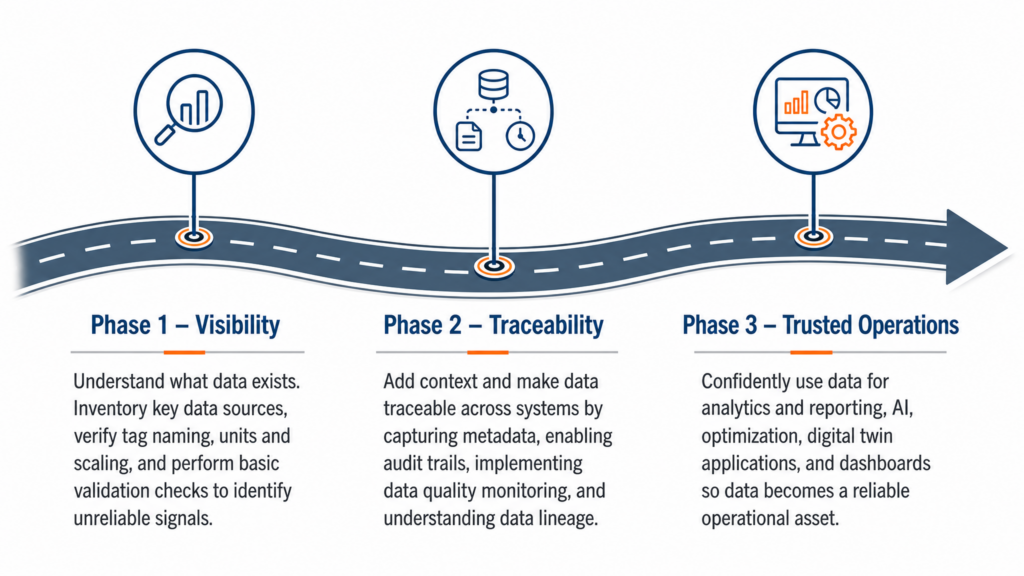
Organizations can adopt a phased approach that incrementally builds trust in data quality. The approach starts with data visibility, progresses to data traceability, then moves to trusted operations, as follows:
- Phase 1 – Visibility. Phase 1 focuses on understanding what data exist and identifying potential issues with the data. Start by creating an inventory of key data sources and verifying tag naming, units, scaling, and other attributes. Basic validation checking should be performed to identify any unreliable or frequently failing signals. At the end of Phase 1, organizations can get a clearer picture of their data landscape.
- Phase 2 – Traceability. Phase 2 focuses on adding context and making data traceable across systems. This can typically be done by capturing signal metadata, enabling audit trails, implementing a data quality monitoring system, and understating the data lineage. Phase 2 shifts the organization from reacting to problems to understanding and managing data systematically.
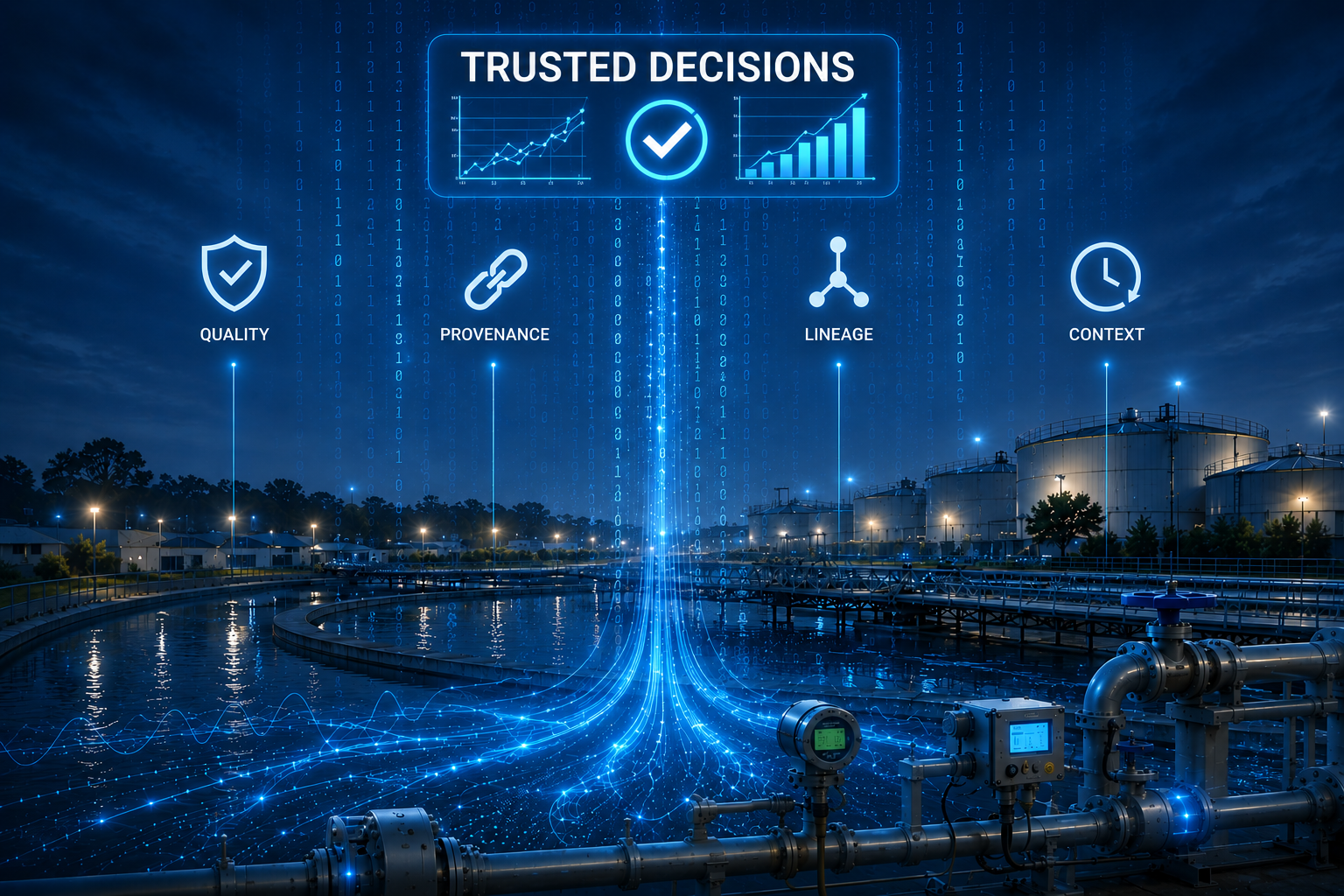
- Phase 3 – Trusted operations. Phase 3 focuses on using data confidently for advanced applications. This typically includes using data for purposes such as analytics and reporting, AI, optimization or digital twin application and dashboard creation. In Phase 3, data become a reliable operational asset, supporting day-to-day decisions and advanced digital initiatives (Figure 5).
Create more value with industrial data, automation
Industrial automation is increasingly driven by data, but the data have the most value when they are trusted. As industrial systems evolve from simple control to analytics and AI assisted decision-making, organizations need to collect data and ensure the data are accurate, traceable, and reliable.
Data quality, provenance and lineage work together to ensure that the origin and context of system data are understood. This forms the foundation of a trustworthy automation system. A provenance-aware architecture allows organizations to move from reacting to problems to using data-driven insights, such as optimization, predictive analytics and digital twins with trust.
The success of future smart industrial systems will not be defined by how much data they generate, but by how trustworthy the generated data are.
Vinoth Upendra Janardhanan is a senior automation engineer and artificial intelligence (AI) proponent; Amal Khan is a junior automation engineer who designs and programs industrial control systems; both are with CDM Smith. Edited by Mark T. Hoske, editor-in-chief, Control Engineering, Arrowfly, [email protected].
Keywords
Industrial data quality, data provenance, data lineage
Consider this
Do your industrial data quality, data provenance and data lineage help your automation and AI efforts?
You also might like
Also from CDM Smith, please see:
https://www.controleng.com/how-to-rethink-automation-through-design-practical-engineering/