Many industrial applications need help connecting disparate data sources in a sustainable way. Data fabric software can help. See examples and benefits.

How and why create an industrial data layer insights
- What is data fabric software and how does it differ from a historian?
- What benefits can data fabric software bring industrial applications?
- How are industrial organizations preparing for enterprise optimization and artificial intelligence software?
Explanations for how to apply and benefit from data fabric software came from several sessions at the Optimize 26 conference centered around how the AspenTech Inmation Industrial Data Platform connects automation, data and industrial AI. The AspenTech Optimize 2026 conference and training, in Houston in May had more than 120 sessions, including AspenTech industry experts and real-world case studies from leaders experts at Aramco, Dow, ExxonMobil, Marathon, Takeda, TotalEnergies and others. Emerson owns AspenTech.
What is data fabric software?
The AspenTech Inmation Industrial Data Platform is said to bridge legacy automation and operational systems with modern capabilities to enable unified data intelligence, advanced optimization and a pathway to autonomous operations. Purpose-built for scale and security, the software helps industrial organizations drive resilience and sustainable performance, AspenTech explained. Data from operational technology (OT) systems often differ in formats and the types of context they provide. Unifying OT data into a persistent, contextualized, AI ready foundation, enabling organizations to progress from data consolidation to increasingly autonomous, enterprise-wide operations.
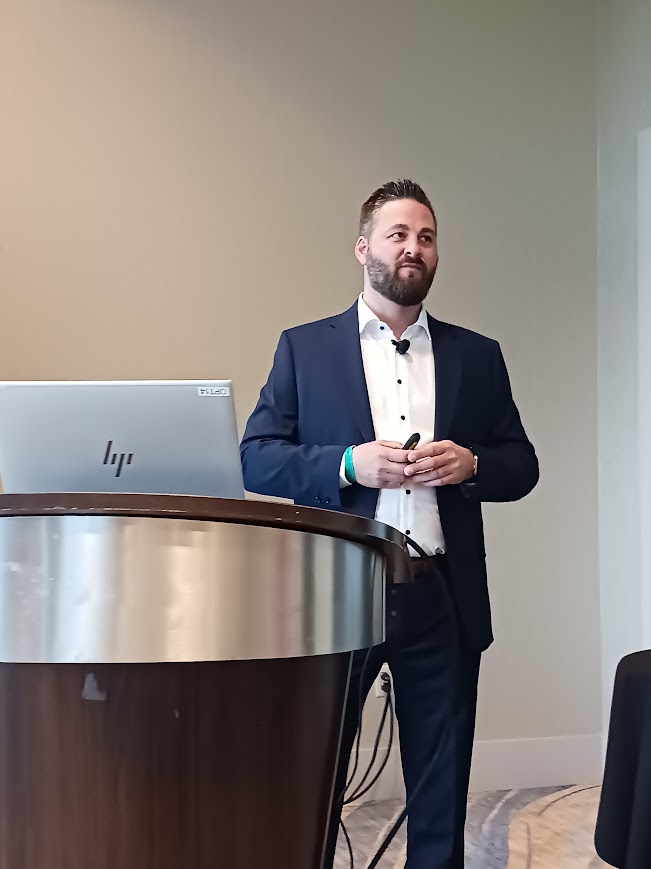
David Streit, Aspen Technology vice president, enterprise operations platform, (Figure 1), said global challenges include greater importance of OT information sharing as the speed of threats is increasing. There’s more supply and demand variability, regulatory pressure, cyber threats a changing rapidly changing workforce and transition of assets and technologies. Managing and getting data from decades-old equipment are challenging as organizations are building digital twins. Artificial intelligence tools change the landscape every few weeks, making it more difficult to predict 3-5 years, and “we need to keep up with the pace of changes.”
Data contextualization without pilot purgatory
Streit said proof of concept traps many projects at the pilot stage preventing scalable benefits that include and “drive enterprise-wide operation and optimization powered by AI.”
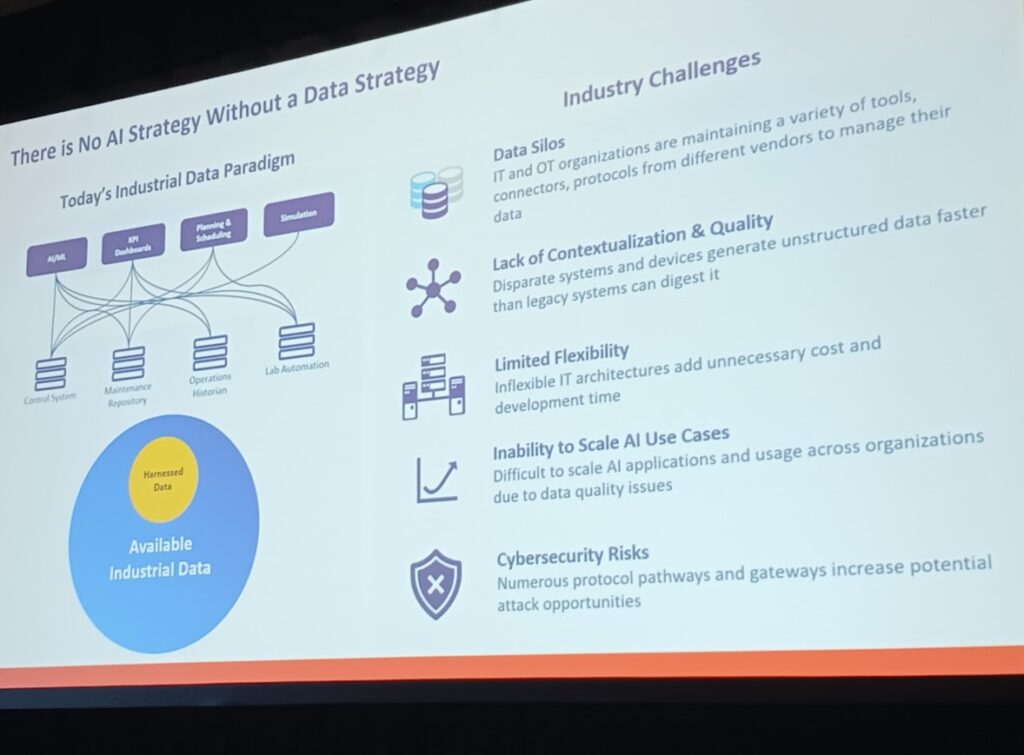
There is no AI without a data strategy (Figure 2). A historian can feed data fabric software, but data also is required from existing silos, an impossible, ever-changing challenge across many plants. Data clean-up challenges to understand it include eliminating double entry, naming challenges and building context around the data. Asset data can be as diverse and 30-year-old programmable logic controllers (PLCs) and high-frequency vibration data.
A 2021 portfolio transformation at Emerson proved ability to drive enterprise-wide data from the automation space across 130 manufacturing sites where automation is built.
A data integration strategy starts with connectivity from field through control into clouds, legacy control rooms and newer software-defined controllers. That data feeds controls and optimization software. Connectivity among applications doesn’t happen overnight, Streit said.
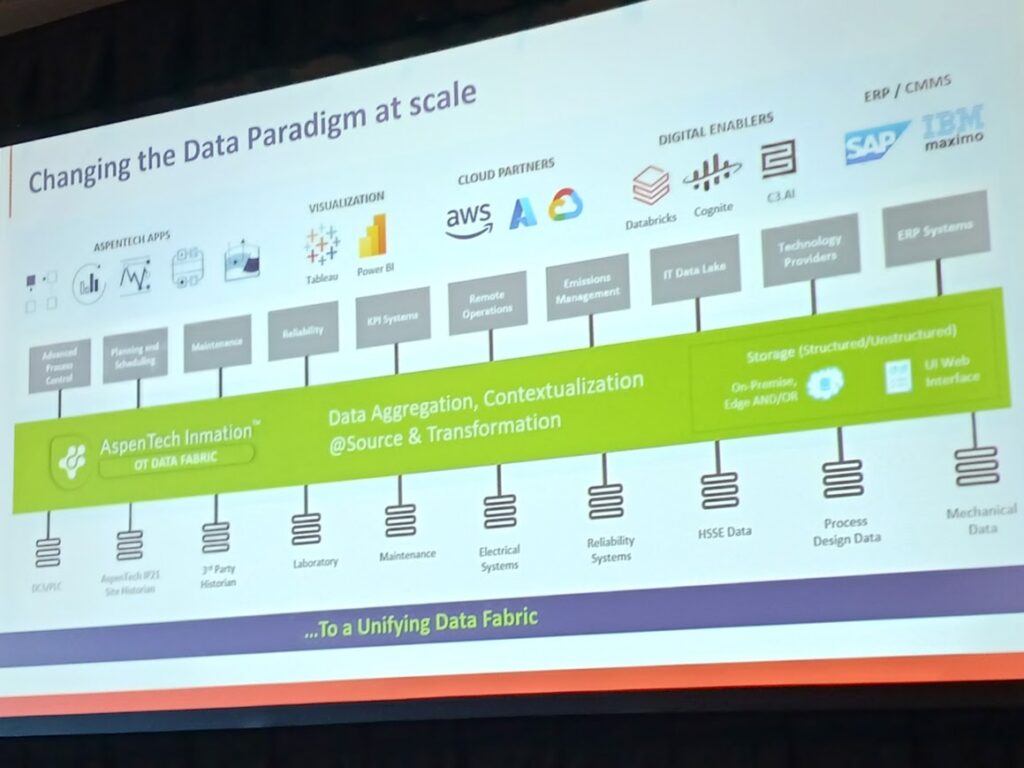
Compute resources, secure networking, unified data operations (dataops), an application catalog, AI orchestration and zero-trust security are spread from field, control and optimization software layers. (Figure 3) Many assets can be connected with one intelligence layer and AVA (Aspen Visualization Assistant (AVA) industrial AI software connecting all in the same model. A data platform decouples applications, providing contextualized insights across assets, systems and sites to get rid of point-to-point data connections with high infrastructure costs. Data fabric becomes the centerpiece, scalable across legacy and modern environments, on premise, at the edge and in cloud-based applications. It has native cybersecurity and provides an integrated, long-term advantage.
OT data fabric feeds AI agents, software-defined control, I/O gateways and disparate distributed control systems. It’s also a central location for guardrails and governance. Data fabric sends data in the form that the consumer needs it as part of the contextualization.
Connected nodes provide OT data fabric, and each node can be used to read data at the source. Data arrives from all levels, is exposed, contextualization is applied, logic is added for data cleansing and buffering is provided to store and forward to ensure no data is lost. Central configuration is provided from the top to the nodes level, securing the OT space. Unlimited nesting is possible.
Data fabric questions and answers
Session attendees asked questions about data fabric software and its use.
Question: Are the AI software (AVA) and data fabric software (Inmation) agnostic?
Answer: AVA and Inmation are agnostic to all data below. Inmation connects OT data, cleans it, adds context and applies it to the models.
Q: What’s needed to connect the software?
A: We provide more than 150 connectors. Where we don’t talk to the fieldbus, we can go through a controller. PLC type is not as important as the protocol used. We can bridge with other devices if needed.
Q: What’s the difference between Inmation and historians?
A: Inmation provides visualization inside dashboards for connecting to everything in the OT space with whatever component or software is needed. Inmation is more than a historian, because it presents data to more than itself, harmonizing data for the OT space.
Q: How do you get data from controllers?
A: By integrating AVA into Inmation, you can just ask: “Please help me to configure this data source.”
Q. Do we need to migrate dashboards into Inmation?
A. Ripping and replacing other software is not required. Over time, customers may replace their dashboards if they like the Inmation visualization better.
Data fabric applications provide guidance
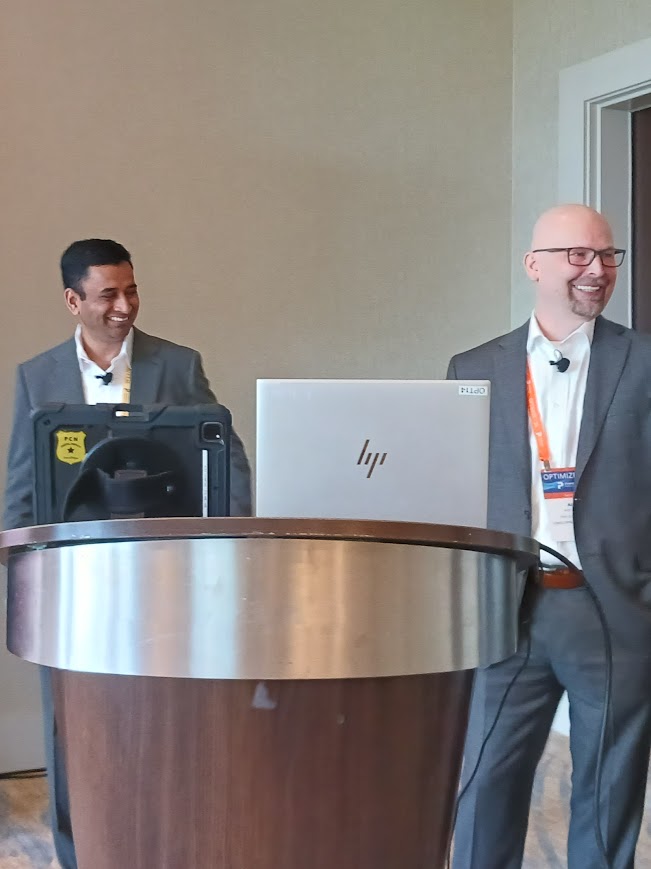
Another Optimize 26 session discussed data liberation in an OT/IT environment by using Inmation to extend AspenTech IP.21 historian data to the enterprise. Two experts offered advice on the massive data integration project: Alex Charyna, ConocoPhillips Alaska, staff SCADA engineer, and Srini Ponnaganti, Emerson, principal consultant engineer, AspenTech platform integration specialist (Figure 4).
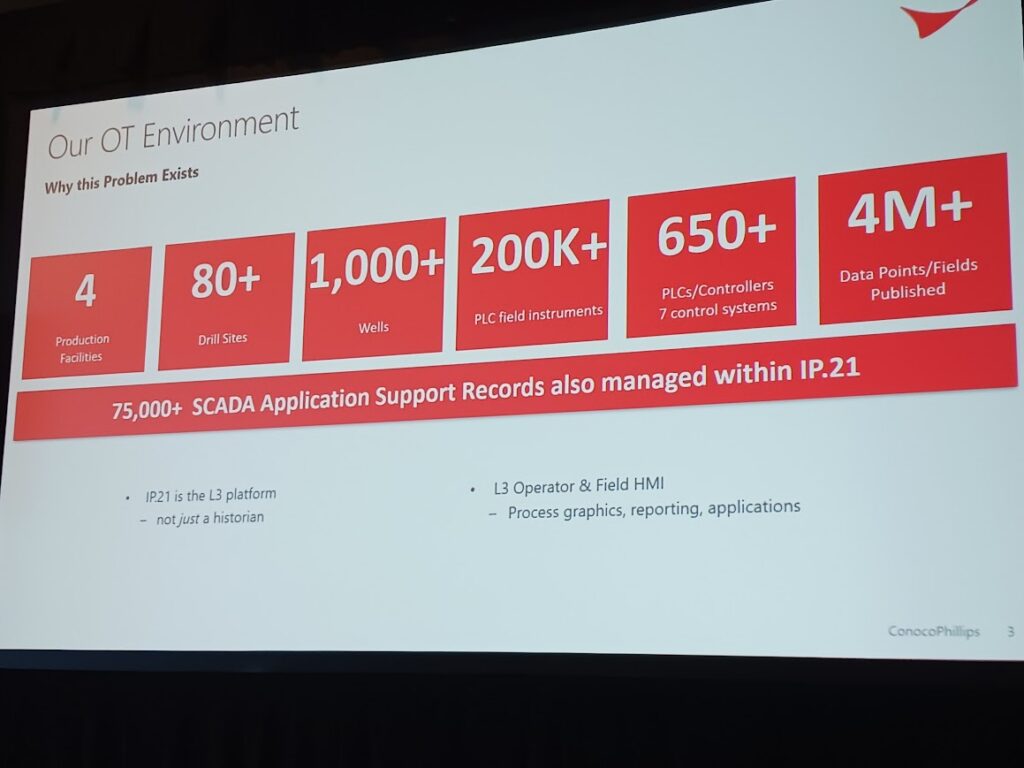
Charyna said the application moves data from level 3 to level 4 to support existing needs. The data integration challenge exists (Figure 5) because 75,000 supervisory control and data acquisition (SCADA) software application support records at four production facilities, more than 80 drill sites, more than 1000 wells, 200,000 PLC field instruments, 650 PLC/controllers and 7 control systems with more than 4 million data points. Business demands asked for all the data. Company security policies keep level 4 out of level 3, so level 3 had to send data to level 4.
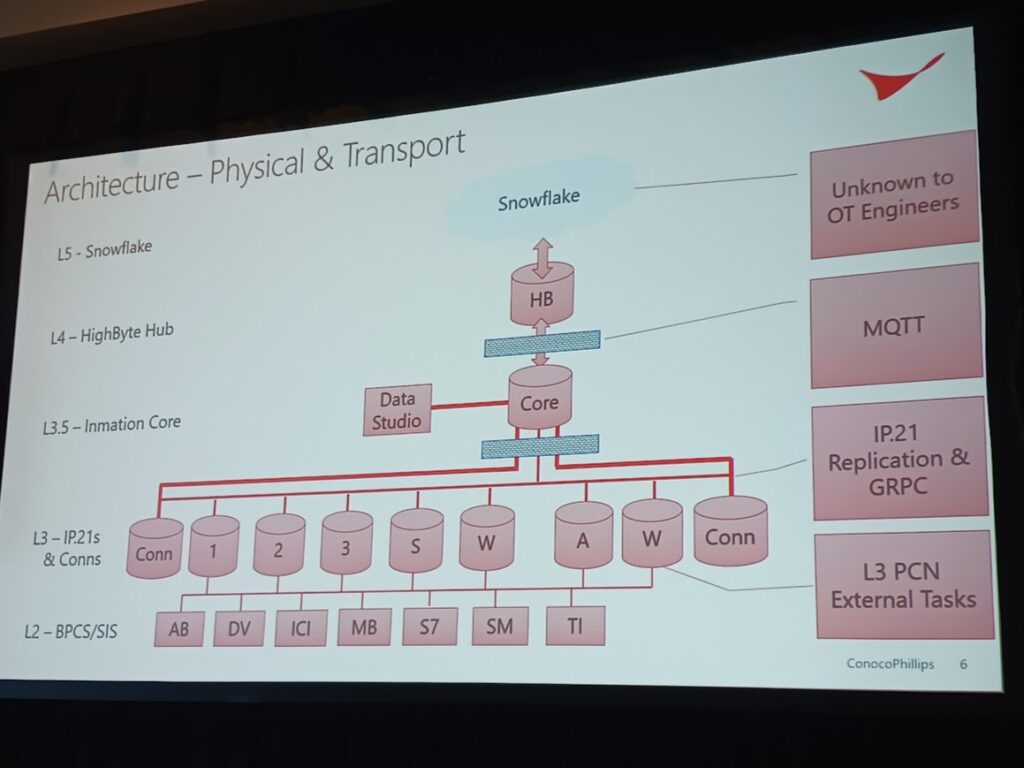
The application constraints (Figure 6) required that it must integrate cybersecurity and be maintainable for long-term (30 years). Ponnaganti said, the data outages are considered a reportable incident, so need to be avoided. Applications reach from level 2 to level 5, but the application must work without a data gap, which is considered a reportable incident.
Data is published and contextualized using JSON and MQTT protocol and goes from the Aspen Inmation core to a HighByte hub into level 5 using snowflake, considered an IT data lake.
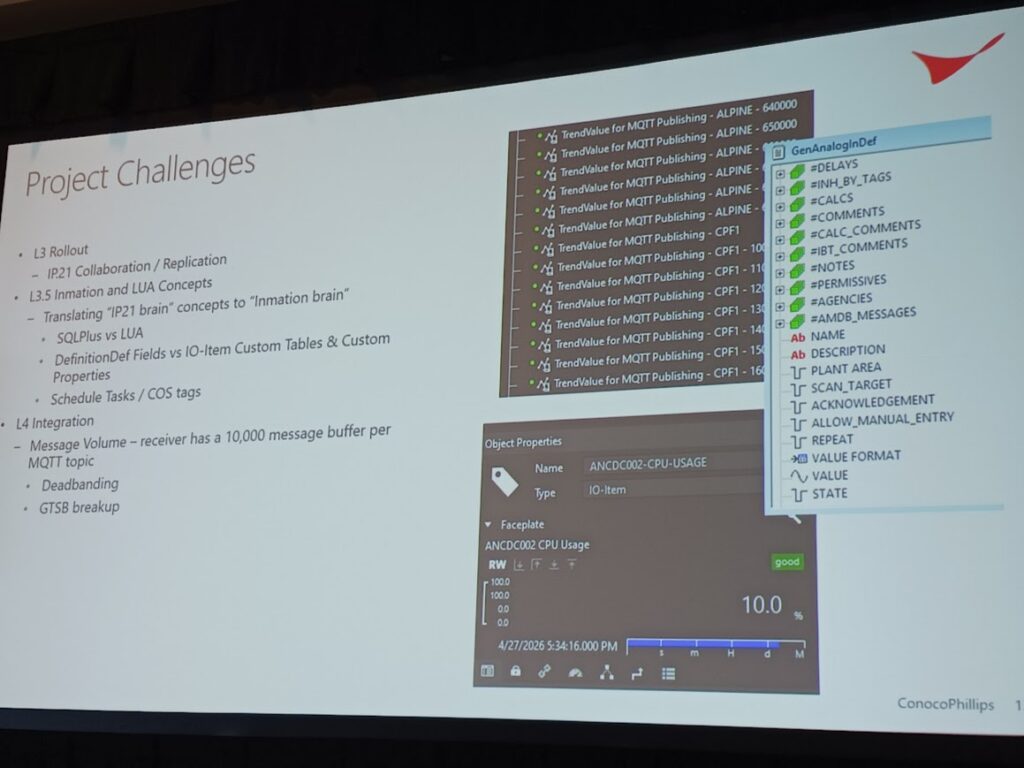
Charyna said the architecture pushes data to Highbyte without text files and point-to-point communications that can cause failures. IT originally underestimated OT constraints (Figure 7); the solution preserved OT ownership and operational authority, Ponnaganti said, decoupling producers from consumers, avoiding tight coupling to any platform and designing for long-term supportability. With embedded scripting (LUA software), more than 200,000 tags feed data from OT to IT; after browsing once the routing is automatic without manual mapping.
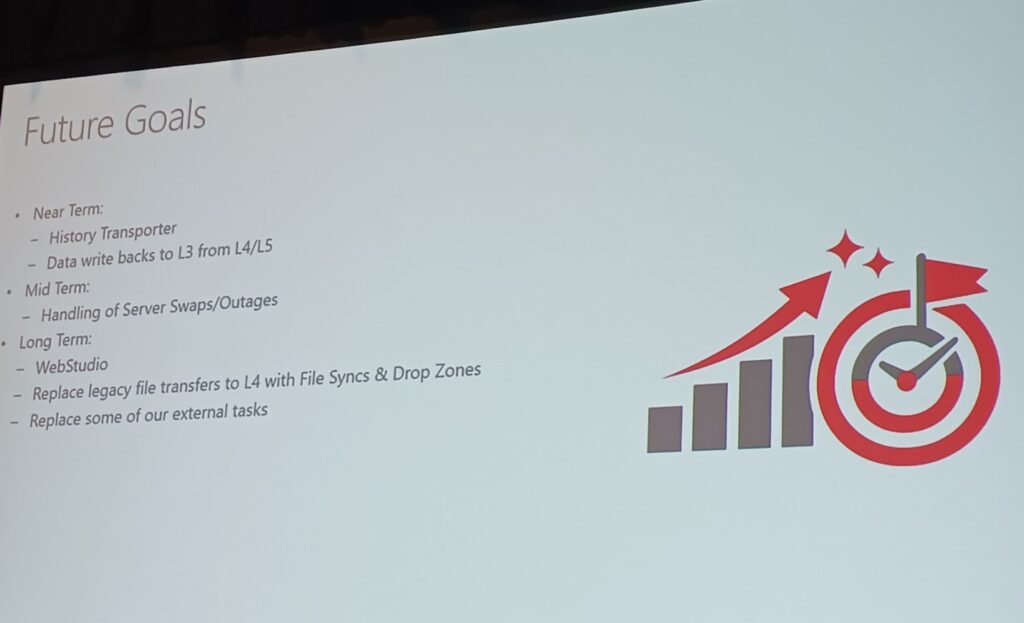
Ponnaganti said the first implementation broke IT’s ability to accept more than a 10,000-message buffer before a storing and forwarding function was set up to back fill data gaps, without intervention, such as when a Microsoft Windows update is needed.
Future implementations include vibration analytics that could prevent downtime and reduce equipment repairs (Figure 8).
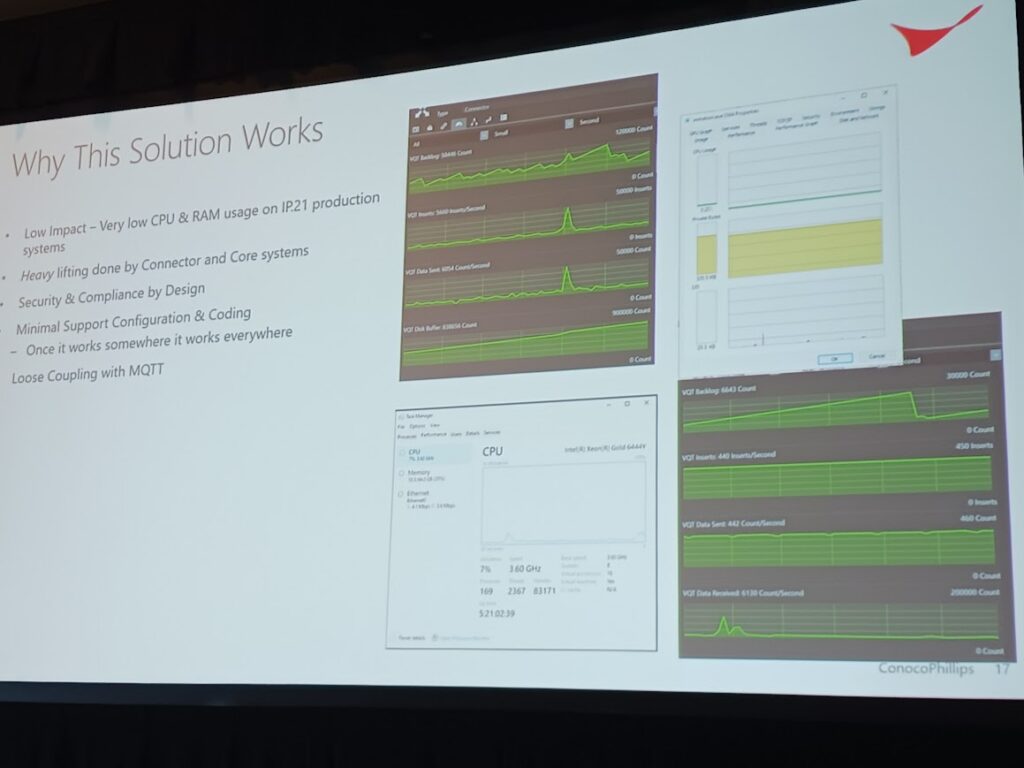
Because the ConocoPhillips implementation is so demanding (Figure 9), Ponnaganti expects easier adaptations for other applications.
Mark T. Hoske is editor-in-chief, Control Engineering, WTWH Media, [email protected].
Keywords
Data fabric, industrial data, data contextualization
Consider this
See other AspenTech Optimize 26 coverage.
Industrial AI, performance optimization, better OT data needed
https://www.controleng.com/industrial-ai-performance-optimization-better-ot-data-needed/
How to optimize data for industrial AI, simulation, analytics, control
https://www.controleng.com/how-to-optimize-data-for-industrial-AI-simulation-analytics-control
You also might like