A design mindset can complement traditional automation engineering to improve operator usability and alarm effectiveness without altering proven control strategies. An alarm management example demonstrates how small, human-centered improvements can deliver meaningful operational benefits during supervisory control and data acquisition upgrades.
Process control, instrumentation design insights
- Explain how an automation project can be technically successful yet still benefit from improvements in operator usability, situational awareness, and day-to-day operability.
- Describe how design thinking complements traditional automation engineering by using a human-centered, iterative approach to improve how operators and maintenance teams interact with programmable logic controller/supervisory control and data acquisition systems.
- Apply the stop, think, observe, proceed framework to evaluate and improve alarm management during supervisory control and data acquisition migration without compromising reliability.
Any automation project’s success is not arbitrary; it is built on strengthened engineering practices refined over many years and proven to deliver successful results. In the water industry, whether the project involves treatment plant expansion, a remote pumping station upgrade, or the modernization of an existing control system, the engineering process is usually structured, disciplined, and technically robust.
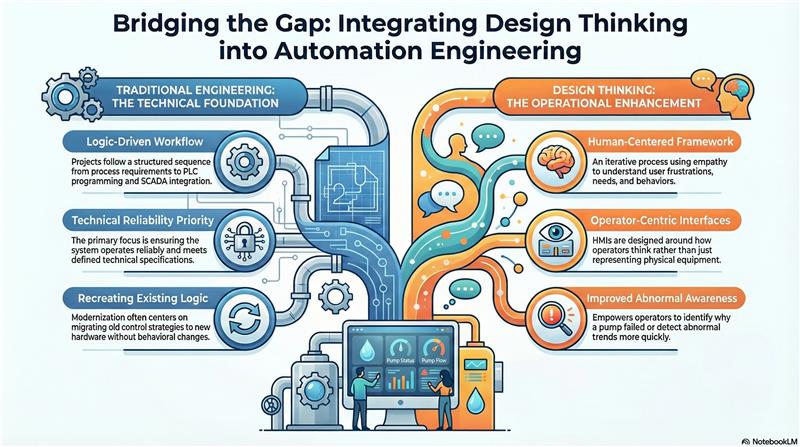
Most automation projects have a clear and logical workflow. A typical workflow starts with defining process requirements, followed by instrument selection based on operational needs, and developing framing control strategies based on client requirements and inputs from cross discipline coordination on how the process must be controlled. These strategies are then programmed into programmable logic controller (PLC) platforms and integrated with supervisory control and data acquisition (SCADA) systems that allow operators to monitor and control the process. In most cases, following these proven methods results in a system that performs exactly as expected.
When “Working” Still Leaves Room to Improve
However, even when an automation project is technically successful, there is often an opportunity to improve how the system supports day-to-day plant operations. In many projects, the control system performs perfectly from a technical standpoint, yet operators may still find it tough to quickly understand the overall plant state—especially during abnormal conditions. This is not a downside; rather, it demonstrates the proven approach used in automation projects, where the priority is ensuring reliable system operation. This strong technical foundation sets the stage for further enhancements in how people interact with the system after commissioning.
A good example of this can be seen in a typical pumping station control system upgrade. Consider a station that has been operating reliably for many years using local control panels and basic level-based pump sequencing. As part of a modernization project, the station is upgraded with a new PLC system and integrated into a central SCADA platform. The project is executed using a well established engineering approach. Existing pump logic is recreated in the new controller, level transmitters are connected, alarms are configured, and the upgraded station is commissioned successfully.
But what if the same project had been approached slightly differently?
Instead of only recreating the existing control strategy, the engineering team could also have evaluated how operators interact with the pumping station during real operating conditions. For example, how quickly can an operator identify why a pump is not starting? How easily can abnormal level trends be detected? Is the human-machine interface (HMI) display designed around the way operators think about the station, or is it simply a graphical representation of the equipment and instrumentation?
Where design thinking fits in a process control upgrade
By asking questions like these during the design stage, the upgrade can deliver the same technical success while also improving operations and maintenance.
This is where the concept of design thinking becomes relevant in automation engineering.
Design thinking is an iterative, human-centered framework that integrates empathetic user understanding, creative brainstorming, and rapid prototyping that solves complex problems.
Because empathy is a key factor of design thinking, it guides solution providers to deeply understand the operators’ frustrations, needs, and behaviors rather than simply recreating what already exists.
Design thinking is not an alternative to traditional engineering practices. Instead, it strengthens them by encouraging engineers to design automation systems around how they are used in the field. It focuses on whether a system works and on how effectively operators can interact with it, how easily maintenance teams can support it, and how well the automation system can adapt to future operational needs.
If the same pumping station upgrade were approached using design thinking principles, the result would still be a reliable automation system. The difference is that the project would modernize the hardware, improve operator awareness, simplify system interaction, and create a more intuitive control environment.
In other words, traditional engineering methods already deliver strong technical results. Design thinking provides an opportunity to make those results even more effective. In this article, we explore how the concept of design thinking can be implemented in any automation project. The section that follows explores a step-by-step approach on how design thinking can be implemented and applied at each project phase, using alarm management as an example.
A practical example of design thinking in application engineering
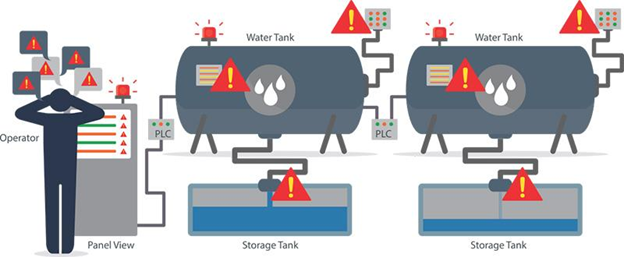
Alarm management is one of the most common challenges engineers face during SCADA upgrades. In many utilities, the alarm system has evolved over years of operation through incremental changes. As a result, the existing system may contain:
- Duplicate alarms
- Irrelevant alarms
- Unclear alarm messages
- Inconsistent alarm priorities
- Frequently triggered alarms.
Despite these issues, the plant usually continues to operate successfully because of the operators, as they are familiar with the system. However, when an upgrade and migration project begins, all existing alarms must be recreated in the new SCADA environment. This creates an opportunity to improve the alarm system (Figure 1). In practice, improvement can be measured by reducing nuisance alarms, lowering standing alarms, and minimizing alarm floods during abnormal conditions.
The question for an engineer, therefore, is how to migrate the alarm system without compromising reliability.
From a technical standpoint, the migration task may seem straightforward: transfer the existing alarm list to the new platform and ensure all alarms function correctly. This method is effective and widely adopted because it reduces operational risk. However, it results in the same alarm user experience persisting in the new system, regardless of whether the previous user experience was positive or negative.
How traditional engineering solves this problem
The traditional engineering approach focuses on reliability and operational continuity. The primary objective is to ensure that no critical alarm is lost during migration.
An engineer typically follows these steps:
1. Extract the alarm list from the existing SCADA system.
2. Verify alarm conditions in the PLC logic.
3. Recreate alarm tags in the new SCADA platform.
4. Assign alarm priorities based on the existing configuration.
5. Test alarms during commissioning.
This approach is technically correct and reliable. The plant continues to operate in the same way after the upgrade, and operators do not need to relearn the alarm management system. From a project delivery perspective, the migration is successful.
The engineering solution works, but it does not fully improve the operators’ experience. This situation allows engineers to apply design thinking to enhance an automation project.
How design thinking solves the same problem
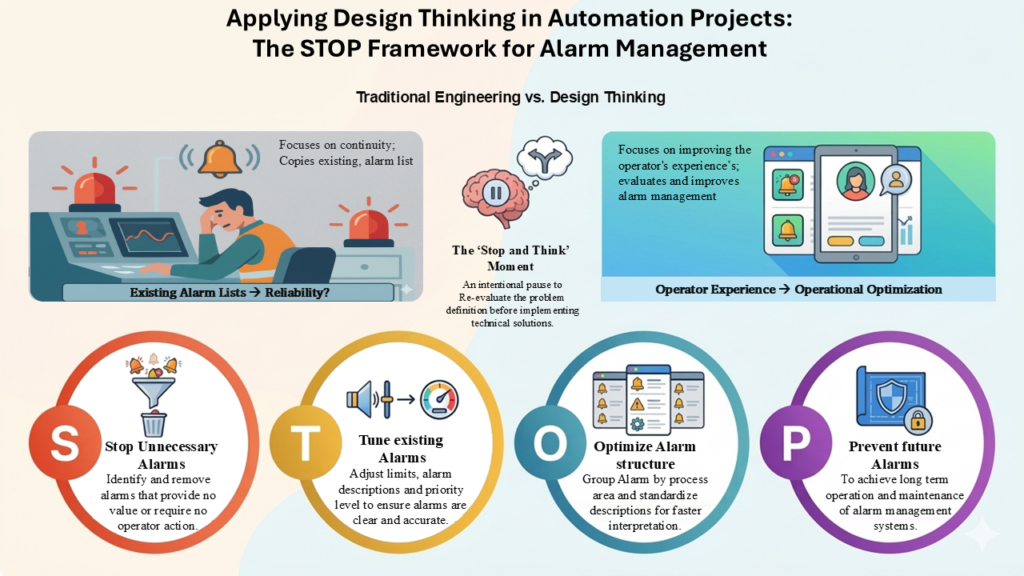
Design thinking can be applied to any problem using several established frameworks; some emphasize discovery and validation, while others emphasize iterative prototyping. This article examines the “stop, think, observe, proceed” (STOP) framework because it provides an engineering-friendly problem-framing tool that emphasizes a “stop and think” moment, which encourages teams to intentionally pause and re-evaluate the problem definition before exploring solutions.
The STOP framework guides teams to pause, reflect on the problem, gather insights, and then move forward with solution development. This intentional pause helps teams validate the real operational need before implementing changes.
Applying the stop, think, observe, proceed (STOP) framework
In the sections that follow, we keep STOP in its original sense—stop, think, observe, proceed—and show how each step can be applied to alarm management during SCADA migration. The goal is to demonstrate a reusable approach: the same STOP steps can also be applied to many other automation design challenges. To illustrate how the STOP framework transforms alarm management, we walk through each step one at a time.
S – Stop (Stop unnecessary alarms)
The first step is identifying alarms that no longer provide value to operators. These may include:
- Alarms that are always active
- Duplicate alarms for the same condition
- Alarms that do not require operator action
Instead of migrating every alarm, the engineer evaluates whether each alarm helps operators make decisions. A practical approach includes:
- Facilitating an alignment workshop with operators and engineers to define what an “actionable alarm” means for this plant
- Defining guardrails to ensure a formal review is performed before eliminating/changing alarms used for protection or regulatory requirements
By only migrating the alarms that help operators make decisions, operations can avoid unnecessary alerts and improve focus. This sets the stage for the next step: fine tuning the remaining alarms to maximize effectiveness.
T – Think (Tune existing alarms)
In the “think” step, empathy enters the process. The team should think about how the current alarm system affects operators during real operating conditions, especially during abnormal events. Many alarms in older systems are technically correct but poorly configured. For example, high priority alarms may be assigned to minor events, or alarm limits may be set so sensitively that operators receive frequent false positives.
Instead of jumping directly to solutions, start by understanding the operators’ experience by:
- Conducting operator interviews to understand which alarms they trust, which they routinely ignore, and why
- Developing a rationalization worksheet to map AlarmàDecisionàAction.
These insights can help the team translate operator feedback into specific improvements, such as:
- Setting accurate priority levels
- Adjusting alarm limits to ensure sensitivity is balanced
- Clarifying alarm messages so they are easier to interpret.
These changes do not alter the control strategy, but they improve how alarms support operator decision making (set points, deadbands, delays, and priorities) and should be validated during testing. The next logical step is to optimize how alarms are structured within the system to make it easier for the operators to interpret plant conditions.
O – Observe (Optimize the alarm structure)
The “observe” step focuses on improving how alarms are organized rather than changing their technical behaviors. The team can observe how the proposed changes perform in practice, both in system behavior and in the operators’ day-to-day experience. This may involve:
- Grouping alarms by process area
- Standardizing alarm messages
- Aligning alarm priorities with operational impact
- Simplifying alarm descriptions.
From an engineering perspective, this step is often configuration-focused, but it still benefits from structured review and operator feedback. By making the alarm structure more intuitive, operators reduce response times and minimize confusion during emergencies.
The outcome of this step should be treated as feedback. If data or operator feedback does not improve as expected, the team should loop back and re-think the assumptions (priorities, messages, grouping, and suppression rules). Practical observation measures should include changes in nuisance alarms, standing alarms and flood frequency, along with operator experience indicators such as time to acknowledge, time to diagnose, the frequency of ignored alarms, and reported levels of alarm fatigue.
Building on this foundation, the final step ensures these improvements remain sustainable.
P – Proceed (Prepared for today and the future)
The final step, proceed, focuses on implementing the improvements identified in the Think and Observe steps, verifying that they work under real operating conditions, and putting practices in place to sustain them.
Practical methods include:
- Implementing changes incrementally (such as by process area or unit first), validating the results with operators, and proceeding to expand to other processes
- Applying configuration actions based on the rationalization decisions, such as adjusting deadbands, delays, set points, and priorities, and improving message clarity
- Establishing governance to prevent backsliding by maintaining an alarm philosophy, using a simple management-of-change process for new/modified alarms, and conducting periodic reviews of nuisance alarms, standing alarms, and floods with operators.
Instead of treating alarm management as a one-time activity during migration, the engineer defines simple rules that prevent the same problems from appearing again. New alarms should be required to follow the same structure defined during this phase.
By embedding these standards, plants ensure their alarm systems remain manageable and effective for years to come, even as technology and processes evolve (Figure 2).
Why the combined approach works best
When traditional engineering practices are combined with design thinking, teams can achieve measurable improvements in usability and operability, even when the underlying control strategy remains unchanged.
What changes is the decision-making approach. Instead of replicating the existing system exactly, the engineering team can use migration as an opportunity to make small, meaningful improvements that reduce operator burden and improve clarity during abnormal conditions (Figure 3). In the water and wastewater sector, where systems often remain in service for decades, these improvements can have a significant long-term impact. A clearer, more actionable alarm system reduces nuisance notifications that lead to alarm fatigue and operator stress, and it improves response time during abnormal conditions.
Alarm management is one clear example, but the same human-centered mindset can be applied to many parts of control system design, such as:
- Improving SCADA graphics and navigation
- Developing clear documentation and procedures
- Implementing consistent and reliable control strategies
- Performing operator training and plant maintenance.
Design thinking complements traditional automation engineering by providing control systems that are reliable, easier to maintain, and upgrade over a facility’s life cycle.
Shri Vidya Selvan, CDM Smith Inc., Chennai, India, is a mid-level automation engineer who designs and programs industrial control systems; Karthicraja Vellaichamy Munisamy, CDM Smith Inc., Chennai, India, is a mid-level automation engineer and an artificial intelligence proponent; Vinoth Upendra Janardhanan, CDM Smith Inc., Chennai, India, is a senior automation engineer and an artificial intelligence proponent who designs and programs industrial control systems. Edited by Mark T. Hoske, editor-in-chief, Control Engineering, WTWH Media, [email protected].
Keywords
Process control modernization, updating alarms, process optimization
Consider this
Don’t just modernize equipment; update the process, too.
You also might like
Recent CDM Smith articles for Control Engineering include:
Power quality fundamentals, VFD impacts
Matching motors and VFDs: What designers need to consider for reliable operation