Europe’s growth forecast was cut to 1.1% while the Americas were revised up to 3.2% and Brazil and Germany saw the largest cuts.
Global 2026 manufacturing growth forecast rises to 3.2%
- Newer sectors are contributing to manufacturing growth.
- Europe’s 2026 growth forecast was revised down 1.1% as high energy costs continue.
- U.S. protectionist measures remain a factor for many economies but have improved domestic figures.
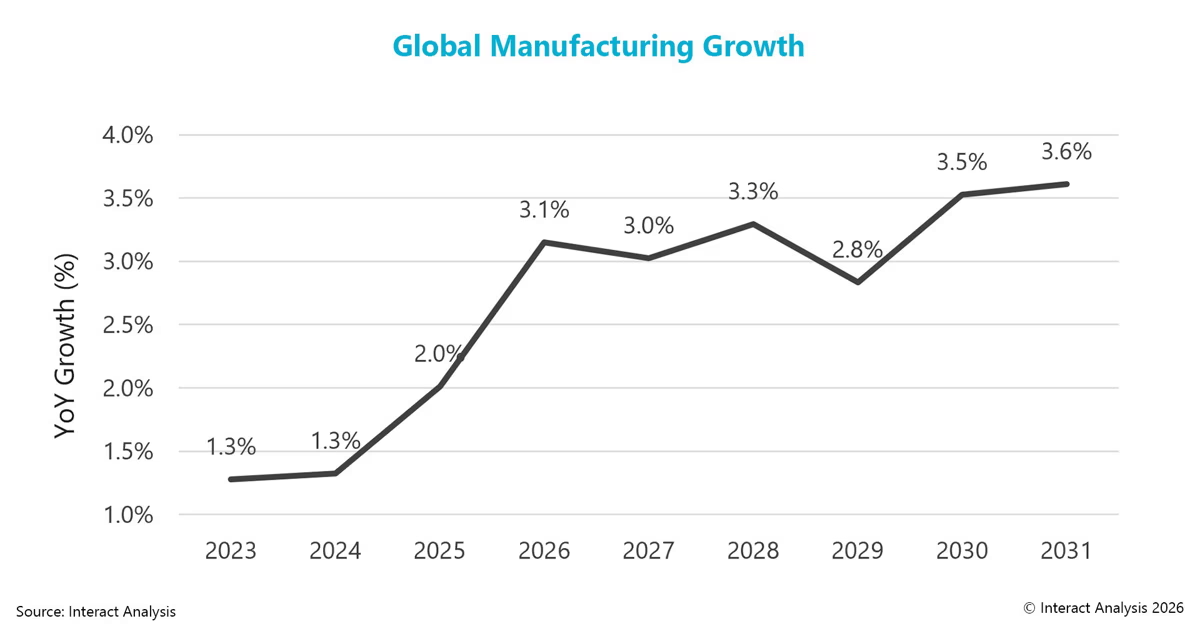
Interact Analysis expects the global manufacturing industry to grow faster in 2026 after revising its forecast upward. In the latest edition of its Manufacturing Industry Output (MIO) Tracker, Interact Analysis raised its 2026 growth forecast from 2.6% to 3.2%, citing semiconductors, data centers, AI and defense as the main contributors to growth and to investment in areas such as power infrastructure and electronics. The August edition of the MIO Tracker also projects average annual growth of 3.2% for the global manufacturing industry between 2025 and 2031, compared with a previous forecast of 2.9%.
The forecast follows an earlier slowdown linked to the US-Iran war. Traditional industrial sectors remain affected by geopolitical shocks and have less influence on overall growth. While these sectors remain comparatively weak, faster growth in newer industries such as AI is offsetting some of that weakness, supported by large expansion plans and demand for raw materials, energy, and capital.
Americas growth forecast surpasses Europe as onshoring continues
Asia is projected to remain the fastest-growing region in 2026, at 3.7%, up from 2.9% in the May edition of the MIO. Although it had the weakest growth forecast in the previous edition, the Americas are now projected to grow faster than Europe in 2026, at 3.2%, up from 1.9% in May’s forecast, while Europe’s growth forecasts has been revised down to 1.1% from 2.2% in Interact Analysis’ May edition. High energy costs continue to weigh on growth in many of Europe’s largest economies, while semiconductors and industrial investment have contributed to growth in the Americas.
In the latest edition of Interact Analysis’ MIO tracker, Brazil and Germany have seen the largest downward forecast revisions. Brazil’s manufacturing industry forecast has been revised down by 3.5%, with analysts now projecting a 0.4% contraction in 2026, while Germany’s manufacturing forecast has been revised down by 2%, also pointing to a 0.4% contraction for the country’s manufacturing sector. For both economies, tariffs issued by the United States continue to weigh on growth, with recent policy changes adding pressure on exporters.
In contrast, the growth forecast for the United States’ manufacturing industry has been revised up by 3.1%, with an updated projection of 4.6% growth in 2026. Ongoing tariffs and tighter domestic sourcing requirements are contributing to onshoring across the US manufacturing sector and supporting additional growth, alongside investment from funds allocated in the 2022 CHIPs and Science act. However, the latest section 301 measures, effective from July, impose new tariffs across 60 trading partners, adding cost pressure for US manufacturers reliant on imports and potentially affecting the growth outlook for the US manufacturing industry.
About the report
In a sector shaped by multiple related trends, it is useful to track current conditions, historical performance and future direction. This quarterly updated tracker measures manufacturing production value across more than 102 industries and sub-industries in 45 countries, using 17 years of historical data to provide coverage from pre-recession to the present.
The country data is organized around a common taxonomy to support like-for-like comparisons. A five-year forecast completes the view.
Edited by Puja Mitra, Arrowfly, for Control Engineering, from an Interact Analysis news release.