
Project Overview
Actemium Toronto developed a smart scheduler in Ignition to provide automatic and algorithmic scheduling for Trioworld North America (TWNA)’s production orders based on defined rules and integration with their ERP.
Challenges
TWNA receives numerous end customer orders for a variety of products that can be made with varying degrees of complexity across numerous lines in their factory. The high number of scheduling considerations makes it difficult for a human to schedule all orders in the most efficient manner.
The only clear metrics for what a successful schedule might look like were reducing late orders or total runtimes, yet under certain scenarios, a different ordering of products and different line assignments may actually be preferable for a wide variety of reasons. The scheduler provided TWNA with the levers they needed to control how the algorithm functions, plus it enabled them to use those levers themselves.
Solution
Ignition provides a unique blend of heavy, organized Python scripting, interoperability with various external systems and databases, and HMI solutions. These tools, along with Agile principles to determine customer need, allowed Actemuim to create a very unique solution: automated scheduling.
Firstly, orders are smoothly imported into the system from TWNA’s existing ERP system. Schedulers are able to review imported information to adjust quantities and due dates based on current stock. They can also limit how far in advance they want to import orders if they want to prevent consideration of orders too far in the future. Once they have the orders imported, they can simply press the schedule button and their schedule will be created.
The algorithm behind the magic is sculpted around TWNA’s specific needs for the facility. It has a series of considerations to determine a viable schedule, and each factor is provided with its own weight that is configurable by the scheduler from the HMI. This includes widely relevant factors like how far apart line items from the same order can be validly scheduled, and custom factors like penalties to apply for running product back to back that changes how the equipment needs to be set up, potentially causing additional delays.
The application also provides an area to define unique “transition rules,” where TWNA can identify that switching from one specific type of product to another will result in the need to create a specified amount of another product(s). This was necessary for ensuring quality of key product types. The algorithm incorporates these definitions into the schedule it produces, including in its determination of what is optimal.
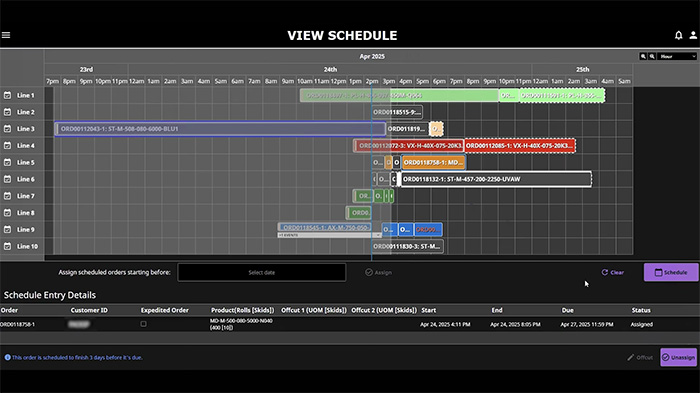
Once a schedule is generated, schedulers are able to review it and “assign” pieces of the schedule as they see fit, locking that part of the schedule in place and making it available to the production team. Schedulers may also make manual movements to keep up with changing demand.
Assigned schedule entries are then visible to the production team on the floor, where they can start and stop the schedule item, see information about how the order should be made, and monitor their progress through the schedule. Supervisors are also given the ability to override start times, quantities, or which item they would like to produce next to give them the flexibility they require on the floor.
Ignition tracks the production events and feeds that information back to the schedule so that subsequent scheduling activities can take into account the progress that has actually been made. The “assign” feature then lets them lock in part of the schedule so that when they reschedule, they remove only what they haven’t locked in, and the scheduling algorithm considers its options starting from the last assigned scheduled item.
Result
For a two-week period during the pilot phase, Actemium compared a manually completed schedule with the automatically generated one to assess performance and illustrate the quick return on investment. Preliminary feedback from the initial rollout indicated that the system:
- Reduced production hours by 34%, reducing the number of changeovers and improving line selection
- Shaved off production time with reduced production hours of five days, plus improved line balancing
- Improved order fulfillment time by scheduling items in a better order
To facilitate new developments and test different scheduling parameters without affecting production, Actemium created a test architecture. It effectively is a duplicate of the production server, but it points to a different (test) database for its key actions. The test server also points to the production database and has a screen with functionality to copy the current production state into the test database. In this way, TWNA can duplicate the existing state for proper 1:1 comparisons when testing different parameters.
Actemium continues to work with TWNA on enhancing the overall Ignition solution, with additional functionality for quality assurance and performance monitoring operations. In the future, TWNA’s goal is to leverage the Ignition solution at other national and perhaps international sites.
Sponsored content by Inductive Automation