This article is sponsored by Rittal. In this Voices interview, Control Engineering spoke with Brian Jung, Director at Rittal Automation Systems, about how panel builders can connect engineering and production workflows to improve throughput, reduce rework and increase manufacturing capacity. Jung shared insights on the disconnect between engineering data and shop floor processes, the role of standardized digital work instructions and automated machining and wire processing, how connected workflows can help manufacturers address skilled labor shortages and the practical steps panel builders can take to move from manual processes toward more connected and scalable production.
Control Engineering: Where do you see the biggest disconnect between engineering and production in panel building today, and what impact does that have on throughput?
Brian Jung: Most manufacturing processes in control panel building are still manual because of the disconnect between engineering and manufacturing. Companies are often still relying on outdated workflows and inconsistent engineering information.
The challenge isn’t necessarily a lack of engineering data, but that too much of the digital information gets converted back into manual processes. We keep going back to doing things the way we’ve always done them.
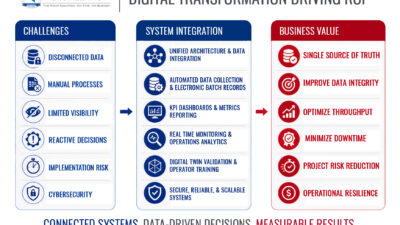
To bring these processes into the modern day, Rittal and Eplan connect the engineering data to the people on the shop floor who are building the panels. This eliminates manual tasks, improves consistency, reduces rework and allows manufacturers to scale without simply adding more people.
To give you an example, we worked with a company that had a large number of control panels to deliver, and its existing processes weren’t keeping up. By standardizing engineering around Eplan and introducing step-by-step digital instructions with automated wire processing from the Rittal Wire Terminal, we were able to make the production process much more consistent.
In this particular case, we reduced the build time for a panel from roughly 12.5 hours to just over an hour, which is about a 90 percent reduction in the time required. Generally, we see efficiency improvements in the range of 60 to 70 percent. These are real-world examples of what happens when you connect engineering and manufacturing rather than treating them as separate processes.
How can manufacturers use engineering data more effectively downstream instead of recreating or manually interpreting information during production?
Manufacturers recreate the same information multiple times throughout the production process. What we want to do is centralize that information and maintain a consistent data stream from engineering and design all the way through manufacturing.
Take something as simple as a circuit breaker. In Eplan, we can capture the information associated with that component, including its electrical characteristics, electrical potentials and drilling patterns. The information stays with the component throughout the entire build process.
So, when the design moves to the shop floor, the people assembling the panel don’t have to interpret the drawings or recreate information that’s already available. They’re working from the same engineering data.
The information also remains valuable after the panel has been built. If somebody needs to service it later, they can refer to the original 3D model and understand how the circuits were assembled, where components are located, and what the wire lengths are.
The quality of this engineering data is also extremely important; if you put bad information in, you’re going to get bad information out. This is why Eplan uses component data that comes from the manufacturers themselves. It’s manufacturer-owned information rather than data that has been manipulated by a third party.
With skilled labor increasingly difficult to find, how can connected digital workflows help manufacturers increase capacity without simply adding headcount?
Experienced panel builders are becoming increasingly difficult to find and retain because they’re in such high demand. COVID also changed the workforce. A lot of people decided to retire or move into other jobs, and that contributed to the shortage of skilled labor in both rural and urban areas. I don’t see that challenge going away anytime soon.
What connected digital workflows allow us to do is make better use of the people we already have. When engineering data is connected directly to manufacturing, we can give workers clear, consistent instructions.
For example, somebody who’s relatively new to the industry can follow digital work instructions while they’re learning. If they have a question about a circuit, they can open the schematic, look at how that circuit is connected, and understand what they’re supposed to do.
They’re learning the skills of a traditional electrical installer while continuing to be productive. It lowers the barrier to entry and makes onboarding and training much easier. It also gives management better visibility into productivity and makes it easier to scale workflows as production requirements change.
There’s an important distinction when we talk about automation: these tools are supplementing workers, not necessarily replacing them. Manufacturers are introducing automation to overcome a specific challenge. Maybe they can’t find enough skilled workers, maybe they need shorter lead times, or maybe they’re trying to keep their overhead under control.
We’re trying to help make the existing workforce more productive. Instead of bringing in a large number of temporary workers whenever a big project comes along, manufacturers can increase their output with the people they already have and grow at a more manageable pace.
What role do standardized work instructions, automated machining and wire processing play in reducing rework and creating more repeatable panel production?
Consistency drives quality, and quality drives production. One of the biggest hidden costs in panel building is rework. You assemble a panel, something isn’t wired correctly, testing fails and now somebody has to go back and fix it.
When you connect consistent engineering data with standardized work instructions, you can eliminate many of the variations that lead to those problems.
Eplan provides engineering data and documentation, and Rittal’s automation solutions use the same information to carry out production tasks such as enclosure machining, wire processing and labeling.
For wire processing, for example, instead of somebody manually determining whether a wire is long enough or cutting it based on their interpretation of a drawing, the machine is working from the wire lengths established during engineering.
This connected approach produces better first-pass yields, less scrap, fewer production delays and much more repeatable panel builds. Manufacturers want production to be predictable and not variable, regardless of which operator is doing the work.
For a panel builder or manufacturer that still relies heavily on manual processes, where should they start, and what does a realistic path toward connected engineering and production look like?
There are plenty of places to start. You can introduce a machine into almost any manufacturing process and see an immediate productivity benefit. But the real change comes from changing habits, and old habits are hard to break.
I recommend starting with engineering data. The first thing manufacturers should do is identify the processes that require the most labor or generate the most errors. Those are going to be the areas where they can achieve the biggest improvements.
Of course, you don’t need to automate everything at once. The first step is to digitalize engineering data and establish a structured, standardized foundation. From there, you can connect engineering to production, develop a digital twin of the panel and introduce digital work instructions on the shop floor.
Once the foundation is in place, you can start automating specific operations. For example, instead of having somebody manually lay out an enclosure and spend hours making holes with punches and jigsaws, you could use a Rittal Perforex machine to automate the machining process.
From there, you can expand into wire processing, busbar processing or other areas of manufacturing because the engineering data is already available to drive those operations.
The real success comes from connecting the workflows and not just implementing isolated technologies that benefit one department. If you make a small improvement in engineering, it can have a significant impact on what happens later in production. That’s what we’re trying to achieve by connecting these processes.
My advice is: don’t start with automation. Start with data. Once engineering information becomes the foundation, automation becomes much easier to implement and scale across the organization.
Ultimately, the future of panel building is about connecting engineering and manufacturing so skilled workers can spend more time creating value rather than correcting errors or performing unnecessary rework.
Learn more about how Rittal and Eplan help panel builders connect engineering and production, reduce manual work, and improve manufacturing efficiency.
About Rittal LLC
Founded in 1982, Rittal LLC is the fully owned U.S. subsidiary of Rittal GmbH & Co. KG, and is headquartered in Schaumburg, IL. With a main production facility in Urbana, OH, a dedicated Modification Center in Houston, TX, and logistic hubs in Urbana, OH; Springfield, OH; Houston, TX; Sparks, NV; and Atlanta, GA, Rittal LLC is fully committed to providing the United States with quality enclosure solutions.
Founded in 1961 in Germany, Rittal is a global manufacturer of industrial and IT enclosures, racks, and accessories, including cooling solutions and power management systems for industrial, data center, outdoor and hybrid applications. As the largest enclosure manufacturer in the world, Rittal provides quality solutions for practically any industrial or IT infrastructure application. Rittal is part of the owner-operated Friedhelm Loh Group along with Eplan.
About Eplan
Eplan is a global leader in software and service solutions for electrical, automation, and mechatronic engineering. Specializing in cutting-edge design software for machine and panel builders, Eplan supports 68,000 customers worldwide via standardized and customized interfaces to ERP and PLM/PDM systems. As part of the Friedhelm Loh Group along with Rittal, Eplan is dedicated to pushing efficiency, integration, and automation in engineering-forward. Learn more at eplanusa.com.