System integrators entered 2026 facing some familiar problems –– tariff pressures, shifting trade policies, economic volatility and workforce shortages. And that doesn’t even include AI.
The control system integration industry entered 2026 facing a familiar paradox: uncertainty remains in areas that affect investment, yet opportunity is not only abundant but increasing in new areas.
Economic volatility, shifting trade policy, tariff pressures, workforce shortages and the rapid emergence of artificial intelligence (AI) have created a business environment that demands adaptability. System integrators increasingly serve as the critical link between automation technology, operational objectives and business outcomes. Manufacturers, utilities, life sciences companies, data center developers and infrastructure owners increasingly depend on system integrators to translate technology investments into measurable operational results.
The Control System Integrators Association (CSIA) has seen this reality reflected throughout our ongoing conversations with our system integrator members, including at the CSIA 2026 Conference, where members explored the theme of navigating change. Conference discussions focused heavily on leading through economic uncertainty, leveraging AI and digital technologies, attracting and retaining talent, scaling operations and transforming technical expertise into business growth. Throughout the conversations the message was clear: the integration firms that thrive over the next decade will be those that evolve beyond traditional project execution and position themselves as strategic business partners.
Current economic trends for the system integrator market
Unlike the boom years that followed the pandemic, 2026 has not been characterized by broad-based industrial growth, but instead has shown concentrated growth in specific market segments.
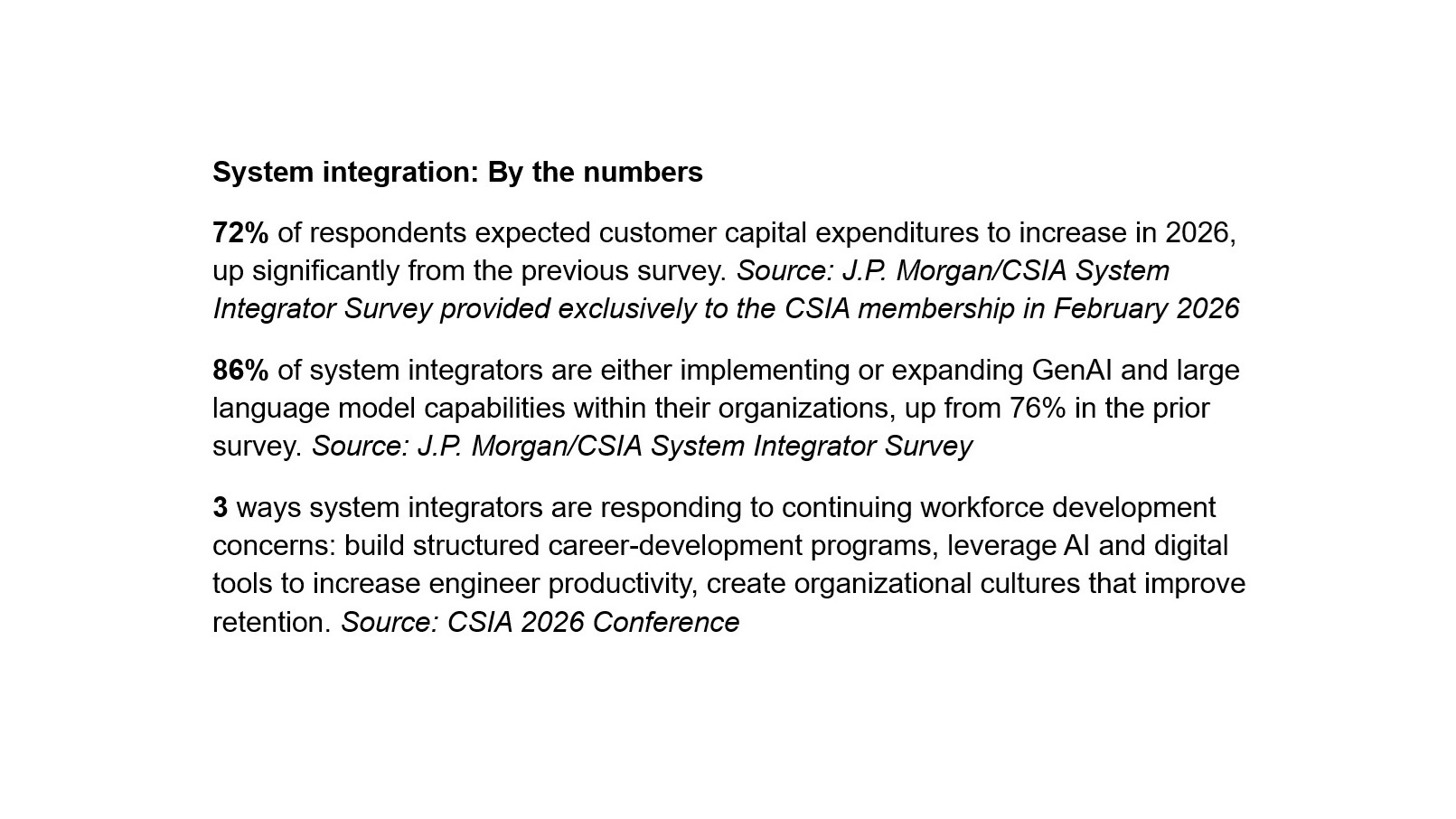
According to the J.P. Morgan/CSIA System Integrator Survey provided exclusively to the CSIA membership in February 2026, 72% of respondents expected customer capital expenditures to increase in 2026, up significantly from the previous survey. Order activity, backlog visibility and revenue expectations all showed improvement, signaling a healthier environment than many integrators experienced over the previous 18 months.
However, there are sectors reporting stronger activity than others, most notably data centers, defense and military, semiconductor and electronics manufacturing, power and energy and life sciences. In particular and perhaps no surprise to readers, data centers ranked as both the strongest current end market and one of the most attractive sectors for future expansion, driven by current AI computing requirements, cloud infrastructure growth and global digitalization.
Despite growth indicators, economic risks do remain. At the CSIA 2026 Conference, market researcher and economic analyst Alex Chausovsky emphasized that business leaders must learn to operate in an environment defined by geopolitical uncertainty, trade disruptions and persistent cost pressures, moving as he described from “simply navigating change to handling continued complexity.” His economic outlook highlighted the importance of continuous scenario planning, data-driven decision-making and value-add customer partnerships as tools for continued system integrator growth.
Going into 2026, for example, tariffs remained a major source of uncertainty across industrial markets. The economic outlook presented to CSIA members showed ongoing investigations and policy actions affecting sectors ranging from semiconductors and critical minerals to robotics and industrial machinery. Chausovsky noted that tariffs were likely to continue to evolve rather than disappear. Echoing this, the J.P. Morgan survey found that uncertainty regarding tariffs and input costs remains one of the primary causes of project delays. At the same time, many respondents believe tariffs will ultimately accelerate onshoring activity for U.S. manufacturers, although the benefits will take years to materialize.
Chausovsky’s outlook suggested that industrial production remains positive but is losing momentum. gross domestic product continues to expand and labor markets remain relatively healthy, but business leaders should expect slower growth than the headline numbers might suggest. The result is an environment where project opportunities exist, but customers will continue to demand fast paybacks, greater certainty and measurable business outcomes.
How CSIA members are meeting the challenge
In parallel with these demands, CSIA members are leveraging emerging technologies to innovate their businesses — both internally (operations, processes, procedures and efficiency) and externally (client solutions, partnerships and market positioning) — to create sustainable, long-term competitive advantage for both themselves and their clients. At the heart of these emerging technologies of course is artificial intelligence. The latest J.P. Morgan survey found that 86% of system integrators are either implementing or expanding GenAI and large language model capabilities within their organizations, up from 76% in the prior survey. Every respondent using AI reported positive returns or expected long-term benefits. More importantly, AI is increasingly being used in practical ways, including proposal development, code generation and review, knowledge management and more. Survey participants reported using AI to search user manuals, maintenance logs, spare-parts information and operational data to reduce downtime and improve service delivery.
Notably, the survey also found that customers’ investments in AI are not significantly crowding out spending on traditional automation equipment. The overwhelming majority of respondents believe AI and automation investments are complementary rather than competitive. For the future of system integration, that distinction is critical, as it shows the value of automation in making systems more adaptive, more intelligent and more useful to operators and executives.
CSIA certification: demonstrating operational excellence
As customer expectations continue to rise, system integrators must demonstrate not only technical competence but also strong business, project, service and cybersecurity practices. CSIA Certification provides an important differentiator by offering independent, third-party validation that an integration firm operates according to industry-recognized best practices. Certification evaluates performance across critical areas including project management, quality management, financial management, human resources, service and support, system development lifecycle processes and information systems management and cybersecurity.
For end users who are making the choice on an integration firm, CSIA certification offers increased confidence that a system integrator has established processes that support consistent project delivery and long-term business stability. For integrators, the certification process often drives operational improvements that strengthen scalability, profitability, employee development and client satisfaction. As automation projects become increasingly complex and interconnected, CSIA certification provides a valuable framework that helps integrators manage risk, improve performance and position themselves as trusted long-term partners in their customers’ digital transformation journeys.
People driving innovation
In addition to adapting to AI, workforce development remains one of the industry’s most pressing concerns. The CSIA 2026 Conference featured multiple sessions focused on attracting, developing and retaining talent, recognizing that labor continues to be the industry’s most constrained resource. With experienced engineers retiring, the competition for the right technical talent remains.
Meanwhile, hiring activity across the broader economy has slowed, even as layoffs remain relatively low. According to Chausovsky’s analysis, labor market conditions remain stable but less dynamic than in previous years. For system integrators, this means growth is increasingly limited not by demand, but by delivery capacity.
The most successful firms are responding in three key ways, all of which were featured at the CSIA 2026 Conference. First, they are building structured career-development programs. Chad Wallace of CSIA Member Blue Ridge Automation presented a model for a ground-up internal “factory” for cultivating its own workforce, a proactive concept to talent generation rather than a reactive one. Second, CSIA Members are leveraging AI and digital tools to increase engineer productivity, such as the framework shown by Becca Johnson and Geoff Ables of CSIA Members Sky-IO and C5 Insight respectively. Finally, they are working on creating organizational cultures that improve retention. Multiple presentations showed ways that system integrators can structure themselves internally for impact, from considering team strengths through the Working Genius model, presented by Joe Martin with CSIA Member MartinCSI, to a shift to strategic work, presented by John Sullivan with CSIA Member DMC Inc.
What’s next for system integrators?
One of the most significant shifts occurring within the industry is the evolution of the system integrator’s role from project executor to lifecycle partner. Historically, many integration firms were engaged primarily during the design, implementation and commissioning phases of a project. Today, customers increasingly expect support throughout the entire automation life cycle, from concept development and technology selection to startup, optimization, cybersecurity, training and continuous improvement. This expanded role enables integrators to deliver greater value while helping clients maximize return on their automation investments.
The drivers behind this shift are clear. Manufacturers and infrastructure operators face increasing pressure to improve productivity, reduce downtime, enhance cybersecurity, address workforce shortages and make better use of operational data. Meeting these objectives requires more than installing control systems: it requires connecting people, processes and technology across the enterprise. As a result, system integrators are becoming trusted advisors who help customers align automation initiatives with broader business goals.
A key element of this transformation is the growing convergence of information technology (IT) and operational technology (OT). Today’s industrial organizations are seeking greater visibility from the plant floor to the executive suite. Integrators are helping customers connect control systems, historians, MES platforms, Enterprise Resources Planning (ERP) systems, cloud applications and analytics environments so that information flows more effectively throughout the organization. Improved access to operational data enables faster decision-making, stronger performance management and more informed capital-investment strategies.
As customers increasingly seek partners capable of delivering integrated solutions that combine these, leading integrators are building recurring relationships through remote support, performance monitoring, data analytics, cybersecurity services and continuous optimization programs, rather than viewing projects as one-time engagements. As discussed at the CSIA 2026 Conference by Matt Wise with CSIA Member E Tech Group, the most successful system integrators will embrace lifecycle-based service models, enable greater information flow across enterprises and serve as strategic partners committed to improving measurable business outcomes.
In an increasingly complex industrial environment, the value of a system integrator lies not only in implementing technology, but in helping customers continuously derive value from it. At CSIA, we are here to help our integrator members create strong businesses to help them deliver that value.
Adrienne Meyer is the chief executive officer of the Control System Integrators Association (CSIA). Edited by Sheri Kasprzak, executive editor, Control Engineering, Plant Engineering, [email protected].
Keywords
System integrators, CSIA
Consider this
While system integrators can be proficient with technologies, adding business excellence makes a better control system integration lifecycle partner.
You also might like
Learn more from Meyer in this discussion with Control Engineering.