Intelligent, networked motor management benefits include better diagnostics, real-time operating data and improved motor performance visibility compared to aging motor control centers.
Smart motor management integration insights
- Moter control modernization project replaced aging motor control centers.
- A system integrator’s upgrade included industrial PCs, motor controls, energy management and supervisory control and data acquisition software.
- Benefits include better diagnostics, real-time operating data and better motor performance.
A customer in the food and beverage industry contracted Industrial Automated Systems (IAS) to replace and modernize aging motor control centers (MCC) that had reached the end of practical service life. In addition to containing obsolete components that were becoming increasingly difficult to support, the metal-enclosed MCCs were beginning to exhibit corrosion and other signs of environmental wear.
Working closely with the customer, IAS evaluated several options for replacing the legacy system. Rather than simply installing new MCCs based on conventional motor starters, the project team identified an opportunity to modernize the motor-control architecture using intelligent, networked motor management.
The resulting design replaced the aging MCCs with new control panels incorporating an integrated motor-management platform. This approach provided motor switching and protection, enhanced diagnostics, real-time operating data, network connectivity and improved visibility into motor and load performance.
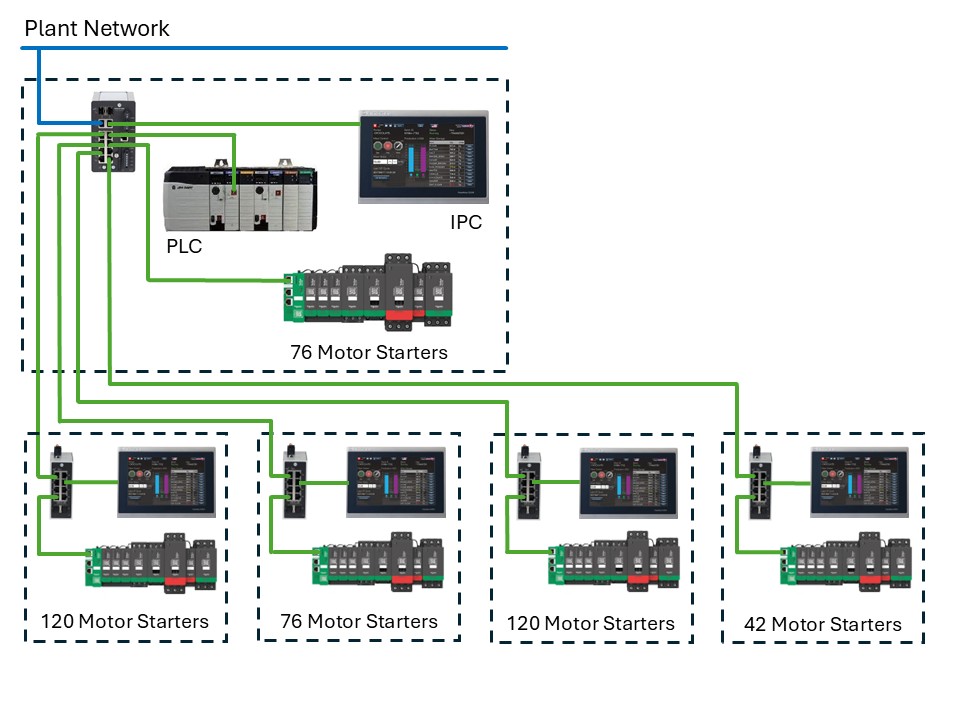
The system was segmented into five automation islands and incorporated a control platform. Operator interface was provided through 19-inch industrial PCs running with edge software and supervisory control and data acquisition (SCADA) software. Five new control panels were designed and fabricated to house the control and motor-management systems, supporting 434 motor starters.
The system has five automation islands, five control panels, industrial controllers, load management devices and SCADA.
Smarter motor management benefits
By upgrading from conventional motor starters to an intelligent motor-management system, the customer realized several important operational and maintenance benefits:
- Detailed diagnostics: Provides significantly more information than a conventional motor starter, helping maintenance personnel identify overloads, phase issues, jams, excessive starts, and other operating problems.
- Predictive maintenance capability: Motor and load data can be monitored and analyzed to identify developing problems before they result in equipment failure or unplanned downtime.
- Energy monitoring: Provides electrical and energy-related information that conventional contactor and overload combinations typically cannot deliver without additional hardware.
- Ethernet connectivity: Integrates motor control directly into the automation network, reducing discrete PLC I/O requirements, field wiring, and associated installation complexity.
- Improved troubleshooting: Operating status, alarms, trips, and diagnostic information are available through the control system, allowing technicians to identify problems more quickly without relying solely on troubleshooting individual components at the panel.
- Easier system expansion: The modular architecture simplifies the addition or modification of motor loads compared with redesigning and rewiring conventional starter circuits.
- Improved data availability: Motor status and operating data can be communicated to PLC, HMI, SCADA, and higher-level systems, providing valuable information for maintenance, production analysis, and continuous improvement initiatives.
With the successful implementation of this project, the customer will realize years of improved reliability, increased equipment uptime, and greater visibility into the health and performance of its motor-driven assets. The intelligent motor-management architecture provides enhanced diagnostics and real-time operating data, allowing maintenance personnel to identify developing issues more quickly, troubleshoot faults more efficiently and reduce unplanned downtime.
Beyond addressing the immediate concerns of obsolete equipment and deteriorating MCCs, the new system provides a modern, networked platform that is easier to maintain, expand, and support throughout its lifecycle.
Terry Love is consultant for Industrial Automated Systems (IAS). Edited by Mark T. Hoske, editor-in-chief, Control Engineering, Arrowfly, [email protected].
Keywords
System integration, motor starters, motor management
Consider this
Automation connected to motors can improve operational efficiency.
You also might like
https://si.arrowfly.com/integrators/industrial-automated-systems