Why manufacturers are moving from project-by-project integration toward lifecycle accountability.
System integration lifecycle insights
- Understand why operational technology (OT) project-by-project models can create gaps in continuity and accountability as industrial operations become more connected and complex.
- Recognize how local accountability and access to broader technical and process expertise can improve continuity across engineering, automation, digital systems and support.
- Understand how lifecycle thinking can influence standardization, scalability, maintainability, risk mitigation and long-term operational performance.
Industrial automation has traditionally been delivered one project at a time, but that model is increasingly mismatched to the way modern plants are staffed and operate as automation, data, cybersecurity, operations and enterprise systems intersect. The question is no longer simply whether a project worked at startup, but whether the operation keeps performing better because of it.
For decades, industrial automation often has been delivered as a series of discrete projects. A need is identified. A scope is written. An integrator is selected. The system is designed, commissioned and handed over. Then the project team moves on to the next priority.
There is nothing inherently wrong with that model. In fact, it helped build much of the automation infrastructure operating in manufacturing today. But the environment around those systems has changed. Plants are more connected. Production data is expected to move beyond the control layer. Cybersecurity requirements increasingly affect engineering decisions. Operations teams expect better visibility. Corporate technology groups are becoming more involved in plant systems. And manufacturers are trying to standardize and scale improvements across multiple sites without disrupting production.
In that environment, a collection of individually successful projects can still produce an increasingly fragmented operation. The problem is not necessarily poor engineering. It is the absence of continuity and accountability across the lifecycle.
The project may end; the system does not
A controls project may have a defined start and finish, but the system it creates can remain in production for 10, 15 or 20 years. During that time, products change, equipment is added, software versions evolve, cybersecurity requirements increase, people leave, business priorities shift and new sources of data become important.
Yet many automation programs are still structured as though commissioning represents the finish line. Documentation is handed over, punch-list items are closed and responsibility shifts back to the manufacturer. When the next initiative arrives, a new team may begin again with limited knowledge of the decisions, constraints and lessons that shaped the existing environment.
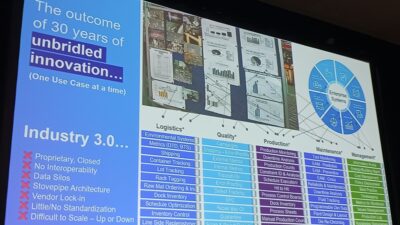
That creates a hidden cost. Engineering teams spend time rediscovering the plant. Standards drift. Different sites solve similar problems differently. Data structures become inconsistent. Support becomes dependent on individual people. The manufacturer is left coordinating multiple vendors and, in effect, becomes the integrator among its integrators.
Integration is becoming an operating model
The more connected manufacturing becomes, the less useful it is to think of integration only as a project activity. Integration is increasingly an operating model: the ongoing work of keeping controls, information, people, standards and technology aligned as the business changes.
Consider a manufacturer adding a new production line. The traditional automation scope might focus on programmable logic controller (PLC) programming, human-machine interface (HMI) development and commissioning. But the business outcome may also depend on production reporting, historian data, MES integration, network architecture, cybersecurity, quality records, enterprise interfaces and long-term support. Those elements cross organizational and technical boundaries, and the decisions made in one layer can affect every other layer.
The same is true when a company modernizes an existing plant. Replacing an obsolete control platform may solve an immediate risk, but the better question is if the modernization also improves maintainability, creates useful data, supports future expansion and fits the standards the organization wants to deploy elsewhere.
This is why leading manufacturers are beginning to expect more continuity from their integration partners. They still need excellent project execution. They also need someone who understands how each project fits into the larger operating environment.
Fewer handoffs matter in project management
Every handoff introduces the possibility of lost context. One firm designs the electrical system. Another builds panels. Another programs the controls. Another handles the manufacturing execution system (MES). Information technology (IT) manages networking. A cybersecurity provider adds requirements late in the process. Operations inherits the result.
Specialization is necessary, and no single organization will perform every task in every project. The issue is accountability. When responsibilities are fragmented, the manufacturer often owns the burden of making sure all of those parties produce one functioning operation.
A lifecycle approach changes that dynamic. It creates clearer ownership for how engineering, fabrication, automation, digital systems and support come together. The goal is not simply fewer vendors. It is fewer gaps between responsibilities.
That becomes particularly important during startup, where small disconnects can become expensive. A network assumption that was never communicated, a data tag that was not standardized, or an interface that each supplier believed belonged to someone else can delay production even when every individual supplier technically completed its scope.
Data changes the economics of automation
One of the biggest changes in the integrator relationship is the growing value of operational data. Historically, automation projects were primarily judged by whether the machine or process operated safely and reliably. Those requirements remain fundamental, but manufacturers increasingly expect the same systems to create information that improves the business.
A packaging line, for example, can generate far more value when its controls data is contextualized with production, quality and downtime information. A process system can become more useful when historian data supports troubleshooting, performance analysis and predictive insight. A multi-site organization can make better decisions when common data structures allow plants to be compared without rebuilding the information model at every location.
This changes the economics of project decisions. A choice that is inexpensive for one project may be costly when repeated across 20 sites. Conversely, investing in a reusable architecture, naming standard or contextual data model can create returns well beyond the original project.
The integrator therefore needs to understand not only how to make the system work, but how today’s engineering decisions affect tomorrow’s information, support and scalability.
Automation vendor independence becomes more important
As manufacturers consolidate relationships and ask partners to take broader responsibility, vendor independence becomes more important. A lifecycle partner should not begin with a preferred product and work backward toward the customer’s problem. It should begin with the operating requirement and determine which technologies best fit the environment.
Most industrial companies already operate mixed-vendor plants. Acquisitions, expansions and years of capital projects create a technology landscape that is rarely uniform. Forcing standardization where it does not make business sense can be as costly as allowing uncontrolled variation.
The better approach is disciplined independence: establish standards where they create value, preserve existing investments where they remain effective, set a common data structure, and make technology choices based on lifecycle performance rather than a short-term project preference.
Local knowledge still matters with automation implementation
Manufacturing is physical. Even as engineering becomes more digital and expertise can be shared globally, successful integration still depends heavily on understanding the plant, the people and the operating realities at the site.
A drawing rarely captures everything that matters. Local teams know which line can only be shut down on a particular weekend, which legacy system has an undocumented dependency, which operators need to be involved early, and where a theoretically elegant design may create a maintenance problem at 2 a.m.
At the same time, local knowledge should not mean solving every problem from scratch. The strongest model combines local accountability with access to a broader network of specialists and proven approaches. A local team can remain responsible to the customer while bringing in expertise in MES, historians, dat operations (dataOps), cybersecurity, process controls or other disciplines when the problem requires it.
That combination shortens learning curves without sacrificing accountability.
From project completion to performance: Automation lifecycle
The shift toward lifecycle accountability also changes the definition of success. Traditional project metrics remain important: scope, schedule, budget, safety and startup performance. But they do not tell the whole story.
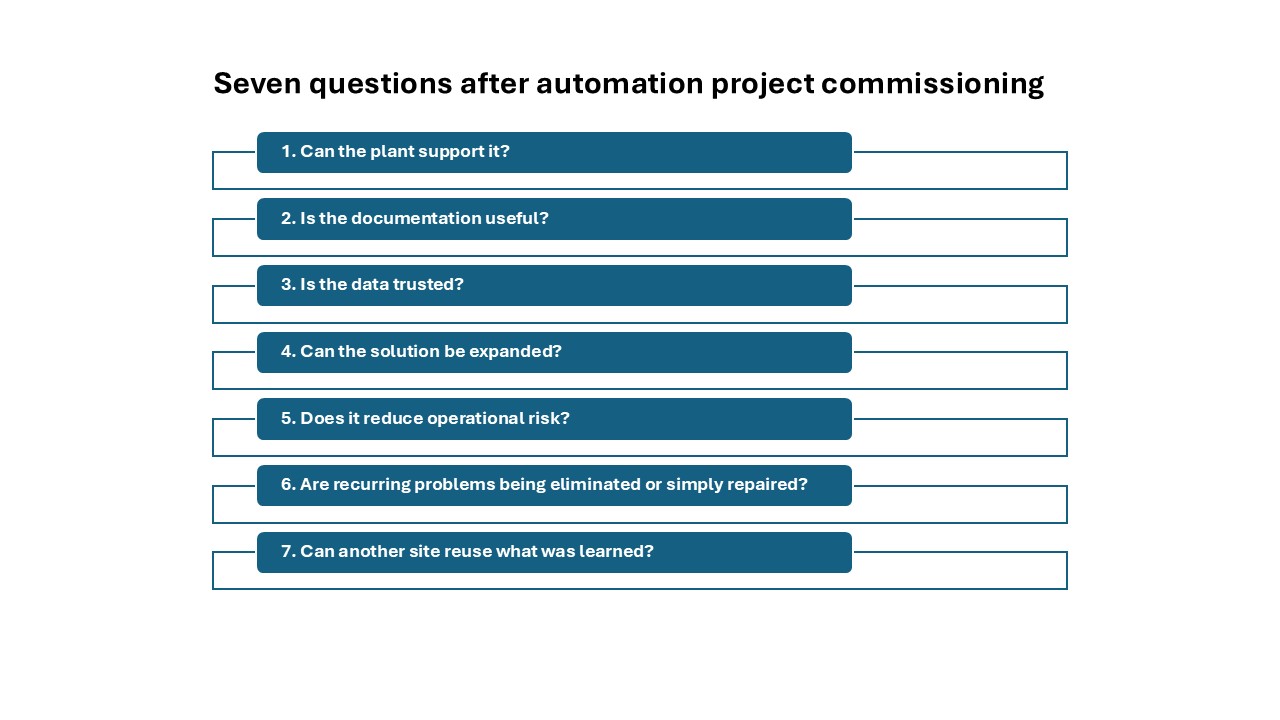
A successful automation investment should also be judged by what happens after commissioning. Can the plant support it? Is the documentation useful? Is the data trusted? Can the solution be expanded? Does it reduce operational risk? Are recurring problems being eliminated or simply repaired? Can another site reuse what was learned?
These questions encourage a different relationship between manufacturers and integrators. Commissioning becomes a milestone rather than the end of the relationship. Support provides feedback into engineering. Operational issues inform future standards. Modernization becomes part of a roadmap instead of a series of emergencies. Data initiatives build on an intentional architecture instead of isolated dashboards.
That continuity also creates accountability. When the same partner expects to support and expand what it builds, design decisions are made with a longer horizon.
Next-generation of systems integrators
None of this means the traditional automation project disappears. Manufacturers will continue to issue defined scopes, manage capital budgets and competitively source work. The change is in what they should expect from the organizations performing that work.
The next generation of systems integrators will need to combine deep technical execution with broader business understanding. They will need to work comfortably from the plant floor to the information layer, understand the implications of cybersecurity and data architecture, collaborate with both operations and IT, and remain engaged as systems evolve.
They will also need to scale knowledge. A lesson learned in one plant should improve the next project. A useful standard should be repeatable. Specialized expertise should be accessible without disconnecting the customer from the local team responsible for the outcome.
Most importantly, they will need to accept a broader definition of accountability.
The systems integrator of the future will not simply ask, “Did the project work?” It will ask, “Is the operation performing better because of it?”
That is the larger shift taking place in industrial automation. Manufacturers do not need less project discipline; they need project discipline connected to a longer view of the operation. They need partners that can help them design, build, integrate, modernize and support systems with an understanding of what came before and what needs to come next.
The era of the one-and-done automation project is giving way to something more durable: accountable industrial transformation built around the lifecycle of the operation.
Matt Ruth is president, Actemium Avanceon. Edited by Mark T. Hoske, editor-in-chief, Control Engineering, Arrowfly, [email protected].
Keywords
Control system integration, project management
Consider this
How are you ensuring system integration success?
You also might like
https://www.controleng.com/video-interview-data-analytics-and-machine-learning-on-the-plant-floor