
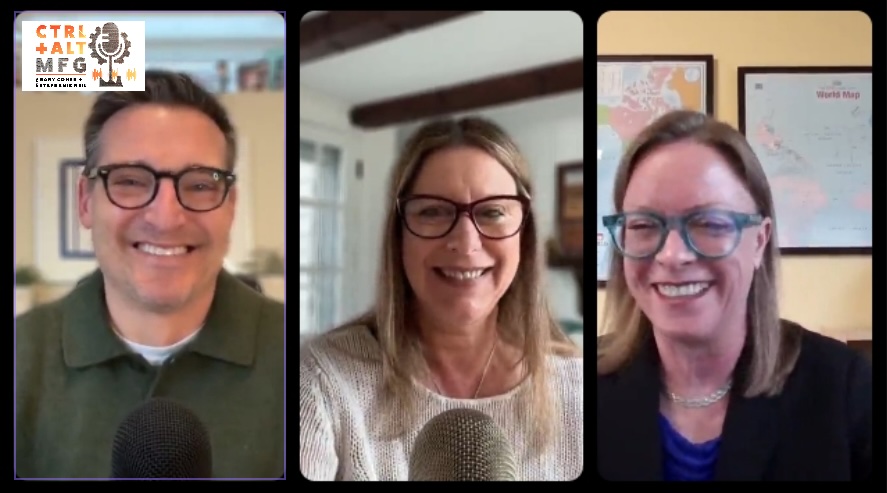
As manufacturers push forward with AI, digital transformation and smarter automation, Adrienne Meyer, CEO of CSIA, explains why system integrators have become essential to connecting legacy systems, deploying new technologies and helping industrial companies navigate rapid change.
As manufacturers race to adopt artificial intelligence (AI), modernize automation systems and connect more of the enterprise, one reality is becoming clearer: None of this works without integration.
That was a central theme in a recent episode of the Ctrl+Alt+Mfg Podcast featuring Adrienne Meyer, CEO of the Control System Integrators Association (CSIA). In the conversation, Meyer described a manufacturing sector moving quickly toward more connected, data-centric and AI-enabled operations and a system integration community that is being asked to do more than ever before.
“The system integrator is always going to be the key partner for manufacturers and industrial end users when they need to automate a process,” Meyer said. ntegrators are going to help you think broadly about that and do what they do best, which is integrate.”
Meyer, who took the CEO role in July 2025, came to CSIA after more than two decades with ODVA. While she is relatively new to the system integration side of the industrial automation market, she is not new to the larger forces shaping it. On the podcast, she pointed to a long arc of change stretching from the early adoption of Ethernet on the factory floor to today’s conversations around virtual programmable logic controllers (PLCs), digital twins and AI.
That background is useful at a moment when manufacturers are no longer evaluating digital transformation as a future concept. Instead, many are trying to put it into practice, often while managing labor shortages, aging infrastructure and uncertain economic conditions.
For Meyer, that places renewed attention on the organizations that make industrial technology work in the real world.
A community built on collaboration
CSIA, founded in 1994, was created to help system integrators build stronger businesses, not just stronger technical capabilities. Meyer described the association’s beginnings as a group of integrators who had engineering expertise but needed support in running and scaling companies.
“They were really great engineers, and they knew how to do the work that was required. They didn’t have experience running businesses or setting up businesses,” Meyer said.
That founding spirit, she added, still defines the organization. Members join to share best practices, benchmark operations, improve management processes and learn from peers facing similar challenges.
One of the most notable aspects of the system integrator community, Meyer said, is its unusual willingness to collaborate even though many members compete in overlapping markets.
“CSIA is where people speak their language,” she said, describing what she has heard in meetings with members. Another phrase she said she hears regularly captures the organization’s value proposition more directly: “I put in one idea, and I get 10 back.”
That exchange of knowledge matters because integrators are increasingly confronting similar business and technical questions, such as how to apply AI, how to adapt cybersecurity best practices, how to serve customers pursuing phased modernization and how to recruit and retain talent with hybrid operational technology (OT) and information technology (IT) skill sets.
What system integrators are seeing now
Since joining CSIA, Meyer said she has prioritized in-person visits with members to understand the pressures and opportunities they are facing. In addition, the association conducts a twice-yearly industry survey with JPMorgan to give members a broader view of business conditions.
According to Meyer, the most recent survey, published in February, showed improved sentiment compared with May 2025. She said the findings suggest automation trends are stabilizing, customer capital expenditure expectations are improving and backlog visibility and lead times are “normal to high.”
There are also signs that end users are taking a practical approach to modernization. Meyer noted an increase in customers making “incremental brownfield improvements” to existing facilities rather than relying solely on large-scale greenfield projects or complete overhauls.
That trend aligns well with the system integrator role. Integrators are often the ones helping manufacturers assess where upgrades make sense, how to phase projects and how to connect new capabilities to legacy infrastructure.
“They need information on using and being used by AI, what their customers are doing, what they can do with it,” Meyer said of CSIA members. “They need an understanding of customer sentiment and economic conditions.”
AI creates both opportunity and disruption
If there was one topic that dominated the podcast discussion, it was AI. Meyer said artificial intelligence is both the largest opportunity and the biggest source of disruption for system integrators.
“AI supercomputing platforms and multi-agent AI systems are rapidly reshaping industries,” she said, adding that these technologies are generating new demand for orchestration, infrastructure redesign, workflow changes and governance.
That expanding scope means system integrators must increasingly understand not only controls and automation, but also networking, cloud architectures, data engineering, cybersecurity and interoperability standards.
“Control system integrators are no longer focused solely on PLC, DCS, programming and panel building,” Meyer said. “They’re increasingly expected to deliver data-centric, networked, AI-aligned automation solutions.”
But with all this change come significant opportunities for growth. Meyer said the strongest end markets cited by integrators in the CSIA/JPMorgan survey were data centers, semiconductors and defense, both in terms of current activity and long-term growth expectations.
At the same time, AI is changing the nature of the work itself. As tools move toward more autonomous operation, integrators are being pushed to develop new skills around AI deployment, infrastructure orchestration and adaptive security architectures.
Cybersecurity, of course, remains part of that equation. As more AI, edge and Internet of Things (IoT) technologies are connected into industrial environments, the potential attack surface expands. Integrators, Meyer said, will need to evolve beyond basic provisioning to support more continuous and responsive security approaches.
Navigating change in 2026 and beyond
Those themes will be front and center at the 2026 CSIA conference, scheduled for May 4-8 in Baltimore. Meyer said this year’s conference theme, Navigating Change, reflects the kind of practical, actionable guidance members are asking for.
“Our audience is hungry for actionable,” Meyer said. “They don’t want to hear fluffy things. They want to hear how you can actually make changes in your business.”
Sessions will cover AI, cybersecurity regulations, digital twins, people management and business growth. Meyer also highlighted two conference traditions that reflect the culture of the association: a panel on how companies can leverage CSIA resources to scale, and the popular “Lessons from Touching a Hot Stove” session, where integrators candidly discuss mistakes and what they learned from them.
Taken together, Meyer’s comments suggest that system integrators are no longer operating in the background of manufacturing’s digital transformation. They are increasingly central to it. For manufacturers trying to bridge old and new systems, deploy AI responsibly and improve operations without losing momentum, that may be the most important takeaway of all.
The Ctrl+Alt+Mfg Podcast
Make sure to check out other episodes of the Ctrl+Alt+Mfg podcast, where hosts Gary Cohen and Stephanie Neil discuss a range of digital transformation insights. The last five episodes are listed below:
Ep. 8: Inside the 2026 State of Automation Report, with Mark Hoske, Control Engineering
Ep. 9: When cyberattacks go physical, with Ian Bramson of Black & Veatch
Ep. 10: Modernization vs. digital transformation, with Dan Furrow and Luis Atencio of Wesco
Ep. 11: What plant engineers really want, with Amara Rozgus of Plant Engineering