
As life sciences manufacturers turn to AI to streamline recipe creation and simplify complex Manufacturing Execution System (MES) environments, a measured, strategic approach — rooted in a trusted automation ecosystem — will deliver greater long-term value than hastily adopted bolt-on solutions.

Learning objectives
- Understand life sciences’ special needs in Manufacturing Execution Systems.
- Learn how MES needs to interact with automation and business systems to be efficient.
- Determine the ways in which MES must be flexible to be successful.
MES insights
- Manufacturing Execution Systems focus on shop-floor business processes whereas distributed control systems focus on overall process automation.
- Tools like process knowledge management (PKM) are a good start for managing the higher product and process level recipes, but many manufacturers need to make the recipe writing process easier and artificial intelligence (AI) is emerging as a potential solution.
- To maximize the potential of AI in MES environments, manufacturers need solutions that embrace native integration with well-established automation ecosystems.
Life sciences manufacturing relies on a wide variety of extremely complex processes and constraints across the entire treatment development chain. Starting in research and development, with increasing measures through the commercialization journey to full-scale manufacturing, organizations must ensure that processes operate safely, reliably, efficiently and sustainably — a complicated endeavor requiring precise orchestration of people, data and equipment — along with reliable, repeatable procedures.
For decades, one tool has played a critical role at the center of this orchestration in commercial production facilities: the Manufacturing Execution System (MES). The MES executes workflows that are slower, more manual and often more malleable than those driven by other automation systems, such as the distributed control system (DCS).
The MES focuses on the shop-floor business processes whereas DCS is focused on the overall process automation. In addition, process knowledge management (PKM) software is focused on managing the product and process definition, including risk analysis and mitigation. Yet to ensure safe, reliable automation end-to-end, the MES must still be able to interact with those and other business systems to help deliver quality product with efficient execution.
How MES puts flexibility at the forefront
As a result of its required interoperability with other critical systems, the MES thrives on flexibility in implementation. Unlike in a DCS, where a PID loop is often designed in a predetermined way, very similar to others, many elements of an MES are tailored to the unique ways individual organizations run their businesses, so the workflows and rules incorporated within workflow elements vary from one organization to another.

The best MES solutions are therefore designed with the flexibility needed to tailor the MES to match business systems and practices — creating a built-for-purpose solution able to integrate directly with other critical systems, such as DCS, PKM, enterprise resource planning (ERP), scheduling, quality and more (Figure 1).
This requirement for flexibility, however, can lead to challenges. In recent years, life sciences manufacturers of all sizes have experienced a dramatic decline in the availability of expert personnel necessary to support a complex system. As a result, teams are looking for ways to simplify their MES processes, starting with ways to streamline recipe creation.
Tools like PKM are a good start for managing the higher product and process level recipes, but to meet increasing needs around the globe for site enabled recipe requirements, many manufacturers need to make the recipe writing process easier and artificial intelligence (AI) is emerging as a potential solution. Yet as companies implement AI solutions, they are quickly learning a valuable lesson — they must be thoughtful in how they implement AI solutions in conjunction with their MES.
The risks of bolt-on solutions
With the rise of AI comes the rise of the AI startup. It appears there are new companies providing AI tools for life sciences appearing every day and recipe creation capability is no exception. While there are AI-based recipe creation tools available today, most of these are designed specifically for simple MES solutions and not for easy integration with the rest of the value chain.
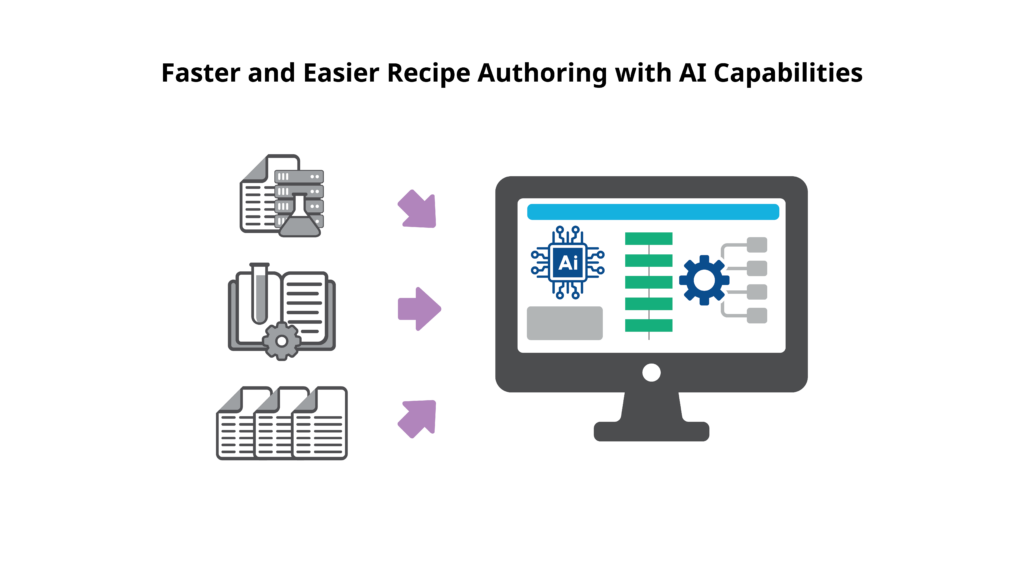
This means that many AI technologies can’t handle the most complicated treatment development processes. They are often much better suited to small scale research and development where fewer requirements need to be embedded within workflow objects, but struggle when a company is ready to move to large scale manufacturing subject to full Good Manufacturing Practices (GMP), which includes implementation of risk mitigation strategies, often built into a traditional MES solution (Figure 2).
The root cause of this problem is that an AI designed for manufacturing and recipe creation is only going to be as good as the system it uses for implementation and its data foundation. If the AI is built only to support a specific type of MES implementation, it will struggle to provide the flexibility necessary to meet a business’s unique needs. More importantly, however, for an AI tool to generate successful guidance, it must have a strong data foundation. This leaves startup AI companies with two options for building AI tools for MES: rely on generic large language models (LLMs) or start with limited initial data and require customers to supply additional data.
Relying on generic LLMs creates significant liabilities. If a recipe generation AI is using data with few or no boundaries or limits, it is far more likely to produce solutions that cannot safely, affordably, or even realistically be implemented. Such a scenario typically requires so much rework that it does not effectively solve the limited resources problem it was designed to circumvent.
Alternatively, a solution designed with limited data at release requires the user to not only have copious amounts of contextualized historical data, but also the time and resources to apply that data to the system and to perform training to help the AI understand what is useful and what is not. Again, this solution requires the application of resources many organizations cannot spare.
Arguably, a team could navigate these challenges by moving to a less flexible MES to make it easier to incorporate bolt-on AI solutions and gain all the associated benefits. However, most organizations cannot afford to limit their business processes based on the capability of their MES, which is why they chose a powerful, flexible MES in the first place. Rather, teams need an MES that supports their business needs, so most will want to stay with the powerful, comprehensive solutions they already have in place.
AI built on expertise
Fortunately, automation suppliers with a long history in the life sciences industry, which include partnerships with the world’s largest pharmaceutical manufacturers, are also focusing on AI solutions. Today’s best MES software is already being updated to incorporate AI technologies and tools. Arguably, the downside to such solutions is that embedded software releases at a slower pace than those created by startups, but this is necessary to ensure it meets the rigor and reflects the depth of domain expertise demanded by the life sciences industry. However, that longer release timeline is supported by key benefits that are hard to ignore.
As automation solution providers build AI technologies into their MESs, they add that capability via interfaces and workflows that are already familiar to users. Iterative design helps ensure new AI technology does not require countless hours of new training but instead operates seamlessly as an intuitive part of the workflow and systems that users already know.
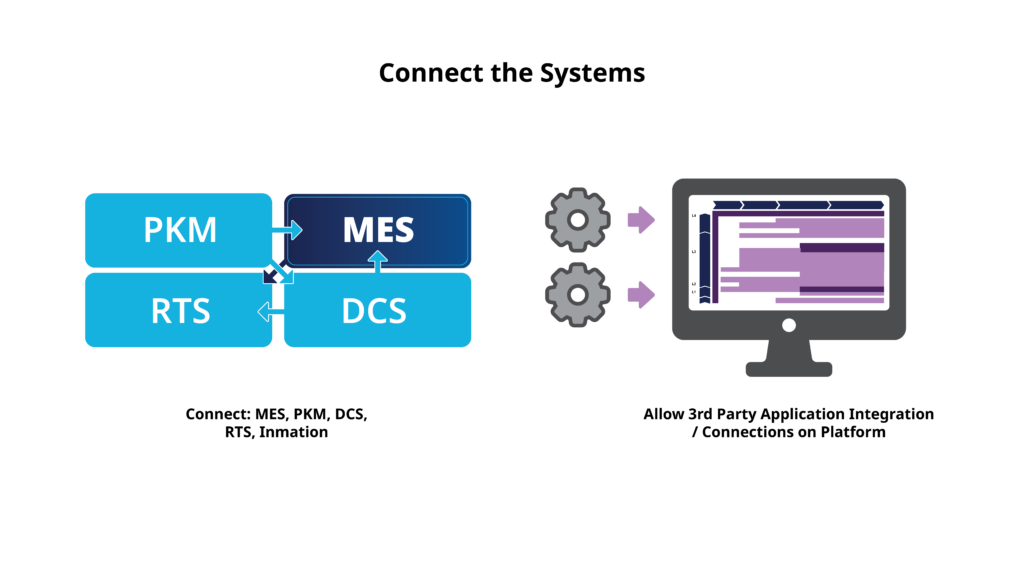
More importantly, those same AI tools will be built on decades of institutional knowledge, providing more reliable answers and supplying guardrails based on the principles that help life sciences organizations protect their business interests and the investments they have already made in their automation infrastructure. In instances where the MES is already designed to integrate seamlessly with other critical systems — DCS, PKM, ERP, for example — the AI technologies will interact seamlessly with those systems as well, making it possible to scale more efficiently and effectively (Figure 3).
Building a future-ready MES with strategic integration
To maximize the transformative potential of AI in MES environments, manufacturers need solutions that don’t rely on bolt-on fixes but instead embrace native integration with well-established automation ecosystems. A seamless data fabric provides the foundation for empowering MES with improved interoperability, making it a cornerstone of future-ready, flexible MES automation in life sciences.
The industrial data fabric acts as a connectivity backbone, creating a seamless data highway across MES, DCS, ERP, historians and AI tools. By introducing standardized International Society of Automation (ISA) 95-inspired models into the fabric, MES workflows gain shared context, transforming siloed systems into unified automation ecosystems to deliver real-time insights and scalable flexibility from research and development, all the way to GMP-compliant production.
The most advanced solutions leverage a boundless automation vision for seamless data mobility that enables modular growth by bridging the IT/OT divide. This ensures MES systems interact fluidly across enterprise and shop floor processes, without sacrificing customization or multi-vendor collaboration. Together, these strategies position MES systems as more than a standalone tool — they become an integral, scalable solution for driving smart automation, flexible workflows and actionable AI integration across the entire treatment development pipeline.
Built for purpose means built for success
AI technologies can be used to improve the capabilities and the usefulness of an MES, but only if those technologies are designed as an integrated part of an already powerful and flexible MES solution. An AI-generated solution is only as good as the systems it uses for implementation and the data it can pull from those systems, hence the need for built-for-purpose AI tools that are part of the organization’s existing system to avoid adding complexity, along with roadblocks to success.
With such a solution in place, operations teams can preserve their workflows and ability to scale up and scale out across the treatment development pipeline — both critical differentiators necessary to capture competitive advantage and get treatments into the hands of patients as quickly as possible.
Kristel Biehler is the vice president of life sciences at Emerson. Edited by Sheri Kasprzak, managing editor of Automation & Controls, WTWH Media, [email protected].