Manufacturers are bridging IT and OT systems using manufacturing execution systems (MES) and manufacturing IT strategies, with a focus on data context, integration challenges and phased implementation approaches.
MES architecture insights for manufacturers
- Manufacturing execution systems (MES) require data collection to data context to operate effectively in a connected environment
- When implementing MES software, architecture decisions are required that require tradeoffs and flexibility.
- Legacy OT systems can be integrated without major disruption, including cybersecurity; alignment among stakeholders helps.
For decades, manufacturing networks and business systems operated in largely separate worlds. The plant floor was the domain of operations and control engineers, while enterprise systems were owned and managed by information technology (IT). Data moved between the two, though often in limited, delayed and highly structured ways. Manufacturing execution systems (MES) can help.
The separation between the plant floor and the enterprise has decreased over time. Today, manufacturing networks are frequently managed or co-managed by IT organizations, bringing more advanced capabilities in networking, infrastructure and cybersecurity. Demand for real-time operational visibility has increased across the business; plant managers, engineers and executives expect to see what is happening in production environments as it happens, not in reports generated hours or days later.
The challenge may not be collecting data, as many facilities have been doing that for decades, although some industries are still playing catch-up in this area. Instead, it’s getting the right data into the hands of the right people in a form that supports timely decision making.
From data collection to data context, distributed control systems (DCS)
Many manufacturers already have large volumes of data available. In some industries, particularly petrochemical and other DCS-centric environments, the issue is finding the right data within what they have already recorded. Engineers and operators can find themselves navigating a sea of information without a clear path to actionable insight.
These users don’t typically need recipe management. Their DCS does that for them, but key performance indicators (KPIs) and connectivity to other manufacturing and business systems may be limited or nonexistent. Even if the connectivity exists, the hub for this data shouldn’t be at the control system level from either an operational or cybersecurity standpoint.
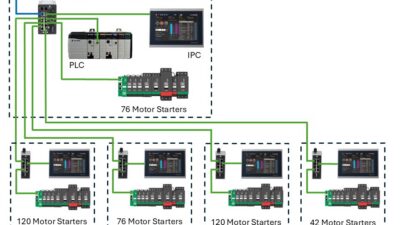
Other sectors face a different problem: disconnected data sources. Discrete manufacturing environments built around programmable logic controller (PLC) -based systems often consist of skids and equipment from multiple vendors, each with its own control system and data structure. In these cases, the data from various work cells may exist at the equipment level but has not been aggregated, standardized or contextualized across the facility.
Getting that data off individual machines and into a unified structure remains a significant challenge. Without consistent naming, a unified namespace, common data models and centralized access, it is difficult to generate meaningful KPIs or identify system-wide constraints.
This divide often reflects how individual systems were designed: DCS platforms were built with integration and data sharing in mind, while many PLC-based systems were not. Solving this disconnect requires intentional architecture and integration effort.
Role of MES in a connected environment
Manufacturing execution systems are often positioned as the solution to these data connection challenges. MES is best understood as a platform that connects systems, aggregates data and enables coordination across functions. MES can support a wide range of capabilities, including:
- Equipment performance and KPI tracking
- Production scheduling and sequencing
- Batch management and recipe control
- Integration with maintenance and laboratory systems.
One of the first questions to address in any MES initiative is what functionality is needed. Organizations should also evaluate what capabilities already exist in current systems to avoid duplicating functionality unnecessarily. A facility looking to improve uptime and identify bottlenecks may prioritize performance dashboards and asset utilization. Another plant may need to focus on batch management or production planning to eliminate manual scheduling, improve production sequencing, and better coordinate resources across operations.
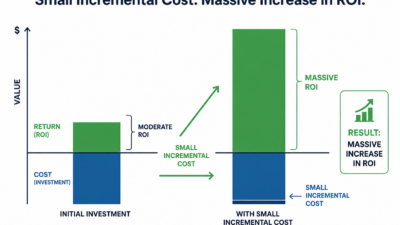
Attempting to implement every MES capability at once is an expensive upfront investment and introduces risk and complexity, and delays return on investment. A more effective approach is to prioritize specific use cases and implement them incrementally, allowing organizations to begin realizing value earlier.
MES implementations also change how operators interact with equipment, how maintenance teams respond to issues, and how production is planned and executed. Those changes require alignment across multiple areas of the organization. An MES investment is not just a technological change but an organizational change.
Architecture decisions: Flexibility, tradeoffs
Organizations must decide between an off-the-shelf MES system and a custom-built solution, weighing the benefits of an established framework and vendor backing versus the greater flexibility of a custom solution.
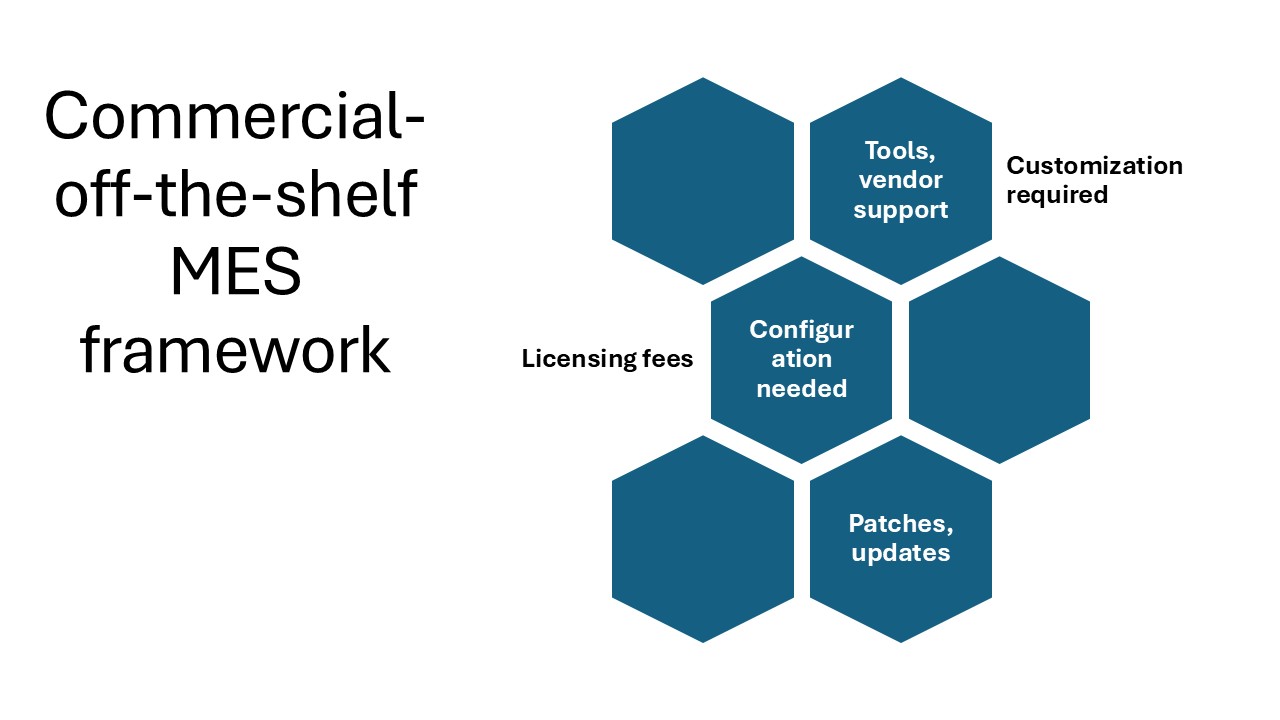
Commercial off-the-shelf (COTS) MES systems provide a framework with established tools and vendor support, complete with patches and updates. A common misconception is that commercial MES platforms are turnkey solutions. They are more like a framework that still requires configuration and customization to align with specific operational needs. The core capabilities are present, but significant effort is still required to configure workflows, data models and user interfaces. COTS systems also typically require annual licensing fees to the software vendor.
Custom-built MES solutions offer greater flexibility as they can be tailored to exact requirements and avoid some of the constraints associated with commercial platforms. In addition, organizations avoid ongoing MES vendor fees. The flexibility of a custom solution includes tradeoffs, including long-term support considerations and the need for specialized knowledge to maintain and extend the system.
The right approach for an organization depends on the scope of the problem being solved. Facilities that need a broad range of MES functionality may benefit from a commercial platform, while those targeting a smaller set of capabilities may find a custom solution to be better suited.
Integrating OT legacy systems without major disruption
Manufacturing operational technology (OT)/IT projects are not strictly software or networking initiatives; they often require physical changes at the process level.
A significant portion of manufacturing infrastructure consists of legacy equipment, and connecting these older OT systems to modern IT environments is a technical challenge.
Interface modules, protocol converters and edge devices can bridge communication gaps between older controllers and modern networks. These solutions are widely available and can typically be implemented without major disruption.
A larger limitation is often the data itself, as older equipment may provide limited process visibility, particularly for analog data such as temperature, pressure or flow. Systems built primarily around discrete signals can indicate whether equipment is running but provide little insight into how well it is performing.
These efforts often extend beyond software and networking. Expanding visibility may require additional instrumentation. Installing sensors to capture process conditions can significantly enhance the value of an MES or data platform by enabling deeper analysis of performance, quality, and resource utilization. In addition to classic instrumentation, there are a variety of minimally invasive wired or wireless instrumentation technologies ideally suited for retrofit situations.
Cybersecurity, connectivity with integrated systems
Cybersecurity remains a central concern as systems become more connected and, in some cases, concerns about risk can delay or prevent integration efforts.
Legacy equipment does not always support modern security practices, though that does not preclude secure connectivity. Network segmentation, industrial firewalls and unidirectional gateways, also known as data diodes, can be used to limit exposure while still enabling data flow.
Addressing cybersecurity early reduces the likelihood of design rework and helps ensure that connectivity does not introduce unacceptable risk.
Execution, organizational alignment: software works better when stakeholders align
Technical challenges in MES and manufacturing IT/OT projects are typically solvable, but execution issues often stem from organizational factors. Successful implementations involve stakeholders early from across the operation, including production, maintenance, engineering, and IT. Each group interacts with an MES differently and will experience different workflow impacts.
Some users benefit directly from improved visibility and decision-making tools, while others may see additional responsibilities without obvious personal advantages. In some cases, those users may view the changes as added burden rather than benefit. Those differing perspectives need to be addressed during planning so that all affected parties see the benefits to the larger organization.
Clear communication of the future state, along with adjustments to roles and responsibilities where needed, can benefit alignment. In some cases, that may involve redistributing workloads or redefining job functions.
A phased implementation strategy also reduces disruption. Pilot projects allow teams to validate architecture, resolve integration issues, and refine workflows in a lower-risk environment before scaling across a facility or multiple sites.
Moving forward with manufacturing IT/OT, MES
Investment in manufacturing IT/OT and MES platforms continues to increase as vendors deliver more flexible, accessible tools and manufacturers seek greater visibility and control over their operations.
Paper-based tracking and delayed reporting are giving way to real-time dashboards and integrated systems. Information is becoming more accessible across the organization, from the control room to the executive level.
The path forward is defined by how effectively systems are integrated, how well data is structured, and how successfully organizations adapt their processes to use that data. Manufacturers that take a measured, use-case-driven approach can build systems that deliver value without introducing unnecessary complexity.
Heath Stephens, P.E., is automation solutions director at Hargrove Controls & Automation, a CSIA Certified Member. Edited by Mark T. Hoske, editor-in-chief, Control Engineering, Arrowfly, [email protected].
Keywords
Manufacturing execution systems, MES, OT/IT
Consider This
Can you integrate older OT systems with newer MES software to optimize the plant floor?
You also might like
Also read this from
Securing the last line of defense: cybersecurity in safety instrumented systems