
How DRM engineered five high-speed automotive glass encapsulation lines in parallel, compressing years of automation work into a single aggressive launch window.

Glass automation insights
- DRM rapidly engineered five high-volume automotive glass encapsulation lines in parallel, condensing years of automation work into a single year.
- Standardized designs, cloned programming and modular tooling enabled speed, flexibility and high-mix production while keeping labor under 5% of cycle time.
- The result was a scalable, safety-focused system producing more than 2.5 million glass units annually, proving the value of standardization, lean execution and long-term collaboration.
Laying the groundwork: From empty shell to 2.5 million glass units per year
DRM’s partnership with a tier-one automotive glass supplier with global operations began nearly a decade ago, but the recent five-line expansion in the southeastern U.S. marked a new chapter in scale, complexity and execution. Around 2015, the manufacturer was establishing U.S. operations in a shuttered automotive facility in Ohio. After observing DRM’s equipment in action at a supplier’s facility, the client engaged them to automate glass processes. DRM developed the client’s first PVC and polyurethane encapsulation lines from the ground up, automating a production step that, until then, had only been done manually at the client’s overseas facility.

That initial scope included multiple lines across two sites, delivered nearly simultaneously. The systems enabled the manufacturer to meet U.S. labor and cost demands while achieving high-throughput, consistent quality and low operator count. Over time, DRM expanded those capabilities, adding plasma treatment, in-mold hardware insertion and smart sensor integration. Through this process, DRM has become a long-term automation partner, supporting the client’s evolving needs in encapsulation and robotic glass handling.
That foundation of trust, technical execution and system evolution paved the way for a bold new challenge: to engineer five new, high-volume lines and deliver them within a single year to meet increased complexity, part size and precision demands.
Parallel design and lean execution
With high throughput targets and tight space constraints, DRM committed to speed and standardization from the outset. The engineers established a repeatable controls and mechanical platform before CAD work began:
- Safety-rated controllers with integrated zones simplified support.
- Six-axis robots on floor rails (seventh-axis robots) increased payload, range and simplified simulation.
- Ethernet-based valve banks reduced wiring and boosted diagnostics.
- Barcode and vision systems unified the sensing interface.
- Quick-change EOAT couplers sped up future changeovers.
- Visualization and data collection software gave the operators a window into the operation of the system while collecting build data for quality control.
Building a single-encapsulation line typically takes nine to 12 months. Several key strategies kept the five-line project moving quickly:
- Programming the first line fully, then cloning code with minimal adjustments for the others.
- Splitting fabrication between in-house teams and local shops to speed up builds.
- Standardizing designs to simplify future changeovers.
Smart use of operators
Fully-automated glass unloading was explored but ruled out. Vision-guided robots could remove paper and racks, but at high cost. Instead, DRM and their partner made the collective decision to keep the model lean:
- One operator loads glass and primer.
- Another handles brackets, unloads parts and inspects.
This setup kept labor under 5% of cycle time while retaining flexibility and quality checks.
Designing tooling for rapid scaling and high mix
With a wide mix of glass parts and a compressed build timeline, the focus was on tooling that could be built fast, adjusted easily and duplicated cleanly.
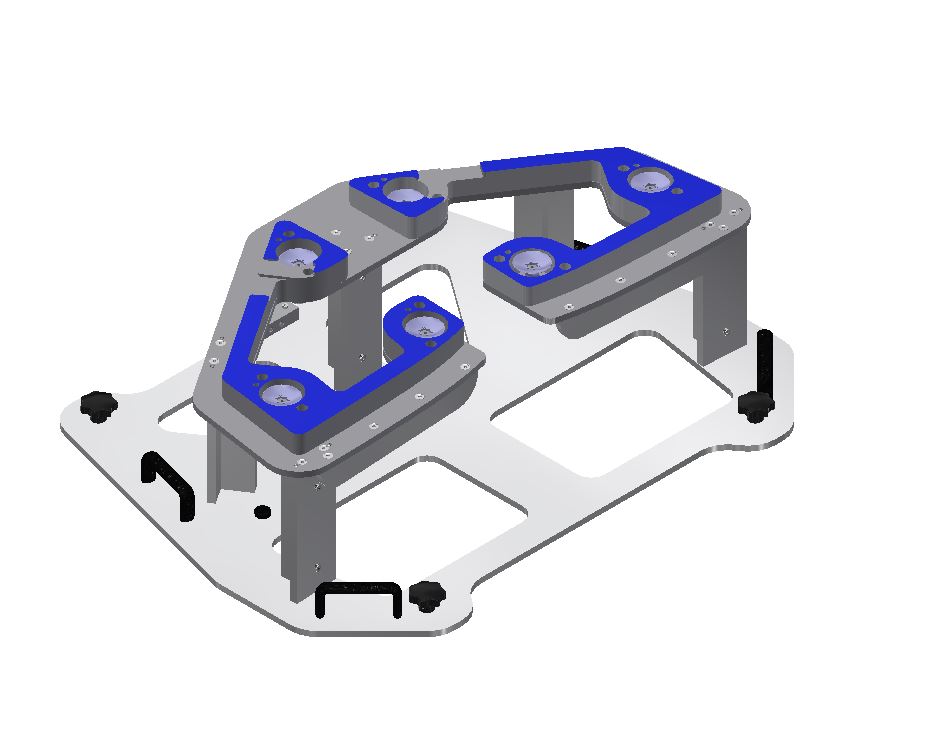
Switching from steel to structural aluminum tables shaved weeks off fixture builds without sacrificing precision. Each table held a modular nest — precision-machined tooling that located and supported each unique glass part. These nests could be quickly swapped across lines to accommodate different parts with minimal downtime, making the system flexible enough for high-mix production without constant rework.
Key innovations included:
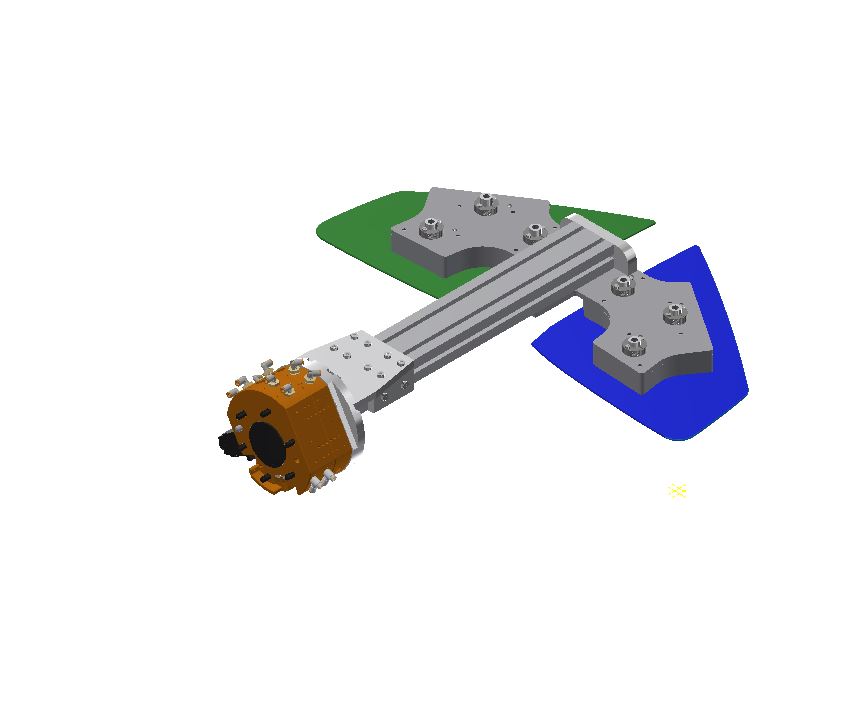
- Three-in-one robot tooling: One EOAT loads brackets, picks raw glass and unloads finished parts, eliminating a robot per application.
- On-tool plasma activation: Boosted primer bond strength without chemical wipes.
- Pre-press conditioning buffers: Stored glass to specific temperatures before molding and helped smooth part flow to presses.
- Full traceability: Every step was scanned, recorded and linked to the final part.
Safety systems designed into the process flow
From the outset, the plan integrated safety: light curtains, gate switches, safety-rated PLCs and e-stops throughout. Divided zones allowed one station to be maintained, adjusted or upgraded while other parts of the line continued running.
Consistent leadership and collaboration
DRM kept the same engineering core from design through install. The customer assigned a bilingual liaison, smoothing cross-team communication and reviews with foreign stakeholders.
How to evolve automation
Automation can evolve with each new automation cell. This includes methods and tools to improve machine precision features inside the urethane edge. Other collaborative advances include alignment features and automated clip and stud loading. A modular automation platform allows fast rollout of these upgrades across lines.
Results at a glance
- Cycle time: 60 seconds encapsulation, 90 seconds total flow.
- Labor: Two operators per PVC line (<5% of cycle time).
- Traceability: Full part genealogy through scanning.
- Changeover: <10 minutes for tooling, <30 minutes for fixtures.
- Throughput: >2.5 million glass units annually.
- Footprint: Fits within 40m x 8m per PVC cell.
Step-by-step: A look inside a PVC encapsulation line
The system combines robotics, motion control and precision tooling to produce a finished encapsulated glass unit. Each step is engineered for control, consistency and speed, and designed to evolve with future upgrades.
- Manual rack load: Operator places glass onto a bi-directional turntable.
- Centering and scanning: Robot orients the glass unit; vision system verifies barcode, orientation and tint (clear, solar or privacy.)
- Robotic priming: Robots apply primer, eliminating floor systems and saving $15,000 to $20,000 per station.
- Buffer zone: Twin racks decouple priming and molding zones.
- Heating/humidity control: Radiant heaters for PVC; humidity chambers for PU.
- Encapsulation: Robot loads glass into press with full traceability.
- Post-process: Robots scan for completed parts and place them on an exit conveyor for inspection. On PU lines, molding flash is automatically collected and recycled to reduce material waste.
- Pack-out: Operator scans and racks the finished glass unit.
One five-line cell can produce more than 2.5 million glass units annually.
Closing lessons: Automation built for change
Five high-volume lines in one year, built from scratch, for high-mix automotive glass is no small feat. It was a massive undertaking with tight timelines, high part variability and zero room for missteps. Achieving this milestone took years of lessons in tooling, integration and process design. That foundation was built over nearly a decade of partnership, learning the client’s product, refining the process and proving out each step. For manufacturers looking to compete on speed and flexibility, the takeaways are clear: Standardize where it counts, design for real-world production and build on what works.
Encapsulation 101: The process behind the project
In automotive glass manufacturing, “encapsulation” refers to over-molding a flexible polymer frame directly onto the edges of a glass panel. This process forms a gasket-like seal that bonds permanently to the glass during a molding press cycle.
The molded frame serves three purposes:
- Weatherproofing: Seals the glass to the vehicle body.
- Structural integration: Adds clips or studs for install-ready parts.
- Aesthetics and safety: Hides sharp edges and improves appearance.
The lines DRM engineered are known as encapsulation lines because the entire system revolves around this process. Two different molding methods are used:
- Polyvinyl chloride (PVC) injection molding: Common for smaller glass parts. It produces rigid but paintable seals.
- Reaction-injection molding (RIM) with polyurethane (PU): Used for larger parts like backlites and sunroofs. It creates flexible, durable seals.
Automation is critical for three reasons:
- Tight tolerances: Curved glass panels vary by 1-2 mm, so robot guidance must be precise.
- Fast cycle times: One part must be completed every 60 seconds.
- Process complexity: Each line primes, cures, molds, trims and inspects with minimal labor.
Because the molded gasket defines the process, the entire production system is commonly referred to as an “encapsulation line” in the industry.
AUTHOR
Jason Cannon, project manager, DRM, leads automation projects at DRM with a background in electrical, mechanical and controls engineering. He has been instrumental in scaling high-volume automation systems for the automotive and consumer goods industries.
LEARNING OBJECTIVES
- Managing high-mix glass variability using adaptive tooling and integrated sensing.
- Balancing cycle time, floor space and labor constraints in multi-material molding automation.
- Standardizing controls and mechanical designs to enable rapid scaling of duplicate lines.
CONSIDER THIS
How can standardization and modular design accelerate complex automation projects while maintaining flexibility for future change?