
Digital cognition technologies will drive safer operations, better performance in complex environments and bridge the skills gap.

As artificial intelligence (AI) makes its way onto the plant floor, manufacturers can expect a shift in how industrial control systems work. Honeywell is embracing this inevitable change in process automation with a new name, a new leader and new technology directions.
Last year, Honeywell announced its plan to pursue a full separation of its automation and aerospace businesses, which, coupled with the previously announced plan to spin out advanced materials, will result in three publicly listed industry players with distinct strategies and growth drivers. Around the same time, Honeywell announced the appointment of Jim Masso as president and CEO of Honeywell Process Automation, a role he has held since July 2025.
Fast forward to earlier this month, Honeywell announced the new brand identities for its automation and aerospace businesses ─ Honeywell Technologies, a pure-play automation business, and Honeywell Aerospace. These will become two independent, publicly traded companies on June 29, 2026, when Honeywell spins off its Aerospace business.
“We are separating them with the intent to have much more purpose-driven companies,” Masso told Control Engineering in an interview.
Also this month, during the annual Honeywell Users Group (HUG) in Phoenix, Masso introduced Experion Cognition, an AI-enabled platform integrated with Honeywell’s distributed control system (DCS), Experion Process Knowledge System (PKS), that uses operational intelligence to detect and resolve anomalies in the control room, makes recommendations to guide operator workflows and decisions, predicts alarm incidents, and ultimately optimizes operations and increases safety within industrial facilities.
As agentic AI proliferates across the plant, applying this decision-making technology to Experion PKS is the next step in the evolution of control operations. The goal of the latest technology developments is to move operations from automated to autonomous.
“As the industry changes, as the pressures on our businesses change and as global tensions raise around the world, there’s a need for stability like never before in industry,” Masso told the HUG audience during his keynote presentation. “Which has given way to our most advanced ever DCS capability, Experion Cognition system.”
Honeywell has embedded software into the control system that combines in-depth process automation expertise with AI models that use autonomous agents to proactively resolve issues. Available later this year, the platform has been tested at Borouge Group International AG’s petrochemical facility in Abu Dhabi.
“The first ever autonomous control room literally running a petrochemical facility with no operator intervention,” Masso said.
According to Honeywell, in multiple pilots the platform was able to make predictions an average of five-to-ten minutes before alarm incidents. And in the Borouge live proof of concept, the companies reported potential improvements of 20% higher efficiency, 20% less downtime and 15% lower operating costs. The technology also enhances process safety and supports more sustainable operations by significantly reducing energy consumption and associated emissions.
Not only does this solve problems faster and improve productivity and uptime, by delegating those cognitive tasks to autonomous agents, Experion Cognition helps enable less experienced operators to run plants with comparable knowledge as that of a seasoned colleague, Honeywell said.
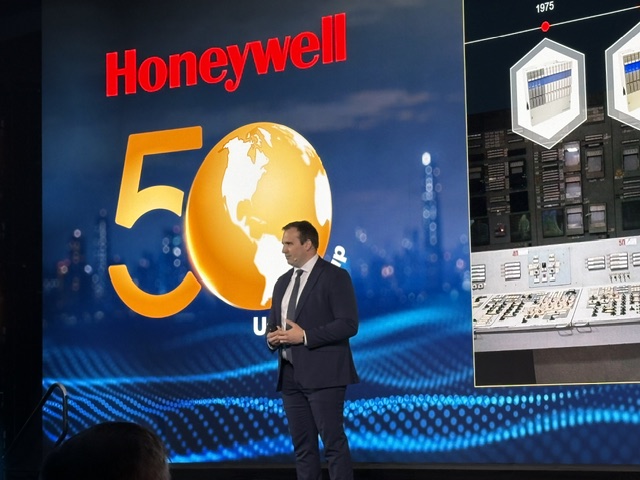
The introduction of Experion Cognition at HUG—which celebrates its 50th anniversary this year—was just one of the strategic announcements made as the company also provided updates that impact engineering, plant maintenance, predictive services, the use of digital twins and cybersecurity capabilities.
A (quick) look back at the history of the Honeywell DCS
The Honeywell DCS journey started with the TDC 2000 that moved people from monitoring analog panel-based controls to a digital-first environment with distributed controls and a human machine interface (HMI) that overlayed complex processes. By the mid 1980s, the TDC 3000 rolled out with visualization and new applications. By the 2000s, Experion PKS was announced, a process knowledge system that was intelligent and could influence plant-wide throughput, reliability and efficiency. In 2019, Experion PKS Highly Integrated Virtual Environment (HIVE) arrived, decoupling the assignment of I/O modules and control strategies from specific controllers. It also allowed for modular project engineering. The notion of virtual control that solved the problem of load balancing and enabling control to move from one hardware generation to another.
Fast-forward to 2025 when the concept of Experion Cognition was introduced.
“Imagine for a moment an industry that’s dramatically safer. Imagine, process plants where every day is your best day of production. And imagine an environment where every person has world-class expertise at their fingertips. It’s not only possible, it’s happening, and we call that digital cognition,” said Honeywell Industrial Automation CTO Jason Urso during his keynote address.
More specifically, Honeywell is combining the decades of precise control of equipment with AI to help provide guidance to operations staff, particularly during transitory conditions where human intervention is required. “We call this probabilistic AI built into the control system Experion Cognition,” Urso said. “It’s like having the company’s best expert at the operator’s side, helping someone less experienced perform as if they had 30 years of experience.”
Engineering a new generation of tools
The cognition techniques embedded within Experion are also being applied to engineering tools. “The future of engineering your Honeywell Experion Cognition system is going to change,” said Joe Bastone, director, growth initiative leader at Honeywell Process Automation. “And it’s going to be completely revolutionary.”
According to Bastone, the Honeywell team is calling this feature, still in development, “vibe engineering” as it is using natural language and generative AI as a basis to engineer projects for better overall speed of execution, reduced effort, better accuracy, fewer changes, and an optimized hardware footprint.
The AI agent allows a conversational approach to engineering. Make a request, such as: “I want to add another boiler to my existing control system. Using existing boiler three, take the controls logic, the HMI alarming trends and reports as a starting point for boiler four.” Behind the scenes the AI agent is reasoning, which the engineer can see taking place to check or refine the rules.
These are pre-trained, ready-to-use control schemes built on Honeywell’s deep record of how systems should run, and they keep improving over time. “It’s going to save a huge amount of time and require less expertise to deliver new projects,” said Bastone. “Instead of weeks of effort for a project like this, we’re talking days of effort.”
Expanding plant intelligence
The cognitive capabilities continue with predictive capabilities that combine Honeywell UOP process knowledge in the refining, petrochemical, and gas processing industries with applications, such as advanced process control and asset performance management, to run plant operations at higher performance for longer periods of time.
If a plant manager is looking to maximize margins with existing assets, a performance predictor, built on UOP expertise and Honeywell Forge advanced analytics, brings process information together to digitally test all operating conditions to generate clear insights. This is called Plant Cognition.
In addition, Honeywell Digital Prime, built on Honeywell Forge, connects assets and proactively turns data into measurable value. Expanded beyond the control system to connect broader assets, Digital Prime’s new portal provides an overview of asset health, risk, and performance signals allowing users to drill down where needed. Issues are seen in context and holistically across sites vs. isolated alerts. This helps with migration and parts inventory.
As data is unified on the platform, AI accelerates diagnostics using a chat style maintenance assistant to shorten time to resolution. Project engineers also have the Digital Prime twin virtual lab environment to make changes without impacting production systems by combining the Prime control system twin with the process twin.
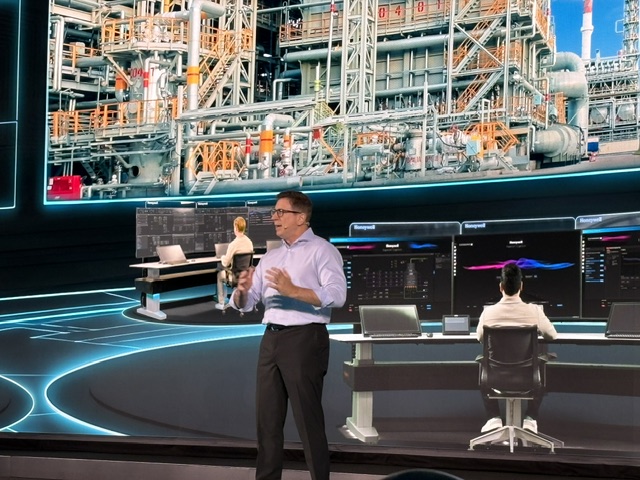
Honeywell Digital Prime is built to unlock financial value, optimize inventory and provide better migration and investment decisions, company officials said.
An AI analyst for cybersecurity
At last year’s HUG, Honeywell introduced a suite of AI-enabled cybersecurity solutions that can detect anomalies and provide actional insights. This year, the focus is on Cyber Insights, a software solution discovers and monitors all devices on the OT network, identifies vulnerabilities and the risk levels, and helps identify lingering threats within the OT environment.
But there are other cybersecurity concerns, specifically as it relates to compliance and regulatory requirements. During his keynote, Urso also introduced Cyber GRC (governance, risk and compliance), an enterprise-grade solution that assures compliance with multiple standards. It continually analyzes the underlying system configuration and compares it to approved compliance standards.
“So, now in real time, you can know confidently that your OT systems are in compliance with your cybersecurity guidelines in addition to knowing precisely where you need to make adjustments if a compliance risk is identified,” Urso said.
50 years of innovation
At the end of the month, when Honeywell Technologies launches as a more purpose-driven automation company, it will be connecting building automation with process control and quality control.
“One of the things we spoke about was bringing our UOP technology and embedding it directly into automation solutions,” Masso told Control Engineering. “So UOP, a hundred plus year history, Honeywell’s process automation business, a 50-year history, and these businesses haven’t created technology together. We’re finally doing that as a more purpose-driven company to be this large capable automation business. That directly maps to outcomes for our customers and allows us to do a lot of things.”