MESA’s research on “Making Manufacturing Analytics and AI Matter,” shows that companies using artificial intelligence (AI) are gaining benefits, sometimes quickly. Data challenges remain in feeding AI systems.
Industrial AI research insights
- Artificial intelligence and machine learning are creating benefits that matter for manufacturers in industrial applications, according to MESA research; 5 ways leaders are using industrial AI are bolstered by benefits and tempered by challenges.
- Data remains the foundation for industrial AI benefits.
- MESA survey and study recommends investments in AI/ML and methods are discussed.
Is it hard to benefit from artificial intelligence (AI) in manufacturing? The answer is: in some ways yes, in others no. MESA’s latest research program, “Making Manufacturing Analytics and AI Matter,” shows that companies using AI are already gaining benefits, sometimes quickly. However, these companies face significant challenges in reliably having the data they need to feed these systems.
AI for benefits that matter
These are difficult times for most manufacturers. Uncertainty reigns in supply, workforce, regulation, supplier quality, cybersecurity threats, competition, costs and more. In our survey of over 420 people from manufacturing companies, 100% report that some of those challenges are having a significant negative impact on their business.
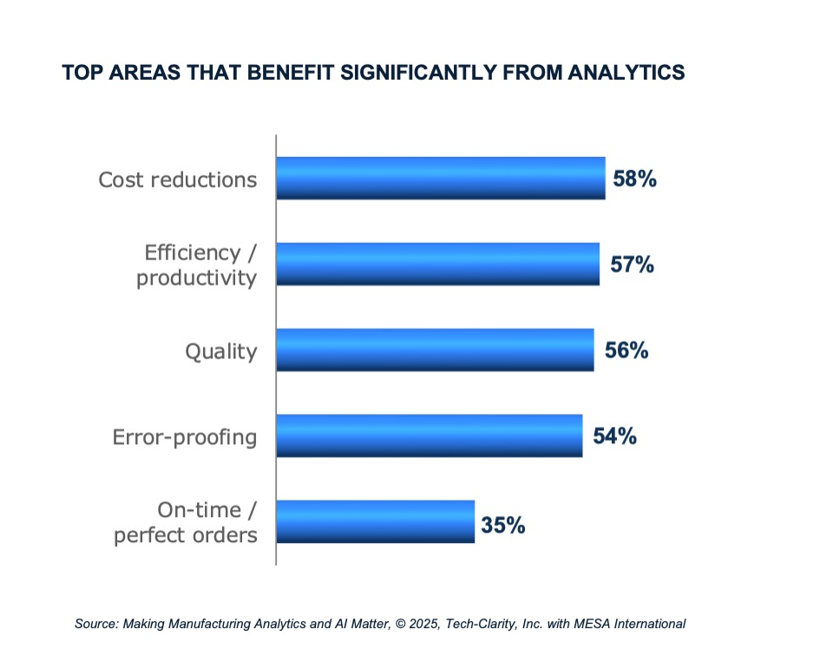
Fortunately, the same 100% are gaining benefits from their analytics and AI programs. The top areas that benefit significantly from analytics match very nicely to those challenges. Most respondents have achieved cost reductions, efficiency, productivity, quality and error-proofing. Over a third have seen an improvement in on-time perfect orders.
5 ways leaders are using industrial AI
Nearly every manufacturer is investing in operations, analytics or AI. The vast majority use predictive analytics (more than 4 in 5), and 25% use generative AI (GenAI). As always, not everyone has the same level of business success. To understand what matters, we sorted top performers versus others based on their ability to improve common operational metrics. The differences in operational metrics also showed better business performance.
What these leaders are doing differently from others:
- Investing in smart manufacturing, including analytics and all forms of AI
- Focusing on getting data to operations personnel for their decisions and tasks.
- Ensuring AI use cases are based on business value
- Seeking vendor-delivered analytics specific to their industry or embedded in applications.
- Being willing to experiment with analytics and AI, to begin the learning.
Predictive AI and machine learning (ML)
Can we use analytics to preempt problems and optimize the future? What does it take to go beyond reports that look at history and dashboards that describe current status to be proactive? Most manufacturers in this research have been using predictive analytics, such as machine learning (ML), for over a year. About half of the top performers have used predictive tools for over three years.
One thing top performers do differently is focus predictive AI on product and process quality. These are upstream and can cause customer-facing issues that others try to predict. Predicting quality problems is crucial to performance on business metrics such as on-time delivery and customer satisfaction, as well as cost of goods sold and profitability.
Top performers are also more likely to use a digital twin of the plant as part of their efforts to predict issues in manufacturing. This virtual representation of a plant enables safe offline problem forecasting. Digital twins also support what-if analysis for process and automation changes, taking simulation to the next level of realism and accuracy based on actual plant operations.
Challenges and benefits of predictive AI
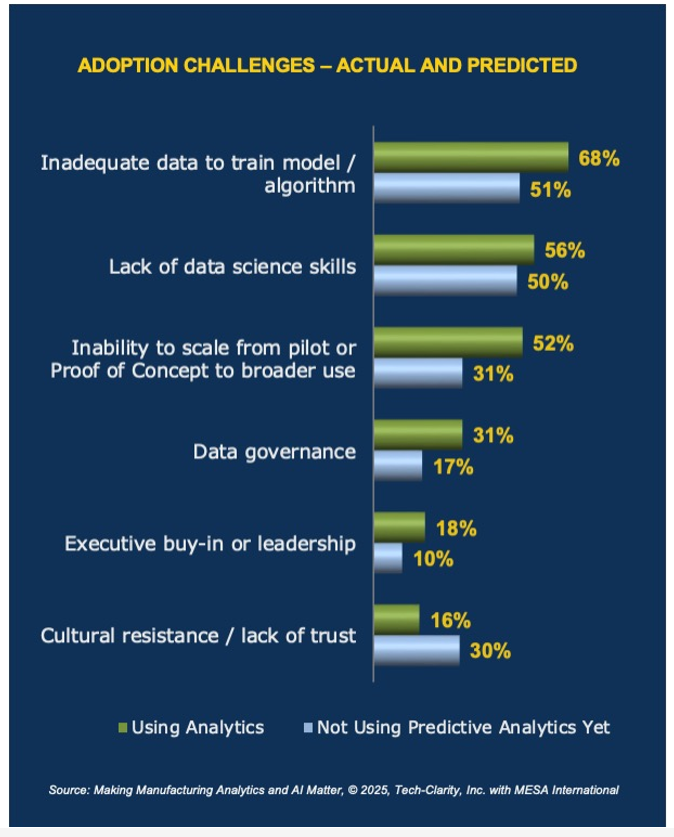
Seeing the future is hugely attractive in manufacturing. So, what’s holding companies back? The number one issue is gaining adequate data to train the predictive model or algorithms. Plus, these systems require data science skills that most manufacturers lack. Scaling from predicting a single thing in one plant to scaling more broadly is also a common challenge.
Manufacturers using predictive AI have typically reported benefits in a year or less. Apparently, the industry is quickly learning how to structure ML and predictive projects: those using it for a year or less are far more likely to gain benefits in three months or less. Most report better efficiency or productivity and error-proofing using predictive AI. Those using it longer also report cost reductions and quality improvements. Our experience is that problem areas vary per company and plant, so these predictive tools provide benefits based on need and application area.
Generative AI for industrial manufacturing
GenAI has been a hot topic of conversation for the past few years, and some manufacturers have an executive mandate to find use cases. While GenAI holds enormous promise and can deliver quick benefits, the mandate may be misguided, particularly in manufacturing operations. Solving problems often requires making sense of diverse sets of time-series, batch, parametric, or other data to support employees. GenAI is particularly good at language-based tasks. Top performers use it more for quality and safety, where instructions, standard operating procedures, forms, and checklists are common.
Top performers are more likely to select GenAI use cases based on business value. That’s not always as easy as it sounds. General-purpose large language models (LLMs) and tools typically search on publicly available information, which is often not where the best data for serving operations lies. Some of the manufacturers in our research use GenAI assistants or copilots embedded in the software they already use to ensure good use cases and access to relevant data, and top performers prefer this approach.
Challenges, benefits of GenAI
Is your data ready to feed into an employee’s assistant or copilot? Is it prepared to feed an autonomous digital AI agent? Probably not. Most manufacturers who have tried GenAI report issues with having inadequate data to train the model. They also report cultural resistance and a lack of trust in the GenAI. There may be a reason employees are skeptical: one in four have seen poor results or hallucinations. Nearly half cite data governance challenges in adopting GenAI.
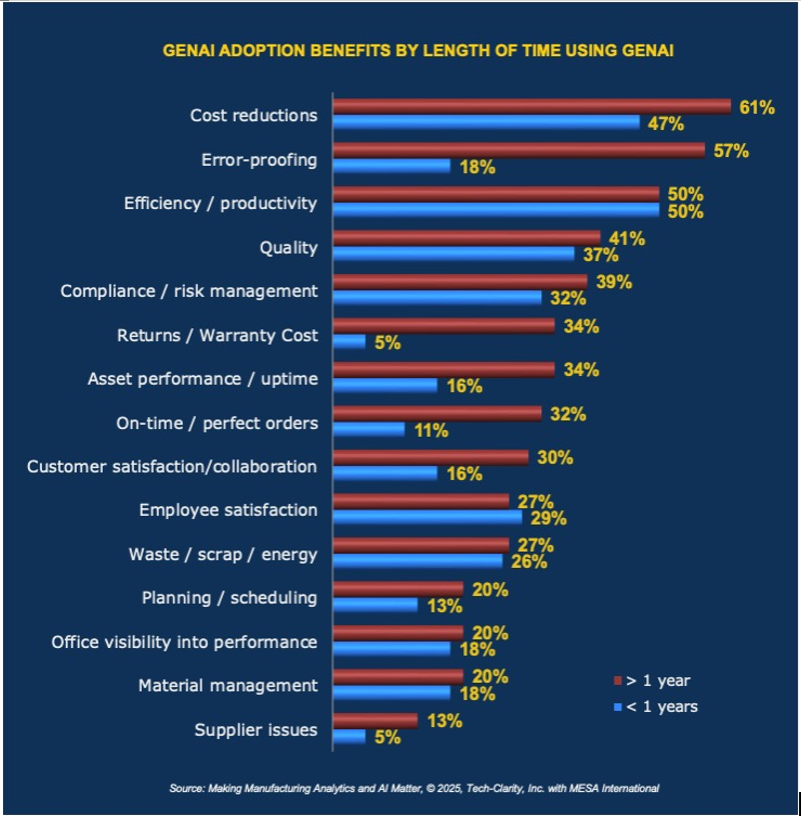
Again, the benefits are worth the effort to overcome these challenges. Over half of manufacturers using GenAI for over a year have gained cost reductions, error-proofing, and efficiency and productivity. This lines up with a typical thought about AI assisting, searching for and delivering data, and supporting a variety of tasks as copilots. About half of top performers gained benefits from GenAI in under six months. This is blazing speed for software to deliver benefits.
Data as foundation for industrial AI benefits
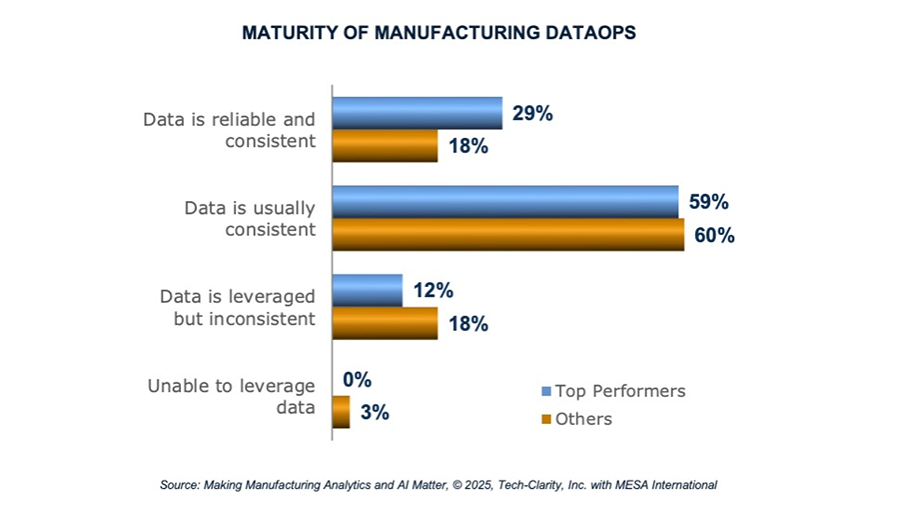
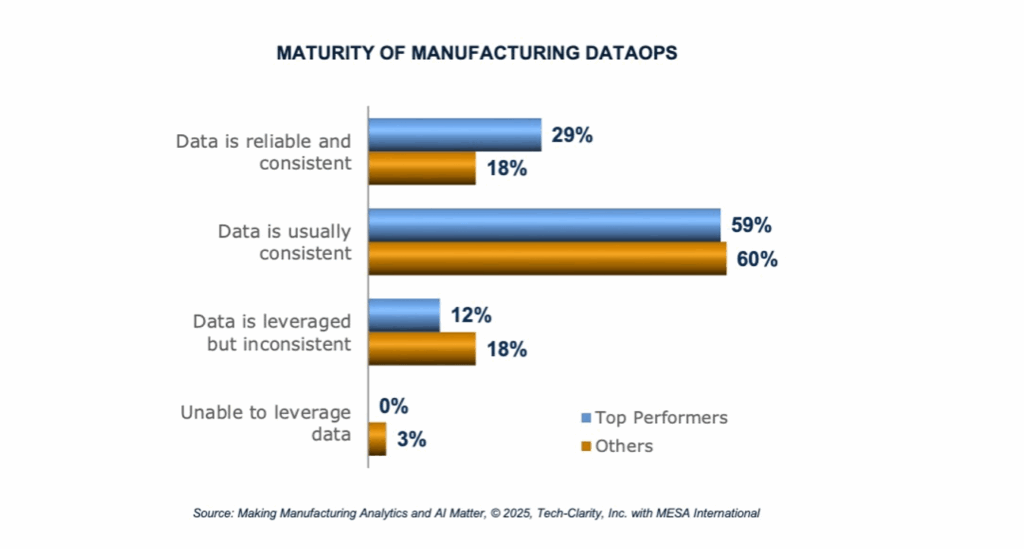
Is data quality and governance holding back AI progress? Absolutely. Less than a third of top performers report that their data is reliable and consistent. In any form of AI, data must be of high quality for the results to be valuable. Manufacturing DataOps needs improvement. A standard data model alone is insufficient to ensure that the data is consistent and reliable enough for AI purposes, or even for employees to trust.
Yet, this is not an insurmountable challenge—obviously, manufacturers have gained benefits from AI. We recommend starting by cleansing and creating structures and governance around the data needed for a specific high-value use case. Do the work with a view to scaling it to the entire operation, but start with what you need to gain a benefit.
It is time to invest in AI
Many manufacturers are already gaining the benefits of AI. With care, your company can launch a project and solve one or more key problems within the next year or even less. Some ideas to speed success are:
- Focus on what matters most to your business now, examine what type of analytics or AI would best solve it, and launch a small project.
- Prioritize AI use cases for upstream issues in the operation, such as quality and error-proofing, as they will have ripple effects on other operational and business metrics.
- Seek manufacturing and industry-specific AI software as a starting point.
- Leverage any AI that your existing software applications are adding.
- Consider investing in a digital twin of your plant(s) for predictive purposes.
- Prepare your data, your processes, and your people for the AI.
- Be ready to experiment and learn from every project to support a path forward.
MESA AI research back story
“Making Manufacturing Analytics and AI Matter” research was conducted by Tech-Clarity Inc., for MESA International. Program sponsors are Aegis Software, Arch Systems, Epicor and GE Vernova. The full report is available for MESA members or from the sponsors. An executive summary is available at https://members.mesa.org/ap/Form/Fill/pl8QoCBp.
Julie Fraser is vice president of research for operations at Tech-Clarity, MESA International lifetime member and facilitator of MESA’s Smart Manufacturing Community. Edited by Mark T. Hoske, editor-in-chief, Control Engineering, WTWH Media, [email protected].
Keywords
Industrial artificial intelligence, machine learning, research, advice
Consider this
Are you considering or expanding your use of industrial AI and realizing benefits?
You also might like
Learn more on AI from Control Engineering on this page.