Semiconductor and data center growth is boosting robot adoption, while AI tools are helping address programming and integration challenges.
The global industrial robot market grew in 2025, with shipments increasing 5.1% and revenue rising 0.8%, with most of the growth coming from Asian markets. Over the next five years, the market is expected to continue growing steadily as robots are used in more manufacturing processes and additional industries, and as AI-related applications contribute to demand growth. This insight examines how recent advances in AI are affecting demand for industrial and collaborative robots and how robot manufacturers are adapting their strategies to serve these applications.
Coming soon: Control Engineering 2026 research on AI and control systems. Find Control Engineering research at www.controleng.com/research. See more robotics coverage, including more from Interact Analysis, at www.controleng.com/robotics.
Two channels of AI-related robot demand
AI is influencing robot demand in two main ways. First, growth in AI-related supply chains is increasing demand for robots in manufacturing. Second, AI-based software is improving robot capabilities and usability, allowing robots to take on tasks that were previously difficult to automate and supporting adoption in markets where robot use had been more limited.
AI supply chains and robot demand
Growth in AI-related manufacturing is increasing robot demand across several segments:
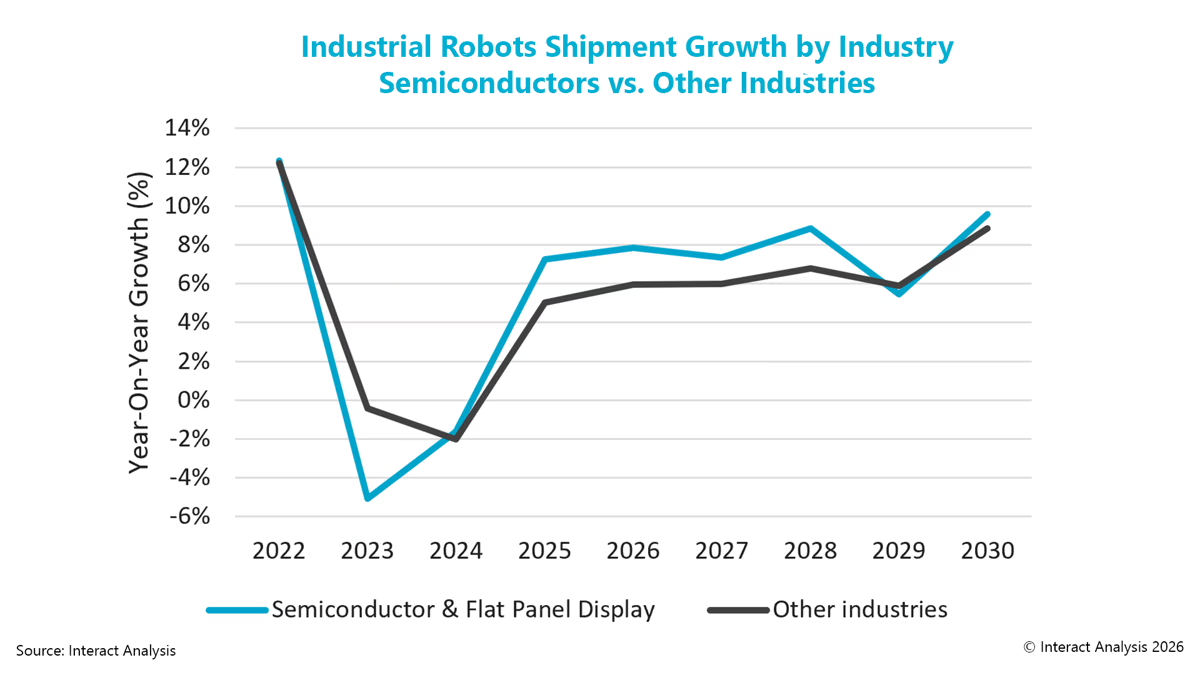
Semiconductor manufacturing: Demand for AI chip is contributing to increased automation in semiconductor production. Robot sales to the semiconductor industry are forecast to grow at an average annual rate of 7.8% through 2030, faster than many other sectors. Light-payload articulated and SCARA robots are expected to account for much of this demand. Mobile collaborative robots (mobile cobots) used for wafer handling are also seeing increased adoption. Demand for these systems is concentrated in Asia, particularly Taiwan, mainland China and South Korea. Suppliers in this segment include Universal Robots, Fanuc, Techman and Jaka.
Data center equipment manufacturing: Manufacturing of AI data center equipment, from server cabinets to printed circuit boards, is increasing demand for robots across the supply chain. In addition to traditional industrial robots, collaborative robots are being used more often for inspection and component handling because they can operate in shared workspaces and support flexible production tasks.
Humanoid robots as a cobot market segment for cobot suppliers: Cobot vendors are supplying robot arms to humanoid robot manufacturers, particularly in China, where some newer companies focus on software development while purchasing standard hardware components. Vendors serving this market include Rokae, Jaka and Fairino.
AI applications robot
At the same time, AI is improving robot improving robot functionality and usability. This is relevant because programming difficulty and integration complexity are commonly cited barriers to robot adoption. In recent Voice of Market research, integration complexity was identified as the leading obstacle to automating material transport in factories, ranking above upfront cost concerns.
AI is being applied in robotics in four main areas:
(1) AI-powered machine vision for robot guidance
(2) AI-enabled robot instruction and programming
(3) AI- based path optimization and multi-robot coordination
(4) Newer applications in remote robot monitoring and maintenance
AI allows robots to process and respond to natural language inputs and supports low-code or no-code programming, which can simplify robot operation. It also enables robots to perform tasks in less structured environments. For example, Fanuc demonstrated AI-based dual control of two cobot arms sorting cables, a task that has been challenging for robots, and showcased AI-based robots tracking moving parts for precision tasks such as screw tightening, illustrating how AI can support robot operation in variable conditions.
However, AI-based robotics remains at an early stage of adoption and continues to face technical and commercial constraints, including cybersecurity risks in remote monitoring, limitations of low-code programming for complex tasks and high R&D costs for AI-based software. Wider commercial adoption is likely to be gradual and will depend on further technical development as well as clear operational benefits across a range of industrial applications.
Robot vendors strategies
Robot manufacturers are responding to AI-related changes in demand in two main ways. First, they are introducing products intended for electronics and semiconductor industries. For example, ABB introduced its Lite+ small robot series in 2025, with electronics named as one of its target sectors, while STEP recently launched wafer handling robots.
Second, robot vendors are adding AI-based functions to their products, particularly in programming and simulation. For instance, Universal Robots and Fanuc have announced collaborations with NVIDIA to develop AI-powered robot programming and simulation tools.
These developments show that manufacturers are working to reduce common barriers to robot adoption, especially those related to robot integration and programming.
Conclusion
AI is becoming a source of demand growth and a contributor to expanded robot functionality in the robotics industry. The expansion of semiconductor and data center manufacturing is creating additional demand, while AI-based software is helping reduce some of e the integration barriers that have limited robot deployment outside structured environments.
In response, robot manufacturers are developing products for AI-related industries and adding AI-based functions to existing platforms. Ongoing discussions with industry participants will help track commercial adoption of AI-based robots and assess how AI affects overall robotics market growth.
Edited by Puja Mitra, WTWH Media, for Control Engineering, from an Interact Analysis news release.