End-users using flat-fee robotic services for packing, stacking and machine tending, eliminate related capital costs, engineering, automation specification, purchasing and maintenance, while lowering risks and training needs.
Robots as a service insights
- Eight reasons why the robotics-as-a-service model helps end users were offered at a headquarters opening.
- Insights offered by Formic experts answered comment robots as a service (RaaS)
- Robots-as-a-service options are described.
Robots as a service can help end-user applications seeking to avoid capital investments, engineering planning, purchases, training, start-up, maintenance and automation lifecycle challenges, replacing that with a flat monthly fee or even lower per month charges with a 3- or 5-year contract. A The no-capital cost automation model and 97% customer renewal rate has expanded the Formic footprint, robot fleet, offerings and customer base since its 2020 founding. Formic started in a small Chicago loft, grew into a 12,000-square-foot headquarters and now opened a new 53,000-square-foot headquarters, in June, in Bolingbrook, Illinois. The independently owned company also has a 20,000-square-foot site in Oakland, California.
Figure 1: Video shows robots holding and cutting the ceremonial opening ribbon at the new 53,000 Formic headquarters in Bolingbrook, Illinois. Shawn Fitzgerald, Formic chief revenue officer, thanked customers and others present. Courtesy: Mark T. Hoske, Control Engineering
At the ribbon cutting (by robots, Figure 1) at the suburban-Chicago location, the company entertained customers and media by operating standard robotic work cells, now under testing to be shipped within weeks to customer locations.
Eight reasons why the robotics-as-a-service model helps end users
Customers for end-of-line packing and stacking robotics services at more than 120 North American plants include Crown Bakeries, Connie’s Pizza, Georgia Nut, Land O’Frost, MattPak and Taylor Farms.
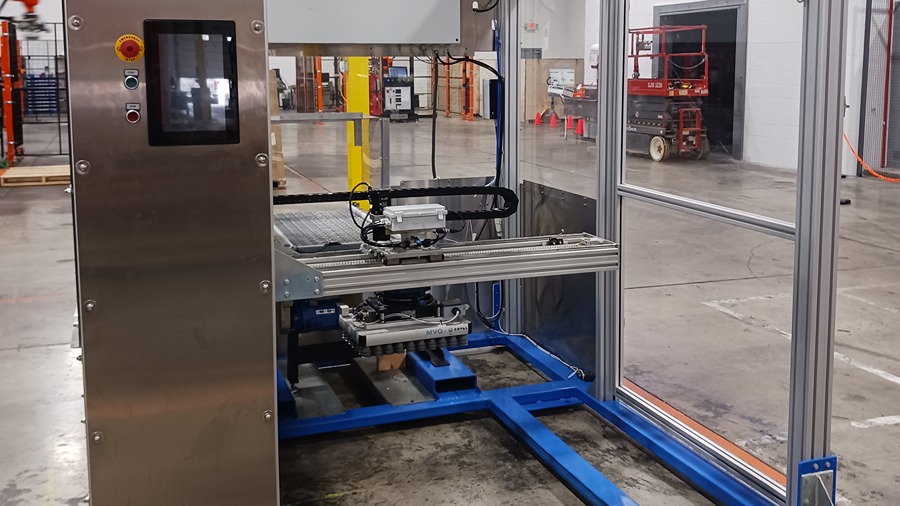
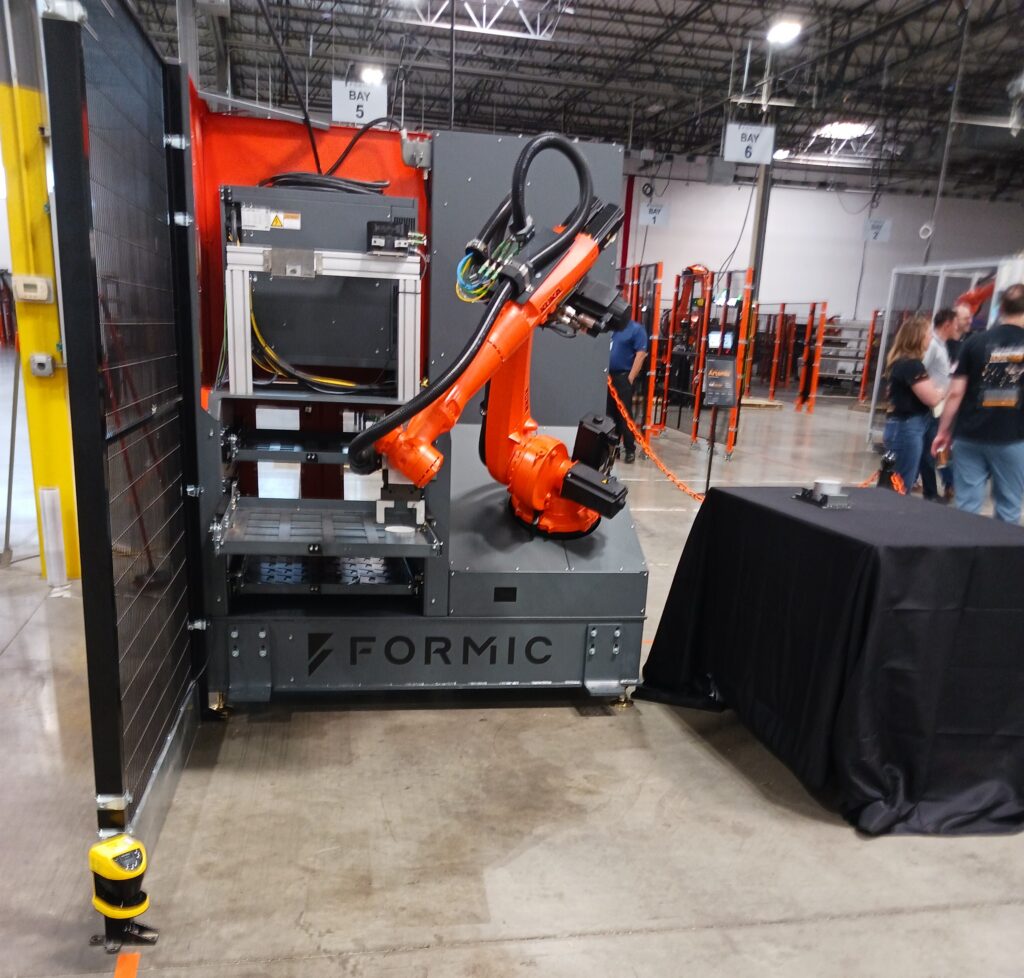
Existing applications include palletizing and case packing. New offerings include a machine tending workcell (Figure 2) and mobile robot that wraps plastic around a loaded pallet (Figure 3, video).
Figure 3: A video clip shows an autonomous mobile robot wrapping stacked pallet with plastic at the Formic headquarters ribbon-cutting event on June 11. Formic offers robotics as a service. Courtesy: Mark T. Hoske, Control Engineering
Formic is growing fast, driven by manufacturers’ needs, said Shawn Fitzgerald, chief revenue officer. Automation can be daunting for those without experience, expertise or bandwidth for what a successful automation installation requires. See eight answers on robots-as-a-service topics.
Safety and staffing: “Most often companies need help at the end of the line without enough humans available to do palletizing and case packing,” Fitzgerald said. Putting finished products into boxes and moving boxes onto pallets can cause humans repetitive injuries with bending, lifting and twisting. It can be boring and grueling work that no one wants to do for very long. One customer, he said, hired 225 workers for 170 positions because attrition was so rapid. Insurance costs may decrease when automation lowers human injury risks, he added.
Capital and robotic skillset: Many companies, by going with automation as a service, can invest available capital in improving the products they’re making, Fitzgerald said. Customer staff engineers may have more process experience than packaging or machine-tending robotic skills.
Automation efficiencies: Fitzgerald said robotics requires expert skills. “Most people who haven’t automated say: ‘I don’t know how to get started.’” The robots-as-a-service approach takes care of that. Training is included. Human-machine interfaces are intuitive and multilingual. Help is available 24/7, and 80% or more of calls can be fixed remotely without a site visit. No robot parts inventory is needed; Formic does all workcell maintenance. Robot fleet uptime is tracked in real time on the home page, late on June 12 shown as 99.3% in the last 12 months.
Return on investment: ROI typically works best with three shifts, though end-of-line staffing can be difficult even with one shift. Fitzgerald said the Formic customer hiring 225 end-of-line workers spent about $17,000 a month to do so. A robotic solution was approximately $6,000 per month, about one-third cost of three shifts. Robots as a service allow operations to continue at a lower cost, keeping humans safer and away from difficult, hard-to-fill applications.
Site assessment: Customers provide numbers on types, dimensions, weights, types of products and desired throughput, said Nick DeLong, vice president of automation engineering. Most projects have 12-week lead time to operation, likely less than a from-scratch robotics application for a similar application. Formic robot experts visit the location to ensure the workcell fits the location. Perhaps one-third will undergo some workflow or layout change to accommodate the automation. Some older sites, Fitzgerald said, may want a faster industrial robot, but can only fit a smaller collaborative workcell, or none because of too-small end-of-line layout. The collaborative robot workcell has a mobile option where it can be rolled to another application. Often customers save time and effort by ordering a second workcell rather than moving it, DeLong said.
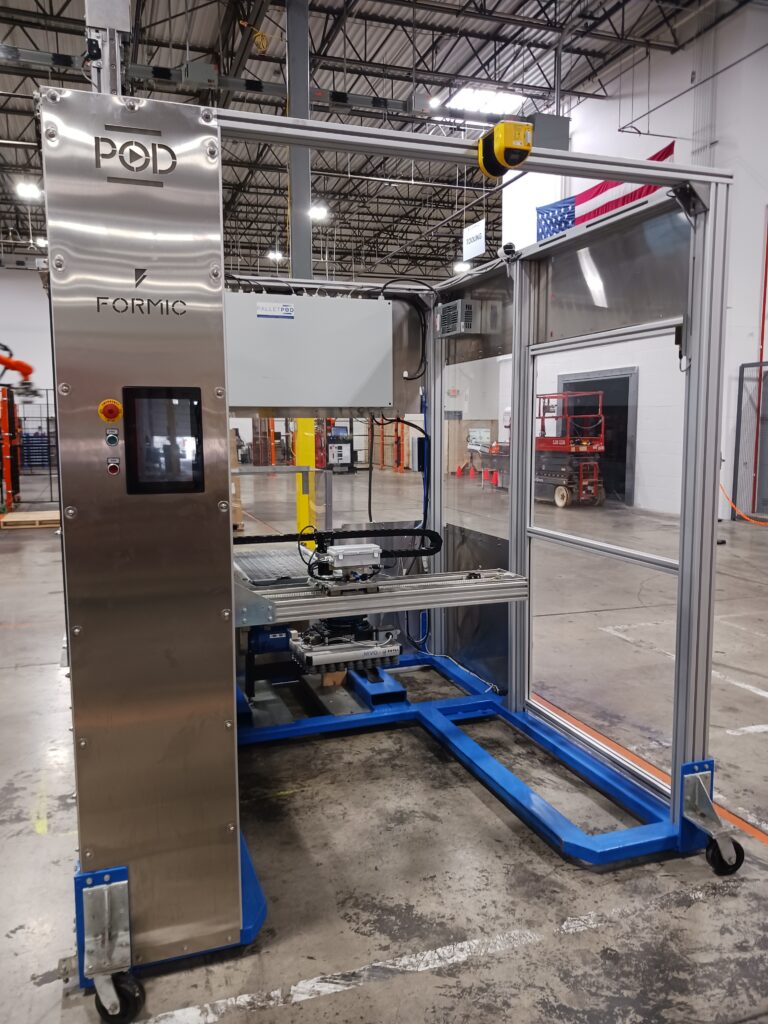
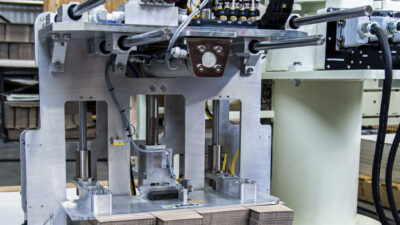
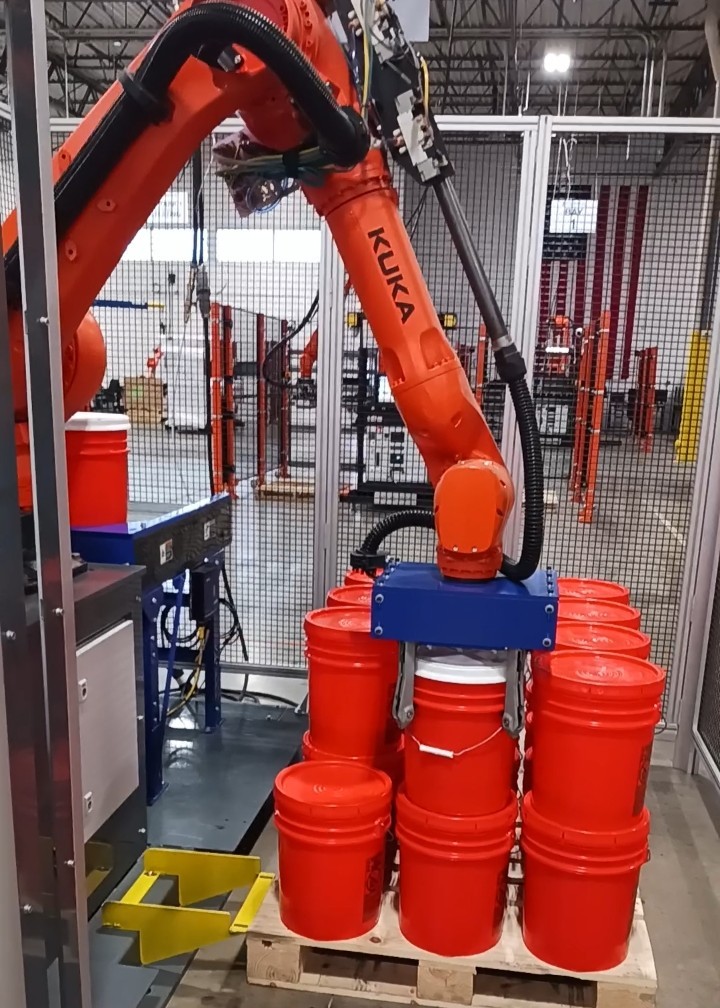
Technologies without maintenance: End-of-arm effectors, the robot attachments that touch the process, are available commercially, but Formic has found success by reliably designing its own for a wide range of applications, including moving 5-gallon buckets (Figure 4) and vacuum grips for boxes of various shapes and weights. For robots, Formic says it’s agnostic; most of what was operating for the demo were Kuka robots; Fanuc and others were mentioned. Some lower-speed applications may get a Formic-designed cartesian robot (Figure 5). Integration with existing customer hardware and software ensures products and data flow accordingly. Adding or extending a conveyor may be needed.
Setup, training, operations: It’s typically a 3-day process for shipping, setup, testing, training and operations. Fitzgerald said customers don’t start paying until the agreed-upon productivity rate is reached. Formic improves on-site success by using its tool simulation software.
Flexibility: DeLong said the quoted monthly price is guaranteed for the life of the project, but customer needs can change, and larger throughput may be needed. “We’re flexible and can take back the equipment and suggest a different configuration as needed. The core system is expandable,” DeLong said. Customers can swap or add as they grow.
Inside Formic’s robots as a service (RaaS)
Formic has teams for engineering and design, software, deployment and field services, DeLong said. Build partners may help with installation. Formic handles service and maintenance.
Formic product teams have vendor road maps and work closely with vendors. Keeping standard designs, as much as practical, helps Formic engineers and maintenance teams, DeLong said.
Focus Integration, Detroit, helps with perhaps 20% to 30% of Formic installations.
Fitzgerald called Formic the largest independently owned robot fleet in the country.
“We had a dream of easy automation and delivery to lower risk for customers. We can impact operations quickly. We take the risks so customers don’t have to.”
Danijel Lolic, Formic chief operating officer, noted that the need for palletizing services is often the gateway for a site’s first automation installation.
“With robots as a service, there’s no need for a customer to develop its own robotic engineering expertise,” Lolic said. “We offer modular flexible and evolving automation services.”
Recent new offerings include the robotic stretch wrapper, a first machine tending application for lathe and mill tending, with more expansion into CNC and plastic injection molding applications.
“We’re looking at what other manufacturing models could look like,” Lolic said.
Robots as a service equipment, messages
Among Formic RaaS offerings:
- Industrial palletizer with up to 5 feet of conveyor; vacuum or bottom support tool is included with the robot. Works for sealed, corrugated cases up to 24 x 16 x 15 inches, up to 50 lb, stack height up to 95 inches and feed rate of 8 cases per minute. End-of-line space for workcell is minimum 14 feet-6 inches x 10 feet by 11 feet-6-inches.
Figure 6, video: A Formic “Essential Palletizer” workcell shows a collaborative robot working in the foreground. In the background is the industrial palletizer for higher speeds and heavier loads. Courtesy: Mark T. Hoske, Control Engineering
- The essential palletizer (with a collaborative robot, Figure 6, video) includes up to 5 feet of conveyor; vacuum tool is included. Works for sealed corrugated cases up to 5-22 inches x 5-22 inches x 4-15 inches, cases up to 40 lb, stack high up to 80 inches, feed rates up to 7 cases per minute. End-of-line space is 14 ft x 12 feet with guarding or 13 feet x 10.5 feet.
Figure 7: Flexible case packer walk-around video, narrated by Nick DeLong, Formic vice president of automation engineering, shows modular design and how up to four robots can be added to increase throughput. Courtesy: Mark T. Hoske, Control Engineering
- Flexible case packer (Figure 7, video) for flexible bags, bundles, pouches, flow-wrapped and film packs up to 15 lb each. Four pack rates are available with one to four robots, offering case per minute speeds of 20-25, 40-50, 60-75 and 80-100. Width is 6.5 feet and lengths are 10.5 feet, 15.5 feet, 20.5 feet and 25 ft.
- Robotic machine tending for CNC, mill and lathe applications has four-drawer storage at 100 kg capacity each to enable hours of unattended operation with automated part tracking. CNC integration includes communication for synchronized door operation, work holding and cycle management. Flexible tooling includes quick-change gripper options. Area scanners lower risk for collaborative operation with operators when needed. Maximum workpiece is 12 kg. Robot payload is 24 kg and reach is 1813 mm with IP65 rating (IP67 at the wrist).
- General-purpose robots (humanoids): Humanoid pilots are underway with select customers across 2026 and 2027. Pilots are scoped narrowly (one task, one cell, one shift) and expanded only when the platform proves the application economics.
- Autonomous mobile robots for pallet handling: AMR fleets can add pallet and tote movements among dock, staging, line and outbound area, running along your team, reducing forklift injuries and product damage without replacing drivers.
Signs and slogans that Formic used for messaging at the new headquarters opening included:
- Robots don’t replace people. They fill labor gaps. Automate now.
- You can’t grow out of this automation.
- Automation without capital risk.
- Automation isn’t luck; it’s guaranteed.
- Automation that adapts as fast as you do.
- Automation without the headaches.
Next to the new facility’s customer entrance was a collaborative robot, not operating, but seeming to offer a greeting, anyway.
Mark T. Hoske is editor-in-chief, Control Engineering, WTWH Media, [email protected].
Consider this
If the entry point to robotics or robotic expansion return on investment seems beyond current abilities, would you consider a flat-fee robotics as a service to help?
You also might like
See other robotic coverage from Control Engineering.
https://www.controleng.com/mechatronics/robotics
See other Formic coverage from PackagingOEM.
https://www.packagingoem.com/three-trends-shaping-packaging-industry-future-pack-expo-las-vegas/