Robots can improve manufacturing efficiency by automating demanding tasks, helping redeploy workers to other roles and supporting changes in operations through modular, centralized control systems.
Learning objectives
- Analyze the benefits of robotic automation beyond labor reduction, including safety improvement, more consistent production and greater workforce flexibility.
- Evaluate the role of a robotic control system in supporting efficiency, scalability and simpler management for plant operations.
- Identify features of an effective robotic implementation, such as application-specific end effectors, integrated safety mechanisms (including geofences and light curtains) and user-friendly, modular programming.
Robot insights
- Robots are being used more often in manufacturing as companies address labor shortages and higher output requirements, with automation supporting efficiency and safety.
- Using robots for tasks such as palletizing can reduce physical strain on workers, streamline operations and support changes in production needs.
In many manufacturing plants, labor shortages and production targets are pushing managers to look for efficiency gains. Robotics has long been part of this discussion and newer systems paired with advanced controls are being adopted more widely for certain applications. Automating repetitive or physically demanding tasks can increase throughput, improve safety and allow workers to move into other roles that require more training.
The case for robotic palletizing
A corrugated box manufacturer had a labor-intensive task at the end of a collator line: workers palletized stacks of flat-pack boxes. The work required rotating employees every 90-minute and contributed to hiring and retention challenges. The company sought automation to reduce manual handling, redeploy workers to other tasks and meet safety requirements.
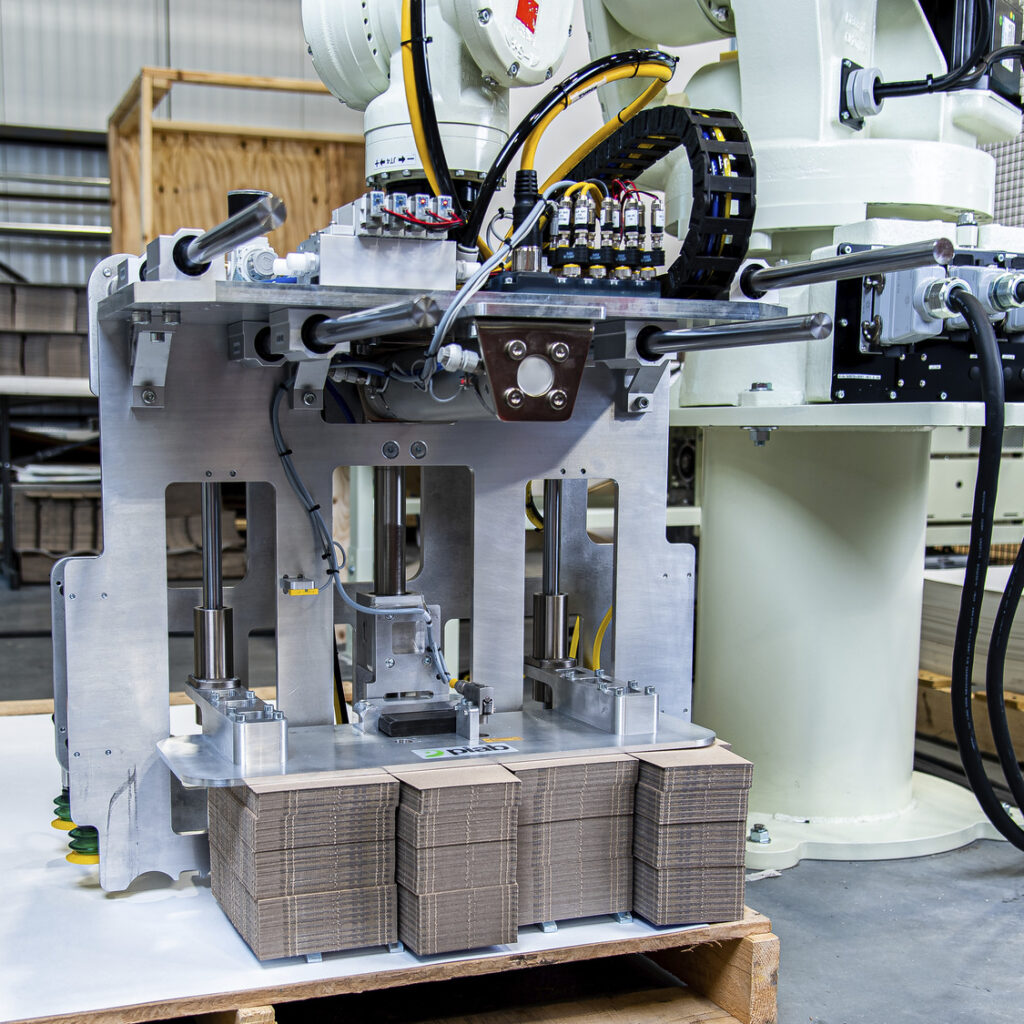
The company installed a custom robotic palletizer to handle seven box sizes. The system used a robot with a custom end effector that included programmable pressure and depth settings to lift and stack cartons while minimizing damage. For thin slip sheets between layers, the end effector also included programmable suction cups to support placement and handling.
After the system was installed, the company reduced staffing on the line from three workers to two. The robotic palletizer handled the manual palletizing task, allowing workers to be reassigned to other roles and standardizing the end-of-line process. The client later purchased a second robot for another line, citing results from the initial installation.
The role of intelligent control systems
While the robot performs the physical work, the robotic control system (RCS) coordinates operation. Instead of using separate controllers for each robot, an RCS can centralize control of multiple robots and peripheral devices under one system. Potential benefits include:
- Simplified management: Controls engineers who work primarily with PLCs can manage, adjust and troubleshoot the cell. This can reduce dependence on specialized robot-programming resources and simplify integration for PLC-based teams.
- Space savings: Centralized control can reduce the need for separate control cabinets and dedicated programming space around each robot, allowing more compact layouts and a smaller footprint.
- Modularity and flexibility: RCS architectures are often designed to support expansion and reconfiguration. When needs change, components can be added or adjusted with fewer changes to existing control logic. In this palletizer setup, new product profiles could be added by entering dimensions and stacking parameters in the controller.
Integrated safety with robots
Safety is a primary consideration in industrial robot applications. The palletizer cell used physical and programmable safeguards. The r work area was enclosed with perimeter fencing plus proximity switches and interlocked doors. A light curtain on the fourth side initiated a safety stop if the beam was interrupted.
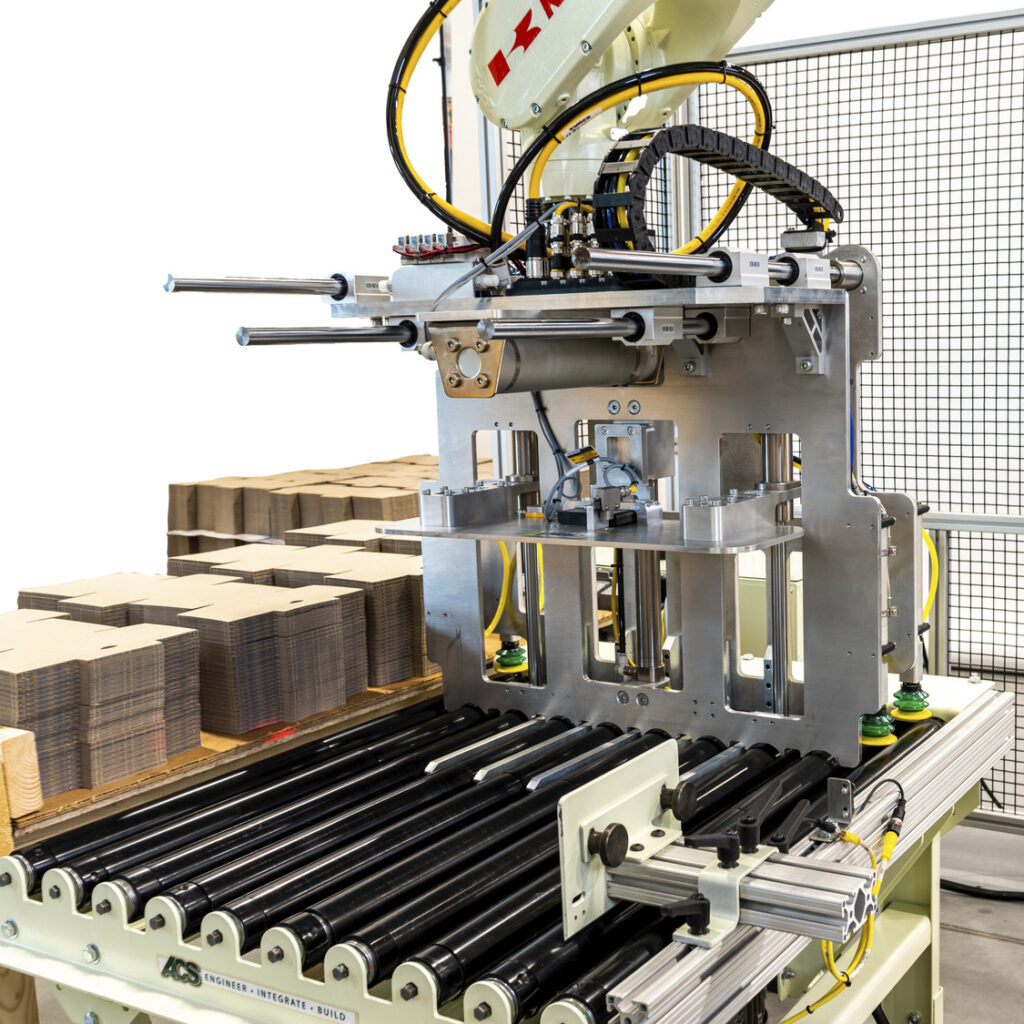
The robot was programmed with software-defined workspace limits that restrict motion to a defined work envelope. Combining physical barriers with software constraints helps protect workers and supports safe operation around the cell.
Robots: a path to scalable manufacturing
Using robots to improve efficiency is often less about replacing workers and more about reallocating labor and addressing bottlenecks. Automation can reduce repetitive manual tasks, improve safety and make it easier to adjust production for changes in demand. With pre-engineered systems and advanced control systems, manufacturers can reduce integration effort, standardize processes and redeploy workers to other roles.
This Control Engineering article originally appeared on another WTWH Media publication, Plant Engineering on November 6, 2025.
Edited by Puja Mitra, WTWH Media, for Control Engineering