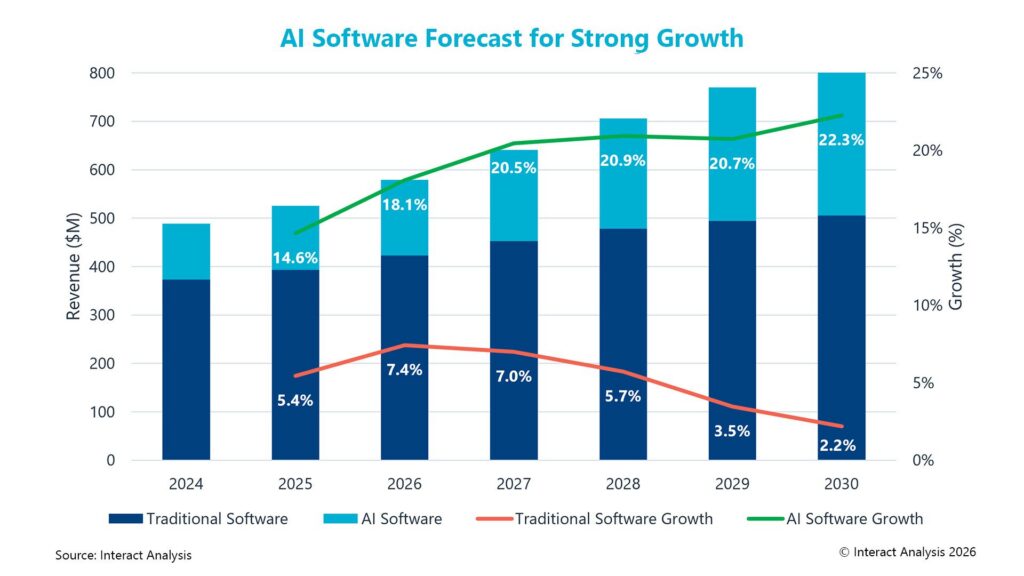
Interact Analysis forecasts AI vision software revenue rising from $132M in 2025 to $336M by 2030, faster than traditional software.
Artificial intelligence is becoming a significant technology in machine vision. Industry discussion often focuses on inspection accuracy, but AI is also changing how machine vision systems are developed, deployed, monetized and maintained. By reducing deployment complexity, lowering engineering costs and improving use of visual data, AI is increasing the number of applications where machine vision can provide measurable return on investment and is expected to contribute to market growth through 2030.
This is important for Control Engineering readers because industrial artificial intelligence (AI) is making machine vision be more capable, easier to use, to integrate and maintain.
The machine vision market was valued at about $5.9 billion in 2025 and is projected to reach more than $8.3 billion by 2030. Cameras and imaging hardware still represent r the largest revenue share, but software is projected to grow faster than the overall market during the forecast period, supported by increased investment in AI-based inspection solutions, demand for data-driven manufacturing and wider use of adaptive automation technologies.
Reducing adoption barriers
A key barrier to machine vision adoption has been implementation complexity. Conventional vision systems often rely on rule-based algorithms, requiring trained engineers to define inspection parameters, tune lighting conditions and adjust system settings for each application. Depending on inspection complexity, deployments can take weeks or months before production use.
AI changes this process. Instead of programming detailed inspection rules, manufacturers can train deep learning models with labeled image data to classify products and detect defects. This can reduce development time and engineering cost, and support deployment in applications that were previously difficult to justify on cost, especially where labor constraints and quality requirements are increasing.
The shift is reflected in software spending patterns. AI-based machine vision software revenue is forecast to increase from approximately $132 million in 2025 to more than $336 million in 2030, while traditional machine vision software revenue is forecast to increase from $393 million to approximately $505 million over the same period. As a result, AI software is expected to account for a larger share of machine vision software revenue, consistent with increased adoption of AI-enabled inspection and broader use in applications that were previously less practical to automate.
Broadening machine vision use cases
Performance remains a key factor in AI adoption. Rule-based vision systems perform well in controlled environments but can be less reliable with cosmetic defects, natural variation, inconsistent textures and subjective quality criteria.
AI-based models can improve inspection consistency in these variable conditions, including battery manufacturing, electronics assembly, food processing, textiles and wood grading. This can reduce false rejects and waste while increasing the number of inspection tasks that are practical to automate.
The software segment generated about $525 million of the $5.9 billion machine vision market in 2025 and is projected to grow faster than other segments through 2030. Growth in AI-based software reflects increased use of data-driven inspection tools that reduce setup effort and support deployment across a wider range of manufacturing applications.
How AI software is changing value distribution
AI is unlikely to create equal value across all machine vision applications. In basic tasks such as presence or absence check, barcode verification, OCR and pass-fail inspection, AI tools are making deployment easier, which may lower entry barriers and increase price competition.
In high-requirement applications such as semiconductor manufacturing, pharmaceuticals and medical devices, advanced imaging hardware, domain expertise and formal validation remain necessary. In these environments, AI is more likely to complement existing vision systems than replace them, as traceability, repeatability, explainability and regulatory compliance continue to limit fully AI-driven deployments.
AI use of vision data beyond inspection
Beyond pass/fail inspection, manufacturers are using machine vision data for quality trend analysis, root-cause investigation, process improvement and maintenance planning.
One OEM reported integrating vision data into its ERP system, where AI monitors defect tolerances in real time and alerts suppliers when metrics exceed thresholds, allowing earlier corrective action.
AI adoption is also changing software revenue models. Instead of relying mainly on one-time licenses tied to hardware, suppliers are adding subscriptions, Software-as-a-Service (SaaS) platforms, cloud model training, remote monitoring and model maintenance services. As core inspection functions become easier to deploy, suppliers are differentiating through data management, lifecycle tools and integration with manufacturing execution and automation systems.
Final thoughts
AI adoption in machine vision is expected to continue, with effects varying by application complexity and regulatory requirements. New obligations under the EU AI Act and Cyber Resilience Act may increase compliance work and extend development timelines for some suppliers. Suppliers that address governance, cybersecurity and deployment requirements are likely to have an operational advantage in industrial machine vision.
Edited by Puja Mitra, Arrowfly, for Control Engineering, from an Interact Analysis news release.