Global machine vision standards organizations regularly update standards that help advance design, implementation and use of machine vision technologies. Updates on standards were provided at the June Automate 2026 conference. Here’s what you need to know.
Insights
- Updates to global vision standards were offered by four standards organizations.
- Cooperative machine vision standards efforts continue in G3.
- Initiatives include machine vision high-speed communications, language, terminology, interfaces and lens control.
Vision systems are affected by decisions made by machine vision standards organizations globally, including recent updates on machine vision high-speed communications, language, terminology, interfaces, lens control and standards unification, as explained at Automate 2026, by the Association for Advancing Automation (A3). In a session on “Updates on Machine Vision Standards,” the following experts (Figure 1) provided updates.
- Bob McCurrach, director of standards development, Association For Advancing Automation
- Suprateek Banerjee, head of IIoT Standards, Robotics and Automation, VDMA e.V.
- Masahito Watanabe, chairman, Japan Industrial Imaging Association (JIIA)
- Jan Pech, EMVA member, EMVA – European Machine Vision Association
Global machine vision standards update
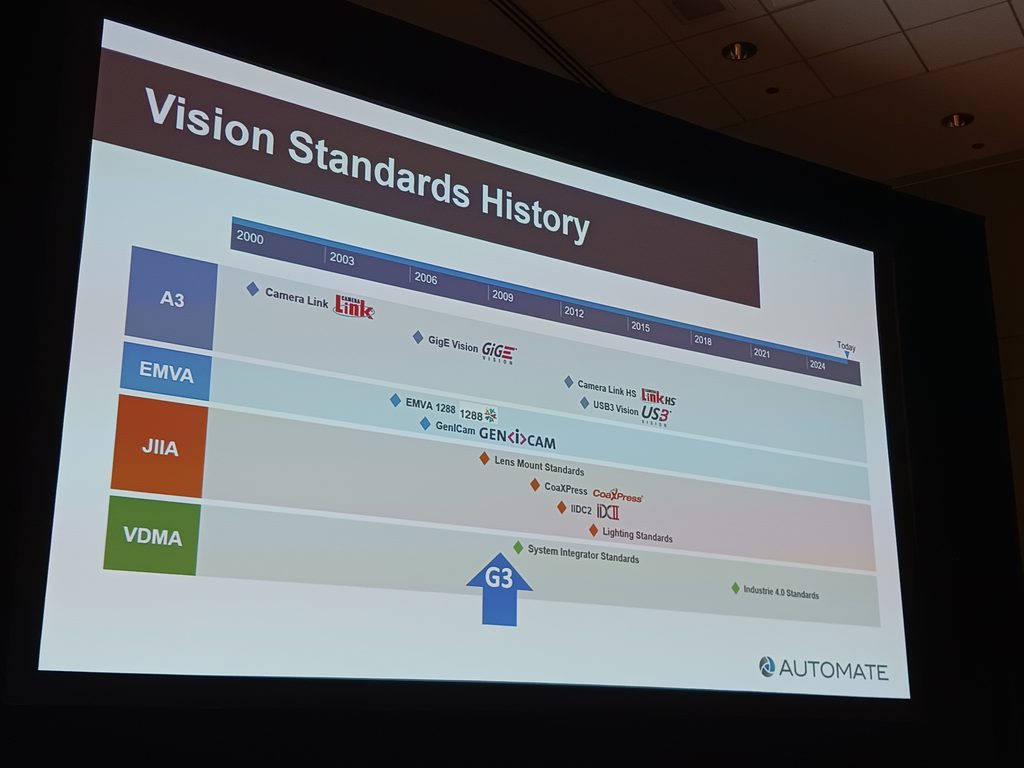
McCurrach began by reminding attendees about the 2009 unification effort called G3 when major standards organizations for machine vision agreed to cooperate rather than compete with vision standards and promote others’ efforts. McCurrach described vision as a stealth technology that so many need without knowing the need. In a brief discussion of vision standard history, he noted major standards from four organizations (Figure 2). Standards help machine vision technologies be more accessible. Four of five machine vision standards organizations are represented; China was missing.
G3 efforts include International Vision Standards Meetings (IVSMs) in spring and fall with an 18-month cycle in Asia, Europe and North America, a PlugFest and Future Standards Forum. Cooperative booths at Chicago, Las Vegas, Shanghai, Stuttgart and Yokohama include a brochure, “Guide to Understanding Machine Vision Standards,” with all G3 standards for camera interface, camera performance, lens mount, lighting, Industry 4.0 and system integrators, available from all G3 websites in English, Japanese and Mandarin.
VDMA: system integrator standards, Industrie 4.0
Banerjee continued, explaining benefits of OPC UA technologies for Industry 4.0 communication, including open-source security, various protocols, semantic machine descriptions with scalability. The cooperation provides a standard payload for different domains (machinery in this case) with easier connectivity. In the old pyramid structure, every device provides its own model, requiring extra engineering efforts versus use of the same model, requiring less engineering effort.
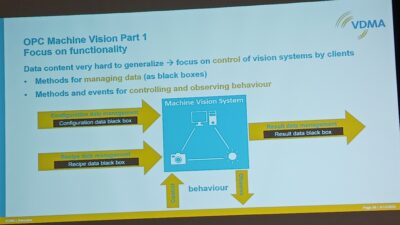
OPC machine vision part 1 (released in 2019) focuses on functionality; since data content is very hard to generalize, focus is on control of vision systems by clients, with methods for managing data as black boxes and methods and events for controlling and observing behavior.
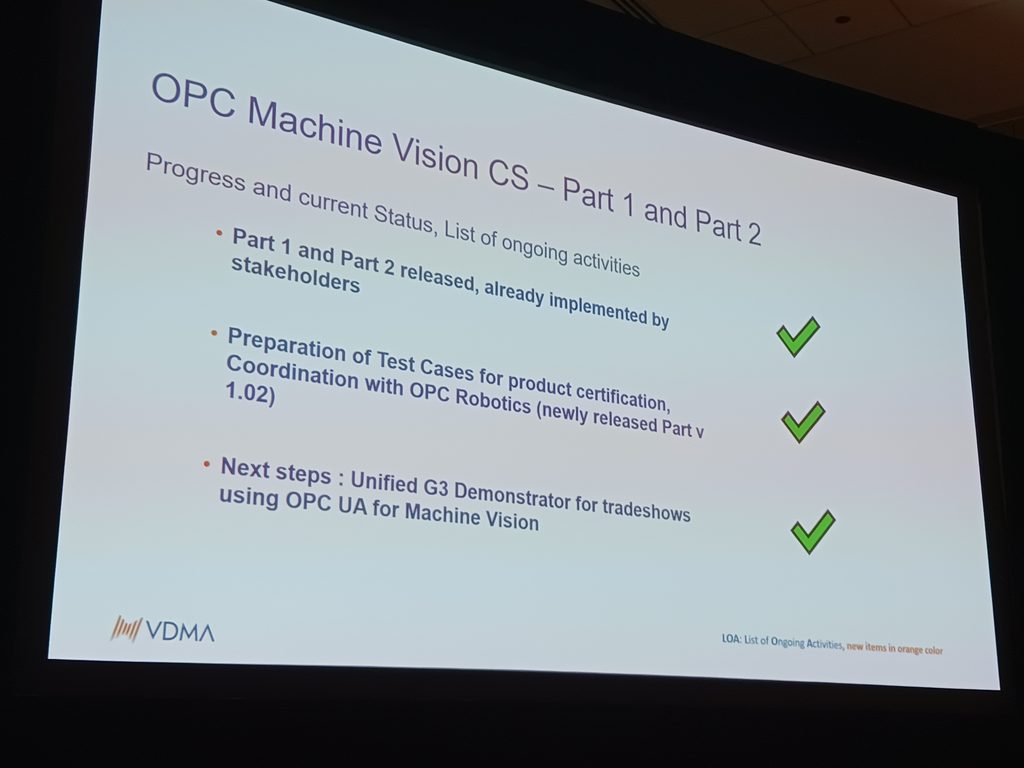
OPC UA for machine vision part 2 (released in 2024) covers asset management and condition monitoring in the factory, application layer and device layer with uses cases, items and system relationships, Banerjee said. Implementations are in place. Test cases for product certification are being prepared with coordination with OPC Robotics (newly released Part v1.02). Unified G3 demonstrations are planned for tradeshows using OPC UA for Machine Vision (Figure 3).
VDMA 2632:
- Part 1 (2022) removes misunderstandings with terms and definitions for machine vision systems to help with machine vision system planning, implementation, acceptance tests and in other areas. A newer version helps with machine learning and clearer wording.
- Part 3: Acceptance test of classifying machine vision systems.
- Part 3.1 Acceptance test of classifying machine vision systems – test of the classification performance.
- Part 4.1 Stability testing in flat steel production.
- Part 4.2 Surface inspection flat steel production – performance evaluation of classification.
JIIA camera configuration, other standards
Watanabe, chairman, Japan Industrial Imaging Association (JIIA) said the organization is covering Interface standards, connectivity and certification, lens standards, methods and framework, technical studies and other information.
He reviewed CoaxPress (CXP) camera configuration standards for coax cable connections (data, control and power) between the machine vision camera and the processing board.
- CXP v1.0 offers 1.25~6 Gbps (effective throughput: 5 Gbps/1ch)
- CXP v2.0 offers 12.5 Gbps (effective throughput: 10 Gbps/1ch), an optical transfer solution released as CXP-Over fiber.
- CXP- v3.0 with target release 2027 with 25Gbps (effective throughput: 20 Gbps/1ch, impedance updated from 75 ohm to 50 ohm.
Developed for image sensors, Scalable Low Voltage Signaling with Embedded Clock (SLVS-EC) is a high-speed interface (up to 12.5 Gbps/lane) between image sensor and processor.
Described as a simplified protocol, it has a multi-lane function, is easy to assemble, without need to adjust skew between lanes for better long-distance transmission.
Version 3.1 adds support for higher data rate (up to 12.5 Gbps/lane) and is backward compatible with previous versions. Version 2.0 describes confirmation of PHY layer characteristics.
Connector and cable certification for machine vision standards will help as factories become more automated and robots expand use, Watanabe said. Vibration worsens jitter, and v1.0 for CXP12 cable (HD BNC connector) was released in April after hearing period of April to June 2025 and interviews with nine robot, mounting machine and camera manufacturers.
For JIIA-HFC-001-2022: Measurement methods for color capturing accuracy of industrial cameras, JIIA is preparing a third-party organization to perform measurement and certification of results. Outsourcing avoids the need to buy measuring equipment.
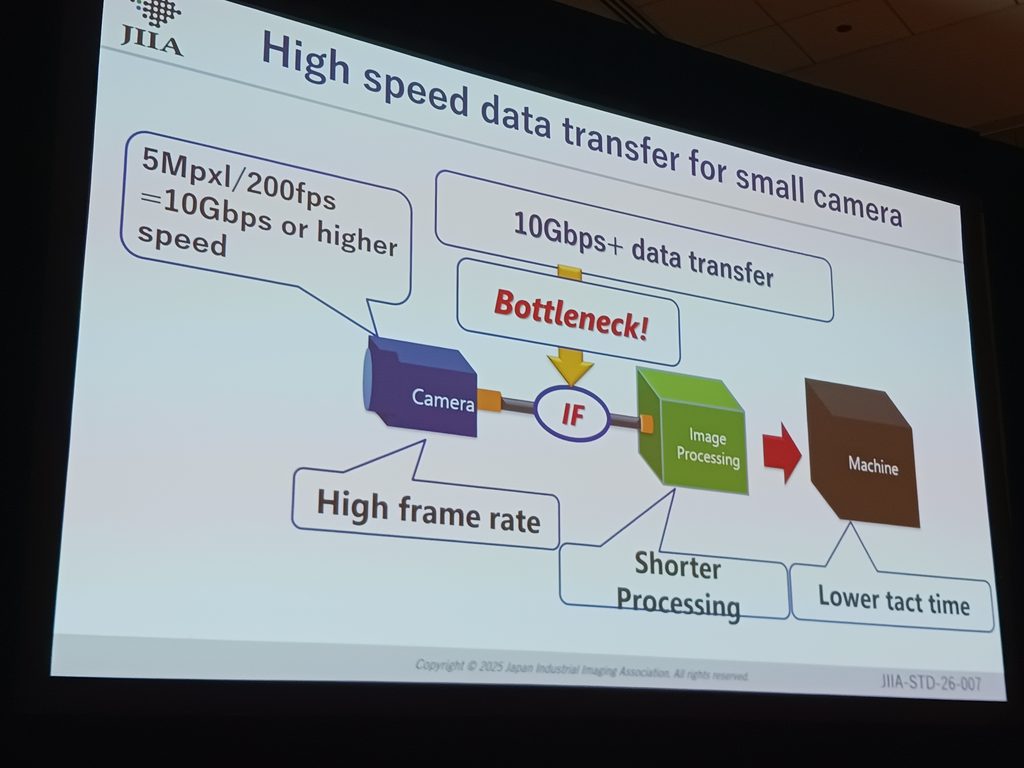
Today’s vision systems can have cameras with a high frame rate, shorter image processing serving machines with lower tact time. To decrease the bottleneck between cameras and image processing, faster data transfer rates are needed (Figure 4). SLVS-EC can help when used over CoaXPress.
EMVA unification, easier integration
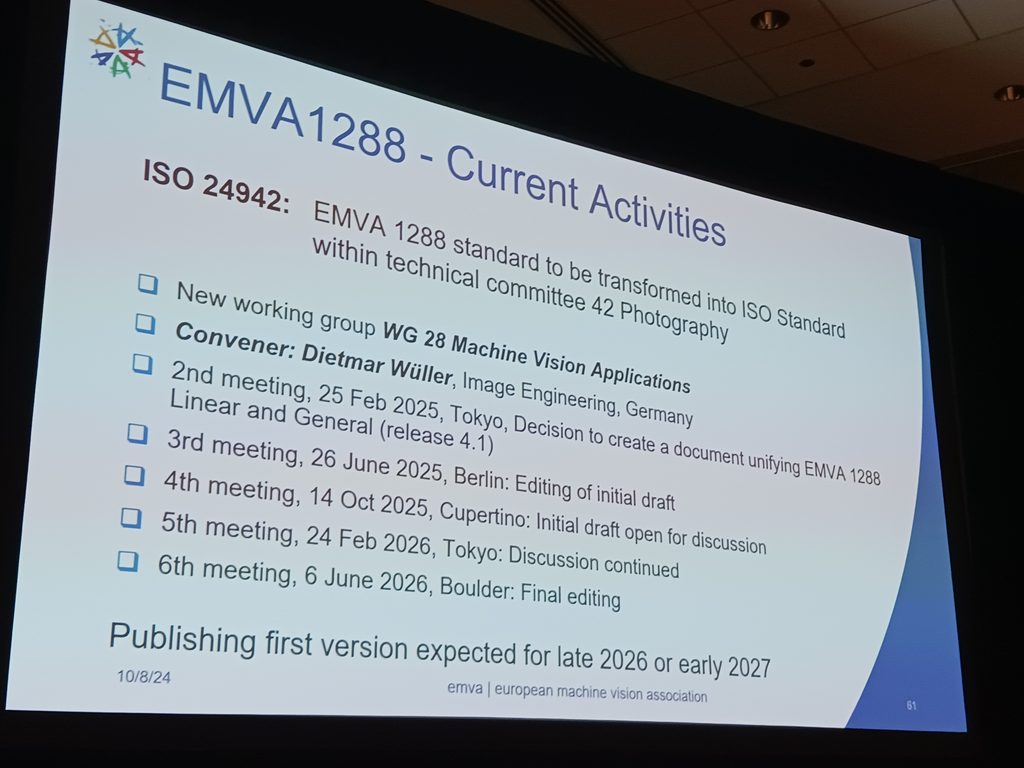
Pech, EMVA member, reviewed EMVA 1288 activities (Figure 5), a standard moving into ISO Standard within technical committee 42 Photography. A new working group, WG 28 Machine Vision Applications, did final editing in a sixth meeting in June. First edition is expected in late 2026 or early 2027.
The upcoming ISO 24942 standard, building on release 4.1 of EMVA 1288 finished December 2024, is expected to unify release of 4.0 Linear and 4.0 General into one document and provide for easier adoption and analysis of measurements for a wider range of cameras, including preprocessing within the camera and high dynamic range (HDR) imaging. It adds simple measurement of parasitic light sensitivity (PLS). It also adds broadband illumination for easier and faster measurements of color, multi- and hyperspectral cameras, along with other small improvements and additions.
GenICam (generic camera) SFNC 2.8 and GenDC 1.2 in April 2026 improves support for 3D applications has new features for GigE Vision 3.0 and JPEG XS.
GenAPI implementation 3.5 released in April 2025 has the latest security patch level for included libraries, and LGPL libraries are no longer required providing easier integration. Several small bug fixes and improvements are included.
A GenICam project, “generic feature access (working title GenFeA) includes a unified interface for device access and data streams, independent of the transport layer technmology. The unified interface to device features include a lean API, ability to handle nested devices, and significantly lower memory and processing requirements to simplify use of embedded, IoT and other edge devices.
GenICam device validation promotes a consistent adoption of GenApi, standard feature naming convention (SFNC) and will be included in the GigE Vision and CoaXPress validation. Next steps include to refine specifications for testability and wide test coverage. Release 1.0.1 with SFNC 2.8 in April 2026 is available to GenICam Working Group members and GigE Vision and CoaXPress licensees.
During second-quarter 2026, GenApi Reference Implementation 3.5.1 was expected, with latest security patch level for included libraries and small bug fixes.
The Open optics camera interface (OOCI) is about lenses and light, including F numbers, aperture and focal length, needed for the camera to generate an image. It includes standard features naming convention (SFNC) in use and integrated by all industrial camera manufacturers. GenCP integrates Camera Link into GenICam. The OOCI working group’s work continues. A JIIA local lens control standard for OOCI implementation was expected to be released in July 2026.
A3 efforts on GigE Vision
McCurrach discussed A3 standards including benefits of GigE Vision, with long reach (up to 100 m without regeneration, switches or fiber), high bandwidth (1, 2.5, 5 or 10 Gb/s link between each node and also 25, 50, 100 and 400 Gb/s), low cost (1000BASE-T) for economies of scale, and network flexibility, with unicast (point to point) or multicast (point to multipoint) and precision timing in IEEE 1588 v2.
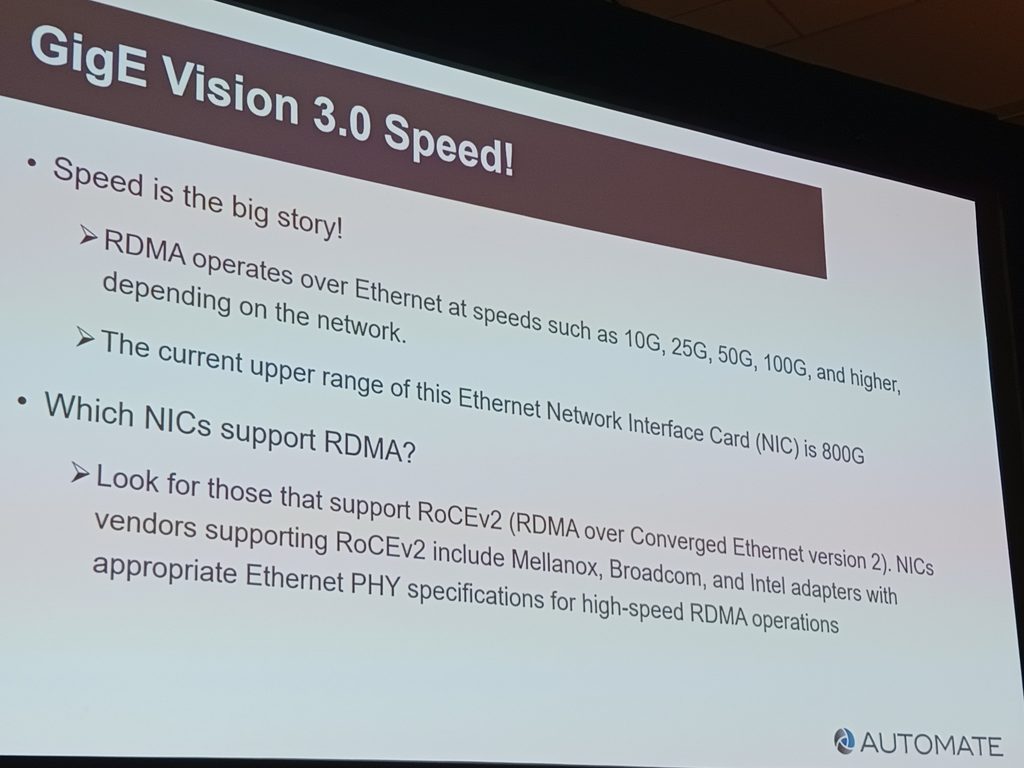
GigE Vision 3.0 (Figure 6), released in May 2026, breaks 10 Gig barrier and is free to download; V3.0 devices exchange data without OS involvement which is huge, he said. It delegates error detection and recovery tasks to dedicated hardware. It uses zero copy image transfer, and supplements, does not replace, GigE Vision 2.2. It uses v2 remote direct memory access over converged ethernet (RDMA is Remote Direct Memory Access). It has an anticipated upper range of 800G.
USB3 vision version 1.2 implements GenCP, GenICam, SFNC, GenDC and all USB speeds up to USB4. It typically uses a one-cable solution with power, control and streaming. It works with the growing USB Type-C ecosystem for higher power and bandwidth. It has extremely low CPU use, a variety of cabling solutions and has a good test suite. New cameras with silicon for higher-speed USB 10 and 20 Gbit are in development.
Mark T. Hoske is editor-in-chief, Control Engineering, Arrowfly, [email protected].
Keywords
Automation, Automate 2026, machine vision standards
Consider this
Machine vision standards aim to ease integration and promote faster, more efficient implementation.
You also might like
https://www.controleng.com/eight-ways-machine-vision-and-ai-are-improving-automotive-manufacturing/
See other Automate 2026 coverage
https://www.controleng.com/can-robots-do-general-manufacturing-tasks-toyota-research-institute-asks/
https://www.controleng.com/how-to-justify-automation-use-ai-to-help-robotics/