CoaXPress migration delivers the bandwidth, resolution and line-rate performance that legacy Camera Link installations can no longer support.

Camera Link to CoaXPress migration insights
- Why upgrade: Camera Link’s bandwidth limitations make it unable to meet the demands of modern high-resolution, high-speed inspection systems.
- How to migrate: A successful Camera Link-to-CoaXPress transition requires deliberate frame grabber selection, application-specific planning, and leveraging a mature, standardized ecosystem.
- What’s possible post-upgrade: CoaXPress unlocks next-generation machine vision performance while future-proofing installations — with BitFlow providing the hardware and expertise to get there.
Machine vision system integrators face a common challenge: existing Camera Link installations that have served reliably for years struggle to meet evolving performance requirements. Higher resolution cameras, faster line rates and increased inspection complexity demand bandwidth that Camera Link cannot provide. Upgrading to CoaXPress offers a migration path that improves performance and manages costs and complexity.
Transition from Camera Link to CoaXPress typically requires 2-4 weeks of integration effort for straightforward single-camera systems and 6-12 weeks for complex multi-camera configurations with custom preprocessing requirements, representing modest investments given the performance gains explained here.
Understanding CoaXPress
Before planning an upgrade, system integrators working on machine vision systems must navigate the CoaXPress standards ecosystem. Unlike Camera Link, which remained relatively static after its initial release, CoaXPress has evolved through multiple speed grades, each offering progressively higher bandwidth.
CXP-6 represents the baseline CoaXPress specification, delivering 6.25 Gbps per coaxial connection. One CXP-6 cable provides approximately 625 MB/s of usable bandwidth, making it suitable for upgrading Camera Link Base (255MB/S) and Medium (510 MB/S) configurations without requiring multiple cables.
CXP-12 doubles the performance to 12.5 Gbps per connection, yielding roughly 1.56 GB/s per cable. This specification is widely used, balancing performance, cost and ecosystem maturity. Most current camera and frame grabber designs target CXP-12 as their primary specification. For most upgrade scenarios, CXP-12 provides sufficient headroom.
A new version of the CoaXPress standard, referred to as CoaXPress v3.0, is in development as of early 2026. It is expected to support higher nominal speeds of 25 Gbps per link, doubling the current maximum to enable faster frame rates, higher resolutions and better performance over longer distances with fiber optics. Integration of CoaXPress over Fiber into the main specification, moves it beyond the current add-on status and is expected to be part of CoaXPress v3.0.
Backward compatibility of CoaXPress
CoaXPress maintains backward compatibility. CXP-12 frame grabbers work with CXP-6 cameras, and vice versa, automatically negotiating the highest common speed. This compatibility simplifies phased upgrades where cameras and frame grabbers might be replaced at different times.
CoaXPress over Fiber: Up to 200km
Standard CoaXPress uses 75-ohm coaxial cable with practical lengths up to 40 meters for both CXP-6 and CXP-12. These distances suffice for most machine vision installations, but certain applications—particularly in semiconductor fabs, large-scale food processing facilities and pharmaceutical manufacturing environments—require greater reach or face challenging electrical noise conditions.
CoaXPress over Fiber (CoF) extends CoaXPress transmission across multimode fiber optic cables, theoretically supporting distances up to 200km while maintaining protocol transparency. From the camera and frame grabber perspective, fiber links appear identical to coaxial connections without special configuration or modified protocols.
CoF delivers additional advantages beyond distance. Fiber optic cables provide complete immunity to electromagnetic interference, crucial in environments with motors, RF equipment, or high-voltage systems. Galvanic isolation protects sensitive electronics from ground loops and voltage transients. Fiber’s smaller diameter and lighter weight simplify cable routing in cramped equipment.
For system integrators, CXPoF adds modest complexity. The downside of the CoF is that power support for the camera is no longer an option. However, being unable to provide power to the camera is a small price to pay with the added distance and flexibility. The cameras are typically 24V, so it’s easy enough in an industrial environment to find a source for this power.
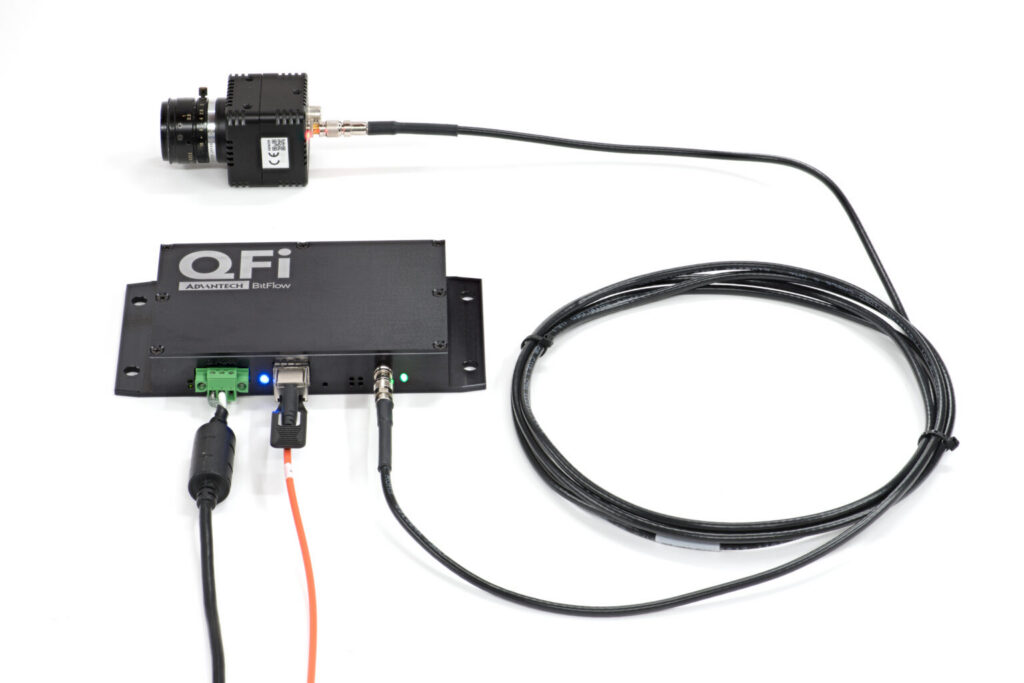
In situations where the camera has a HD BNC (copper) connector, products are available to convert this signal from copper to fiber and bring the signal back to CoF frame grabber. This eliminates the need to convert the signal back to copper and saves a substantial amount of money.
Planning the Camera Link to CoaXPress migration
Successful upgrades begin with a thorough assessment of existing systems. Camera Link installations typically fall into three categories based on configuration:
Camera Link Base systems use one CL cable providing up to 255 MB/s. Typically the cable is either Miniature Delta Ribbon (MDR) or Shrunk Delta Ribbon (SDR), which are interchangeable. These systems upgrade cleanly to single-cable CXP-6 or CXP-12, often without requiring multi-cable frame grabbers. Migration is straightforward, and cost impact remains minimal.
Camera Link Medium configurations employ two cables (MDR or SDR) for 510 MB/s bandwidth. Upgrading to dual-CXP-6 or single-CXP-12 provides comparable or superior performance. Frame grabber selection depends on whether existing systems already use dual-connector frame grabbers.
Camera Link Full systems with two cables delivering 680 MB/s represent the most complex upgrade scenario. These typically transition to a single CXP-12 configuration, providing substantially more bandwidth (3+ GB/s), which future-proofs installations for next-generation cameras.
Camera Link 80-Bit (aka Deca Mode) systems with two cables was the last speed introduced and allows bandwidths up to 850 MB/S, again on the two-cable scenario. This also can be replaced by one CXP-12 cable.
Control requirements in machine vision
Beyond bandwidth assessment, integrators must evaluate trigger and control requirements. Camera Link provides up to four general-purpose I/O signals and two serial communication channels. CoaXPress offers similar capabilities through its upstream control channel, but implementation differs. Camera control software requires updating to use CoaXPress protocols—typically GenICam-compliant implementations that are well-supported by modern software development kits (SDKs_. While most modern Camera Link cameras are GenICam-compliant, an older camera system may require some massaging to bring it to the CXP control levels. However, all CXP products must be GenICam compliant.
Frame grabber selection and installation
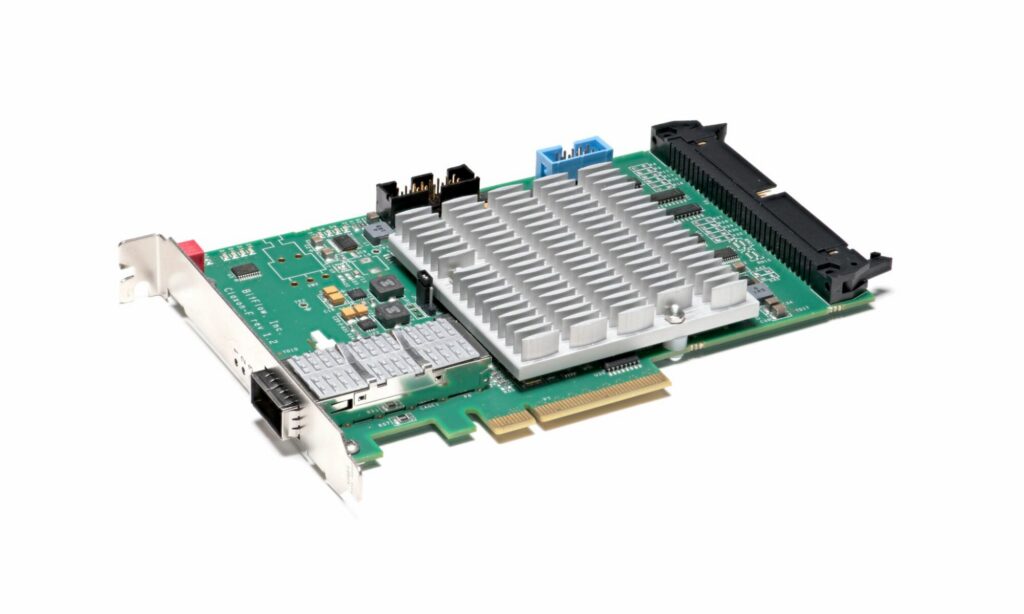
Modern CoaXPress frame grabbers from manufacturers like BitFlow provide multiple configurations to match diverse upgrade scenarios. Single-link models suit Camera Link Base replacements, while quad-CXP-12 designs handle applications requiring multiple high-speed cameras.
Installation complexity depends largely on existing infrastructure. CoaXPress frame grabbers universally use PCIe interfaces, typically x4 or x8 connections. If existing systems already use PCIe Camera Link frame grabbers, the physical installation involves simple card replacement.
Onboard processing capabilities vary significantly among frame grabber designs. Entry-level models focus on acquisition and transfer. Mid-range options integrate FPGAs for real-time preprocessing: flat-field correction, pixel format conversion and region-of-interest extraction. High-end designs incorporate substantial FPGA resources and even AI accelerators, enabling sophisticated edge processing that can dramatically reduce host processing requirements.
For most upgrades, selecting frame grabbers with robust onboard processing potentially can deliver substantial value. However, the preference and defector solution these days to leave the processing to specifically designed hardware such as GPUs. With Camera Link data processing by the CPU was possible in most vision systems, but CXP’s higher bandwidths demanded a newer approach.
Cable infrastructure considerations
CoaXPress leverages standard 75-ohm coaxial cable with DIN 1.0/2.3 connectors (CXP-6) or HD-BNC connectors (CXP-12), compatible with existing broadcast video infrastructure. This standardization provides advantages: cables are readily available, competitively priced and easily field-terminated if needed.
For most installations, pre-made cable assemblies offer the most reliable solution. Quality cables use precision connectors and proper impedance control, ensuring signal integrity across the full CXP-12 bandwidth. Lengths up to 40 meters work reliably without special considerations.
Compared to Camera Link Base’s 10m limit, CoaXPress extends reach significantly further. When those distances fall short, repeaters, extenders and CoF provide solutions. Fiber infrastructure costs more than coaxial in cable and required converters but remains far less expensive than relocating processing equipment or redesigning facility layouts. For semiconductor and pharmaceutical applications where equipment locations are fixed by cleanroom constraints or regulatory requirements, CoF often represents the only viable upgrade path.
Application-specific machine vision upgrade benefits
Semiconductor inspection: The semiconductor industry demonstrates the largest CoaXPress advantages. Modern wafer inspection requires multi-megapixel cameras at hundreds of frames per second. These data rates overwhelm Camera Link’s 850 MB/s ceiling. A dual link CXP-12 frame grabber provides 3+ GB/s bandwidth, accommodating current requirements with headroom for future camera upgrades.
Semiconductor fabs benefit from CoF for remote camera installations on process tools. Cameras mount directly on wafer handling equipment, and frame grabbers reside in climate-controlled equipment racks, sometimes hundreds of meters away. This architecture centralizes processing infrastructure while maintaining deterministic, low-latency acquisition essential for precision inspection.
Food processing: Food inspection systems increasingly employ high-speed line-scan cameras for 100% product inspection. A typical bakery line might run at 600 products per minute, requiring line-scan cameras operating at 100s of kHz. CoaXPress’s bandwidth supports higher line rates and increased pixel counts compared to Camera Link, enabling detection of smaller defects and foreign material contamination.
Food processing environments present electrical noise challenges: Motors, mixers, ovens and refrigeration systems create harsh electromagnetic conditions. CoF’s immunity to interference ensures reliable operation where standard coaxial cabling might experience signal degradation. Additionally, food-grade facility designs often require long cable runs that exceed coaxial distance limits. Similar to semiconductors, having the data coming from the factory floor to an industrial PC can allow monitoring in real time on multiple lines from a safe distance.
Pharmaceutical manufacturing: Pharmaceutical applications demand absolute reliability and comprehensive documentation for regulatory compliance. CoaXPress’s standardized, mature ecosystem provides the stable foundation that validation processes require. The standard’s built-in error detection ensures that any transmission issues are immediately identified, preventing defective products from escaping detection.
High-speed tablet and capsule inspection represents a particularly demanding application. Systems inspect hundreds of products per second, verifying print quality, checking for cracks and confirming proper fill levels. Multi-camera configurations using quad-link CXP-12 frame grabbers enable simultaneous top, bottom and side inspection at production speeds that Camera Link systems cannot match.
Pharmaceutical cleanrooms benefit from CoF with less equipment in controlled environments. Fiber enables cameras in ISO Class 5 cleanrooms to connect to frame grabbers and processing systems outside the cleanroom envelope, reducing heat load, simplifying maintenance and maintaining environmental control.
Cost analysis and return on investment
Upgrade costs vary significantly based on system scope. A single-camera replacement (swapping Camera Link Base to CXP-12) might cost a few thousand dollars for camera and frame grabber combined. Multi-camera systems with advanced preprocessing capabilities can be significantly more expensive.
However, cost analysis must consider performance gains and operational benefits. A semiconductor inspection tool upgrade might cost $15,000 but enable 2x throughput improvement, potentially eliminating the need for a second inspection station costing hundreds of thousands of dollars. The return on investment (ROI) becomes compelling quickly.
CoF adds approximately 10% to 20% to project costs compared to standard coaxial implementations: Fiber cables, converters (if you want to use a CXP copper base camera) and associated power supplies increase the bill of materials. For installations requiring remote cameras, CoF typically costs far less than alternatives like moving equipment or installing multiple processing stations.
Machine vision software and integration complexity
Modern CoaXPress ecosystems minimize software migration challenges. Most current machine vision libraries, including open-source options like OpenCV and commercial packages, support CoaXPress through standard GenICam interfaces. Camera vendors provide GenICam-compliant drivers that work seamlessly with standard image acquisition libraries.
BitFlow and other frame grabber manufacturers supply comprehensive SDKs that abstract low-level details, presenting unified interfaces regardless of underlying hardware complexity. For integrators, this means application code changes often focus on updated camera initialization and configuration rather than complete rewrites. With the BitFlow SDK, the same libraries are used for the CXP and CL image acquisition, so few changes are needed.
Better communications enable improved machine-vision capabilities
Upgrading from Camera Link to CoaXPress delivers transformative performance improvements that enable next-generation machine vision capabilities. The combination of standardized interfaces, mature ecosystems and flexible configurations—from standard coaxial to fiber optic—provides solutions for virtually any upgrade scenario.
For system integrators, the migration path is well-defined and manageable. Careful planning, appropriate frame grabber selection and attention to application-specific requirements ensure successful deployments that deliver immediate performance benefits while future-proofing installations for continued evolution.
As a frame grabber manufacturer committed to supporting integrators through technology transitions, BitFlow provides the products, technical resources and application expertise that make Camera Link to CoaXPress upgrades straightforward and successful. The performance waiting on the other side of that upgrade makes the journey worthwhile.
Donal Waide, is director of business development iSystems, Advantech. Edited by Mark T. Hoske, editor-in-chief, Control Engineering, WTWH Media, [email protected].
Keywords
Machine vision communications, Camera Link, CoaXPress
Consider this
Are your machine vision communications able to support upgraded machine vision capabilities?
You also might like
See an Advantech new product:
Industrial IoT edge gateway has edge computing capabilities, second-stack expansion
https://www.controleng.com/products/uno-2271g-v3-industrial-iot-edge-gateway/
Control Engineering provides more on machine vision and industrial networking.
https://www.controleng.com/mechatronics/vision-and-discrete-sensors