
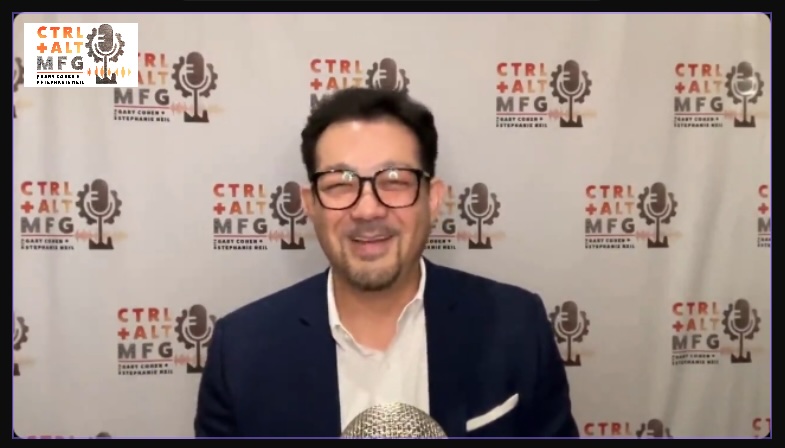
At the 2026 CSIA Conference, Mitsubishi Electric Iconics Digital Solutions’ Tak Tarui explained why successful industrial digitalization depends on more than buying technology. It also must be implemented well by system integrators.
Manufacturers have no shortage of digital technologies to evaluate. Industrial data platforms, cloud services, AI-enabled analytics, robotics and connected control systems are advancing rapidly. Yet the difference between a promising proof of concept and a production-scale deployment is rarely the technology alone.
That was the central message from Tak Tarui, vice president of global business development at Mitsubishi Electric Iconics Digital Solutions (MEIDS), during a live episode of the Ctrl+Alt+Mfg podcast recorded at the 2026 CSIA Conference in Baltimore.
Tarui, who has spent 25 years in industrial automation (including about 20 years with Mitsubishi Electric), said his experience has led him to focus increasingly on software, digital business and partner growth. Today, one of his priorities is strengthening the company’s system integrator ecosystem.
“In my experience, I know for sure the best technologies only create value when implemented well,” Tarui said.
For Tarui, system integrators are the connective tissue between digital platforms, real-world operational requirements and the outcomes manufacturers expect from their investments.
The digital implementation gap
Manufacturers increasingly want to use operational technology (OT) data more effectively. Projects may connect plant-floor assets with enterprise systems, modernize visualization, contextualize production data, establish secure access and apply analytics or AI to improve performance.
But these initiatives can become complicated quickly. A digital project may span controls, industrial networks, data historians, visualization, cybersecurity, cloud architecture and changing operator workflows. The challenge goes beyond simply selecting the right software. It is designing a system that can operate reliably, be maintained by plant personnel and scale beyond a single pilot.
“Purchasing a software, whether that’s on-prem or a SaaS application that sits on the cloud — or even AI, AI platform or AI features that can live in application — it’s not just buying a piece of software like that,” Tarui said. “It’s a digital transformation.”
System integrators, he explained, are responsible for designing systems that work in the day-to-day operating environment.
“If you want to scale a digital business, you need a capable system integrators,” Tarui said.
That distinction is important for technical teams. A technology supplier can deliver a capable platform, but a manufacturer’s results depend on how the system is architected, what data is collected, how it is modeled, how it is secured and how the solution is supported after commissioning.
Designing systems for repeatable integration
Mitsubishi Electric acquired Iconics in 2019. Tarui said the work that followed helped shape the company’s approach to digital growth and partner enablement. The lesson that stood out is that platforms need repeatable implementation models if they are going to scale.
“One of the lessons we learned through that time was platform-only scales with repeatable integration,” he said.
Manufacturers want flexibility, but they also need consistency. While each facility and process has unique requirements, a sustainable digital strategy cannot require engineering teams to reinvent every solution from scratch. Reusable architecture patterns, standardized templates, proven methodologies and trained partners can help organizations move faster while maintaining technical rigor.
Tarui pointed to the company’s Genesis platform and Version 11 release as part of that strategy. The goal, he said, was to make the platform highly capable for data while maintaining a strong security posture.
The platform provides a foundation on which system integrators can build customer-specific applications. That combination — software capability plus delivery expertise — is essential in industrial environments where systems must connect disparate technologies and remain useful to operators, engineers and plant managers.
A simplified SI partner program
At CSIA, Tarui discussed changes to the MEIDS system integrator program that focus on four areas: tier simplification, sales enablement, certification and training, and global deployment.
The revised structure includes Standard, Elite and Diamond Elite levels. These tiers are designed to create a progression path as integrators develop capabilities and deepen their engagement with MEIDS.
“What we are trying to accomplish with this is not just a label, but we want to make a progressive path for the SI,” he said.
The Diamond Elite designation also reflects Mitsubishi Electric’s corporate identity.
“The Mitsubishi Electric logo has three diamonds,” Tarui said. “And the word Mitsubishi literally means ‘three diamonds.’”
As integrators move through the tiers, they receive increasing levels of support, including pre-sales assistance, sales engagement and other program benefits. For manufacturers, a clearer structure may provide another factor to consider when evaluating potential implementation partners.
Trust, clarity and active collaboration with SIs
Industrial digital transformation is already technically complex, but Tarui said that complexity should not be increased by unclear responsibilities or inconsistent support models.
“[My experience working across cultures and organizations] taught me two things, and those two things are the most important things that we tell ourselves,” he said. “Even internally, I tell my team, our stakeholders all the time: It’s trust and clarity.”
The updated program is intended to create more active collaboration between MEIDS and its integrators. Tarui described support that can include pre-sales engagement, account planning, coordinated sales collaboration and lead sharing when appropriate.
“We are making a commitment to say we want to be active to work with SIs and help them to win more projects, obviously when we are welcomed into the conversation,” he said.
For integrators, that engagement can provide access to technical resources and improve coordination during the sales and design process. For manufacturers, it can create a more unified conversation among the platform provider, implementation partner and internal operations team.
Supporting the next generation of system integrators
The MEIDS program is also intended to support newer and independent system integrators. Tarui said joining the program can provide brand recognition, enablement and a path to developing expertise.
“First off, you kind of carry the Mitsubishi Electric brand as an authorized system integrator,” he said. “We are a globally recognized brand, so I hope this means something.”
Where appropriate, MEIDS may also provide professional services support for architecture and design. That can help newer partners build confidence while taking on projects that require expertise across controls, software, data and enterprise systems.
Ultimately, Tarui said, successful digital transformation depends on the people who make technology useful in the real world.
“One of the biggest reasons I wanted to be at the CSIA Conference this year is because I want to feel the SI community,” he said. “I want to talk to those people that are actually integrating the systems into the actual value for the customers.”
As manufacturers move from digital experimentation to scaled deployment, the system integrator’s role is likely to become even more important.
“We are investing in the SI ecosystem,” Tarui said. “You guys are driving digital transformation, so let’s get the conversation started.”
The Ctrl+Alt+Mfg Podcast
Make sure to check out other episodes of the Ctrl+Alt+Mfg podcast, where hosts Gary Cohen and Stephanie Neil discuss a range of digital transformation insights. The last five episodes are listed below:
Ep. 15: Industrial AI’s reality check, with Josh Peeno of JPeeno Innovation Group
Ep. 16: The system integrator playbook, with Daniel Gomez of Omnicon
Ep. 17: Rethinking Industrial Data, with Gary Tillery of Skkynet
Ep. 18: Audacious Goals for Infrastructure Security, with Danielle Jablanski of STV
Ep. 19: The Future of System Integration, with Daren Dieleman of Interstates