
Benefits and salaries decreased. Artificial intelligence, machine learning and automation application upgrades top the list of leading automation technologies. Lack of skilled workers and the economy are the leading manufacturing business challenges.
Control Engineering 2026 salary and career research insights
- Understand that 2026 Control Engineering Career and Salary Report covers salaries, benefits, automation trends and technologies related to manufacturing challenges.
- Learn that automation experts receive lower salary and benefits in 2026 than 2025.
- Explore trends about engineering job satisfaction, hours for those working with automation, controls along with survey methods and demographics.
Lack of skilled workers, the economy and tariffs are among leading challenges while artificial intelligence, machine learning and automation application upgrades are among leading technologies that will help those responding to the 2026 Control Engineering Career and Salary Survey and Report. The full report is available at www.controleng.com/research.
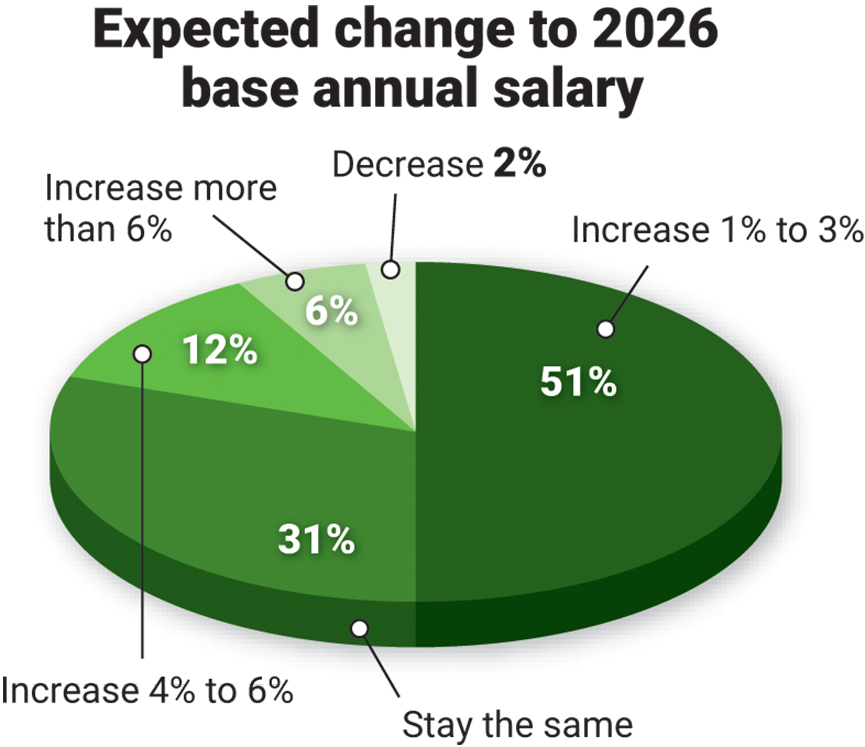
Salaries and benefits decreased for Control Engineering subscribers responding compared to 2025, which isn’t likely to help the automation industry to attract the best and the brightest engineering talent. Salaries decreased to an average $117,395 (Figure 1), 1.9% less than $119,682 for those taking the survey in 2025, but still ahead of $114,771 for the 2024 survey. Even so, most taking the survey expect to receive increases in the coming year. The average of those receiving bonuses decreased to $16,315 (Figures 2, 3), compared to $18,595 reported last year. [U.S. Bureau of Labor statistics said in April the Consumer Price Increase for 12-months was 3.8%.]
Leading threats (Figure 7) to manufacturing businesses (select up to three, the survey said) was the lack of skilled workers at 42%. The economy at 34% and taxes and tariffs at 28% were in a statistical tie for second, given the 6.6% margin of error for the survey at a 95% confidence rate. In 2024 just 8% said taxes and tariffs were a leading threat. In 2024, the economy was the top threat at 41%, and lack of available skilled workers was 33%.
Automation technologies to resolve key manufacturing challenges
What technologies will be helping in the coming year? (Figure 5) Among a technology list expected to help, artificial intelligence and machine learning (AI/ML) at 42% tied with automation applications/upgrades at 38% (within the margin of error). The automation-upgrades category gained 15 percentage points over last year (second only to industrial communications which showed a 22 percentage point gain). [Note that automation upgrades and improved networking can help support AI/ML investments.] Below first place, no technology listed was separated from its neighbor by a percentage greater than the margin of error for the research.
Second place was a tie among process optimization; process design, measurements, optimization; and remote controls, monitoring.
Sharing third place in a statistical tie was a group of eight technologies, all within 6.6 percentage points:
24% Automation: Motion control optimization with advanced actuators, drives
24% Automation: Robotics, collaborative robotics, mobile robotics
23% Better HMI and SCADA designs
22% Industrial communications: faster and easier among devices and systems
21% Analytics: Data analytics
20% Industrial internet of things (IoT), such as more interconnected sensors, monitoring, data collection
19% Cybersecurity technologies
18% Advanced process controls (APC) optimization
See graphic for 18 other automation technologies likely to help.
Those were among the 2026 salary and career survey highlights. Below find more results. Download the full report (and other Control Engineering research) at www.controleng.com/research.
Anticipated increases for automation experts
Automation, controls and instrumentation help manufacturers operate more efficiently and fill the skills gap. Despite a decrease compared to those surveyed last year, automation professionals see themselves as part of the solution with 68% again expecting an increase in base annual salary, similar to the last four years.
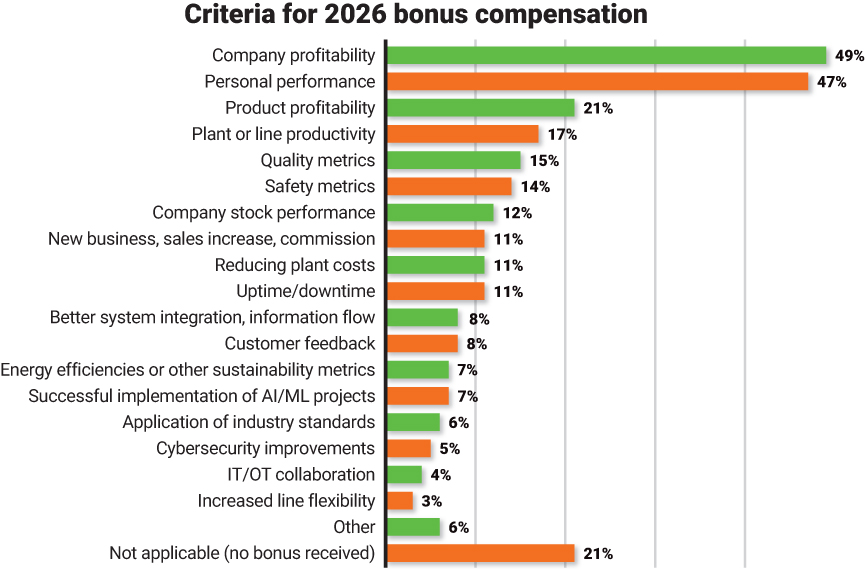
Company profitability (49%) and personal performance (47%) remain statistically tied in 2026 as the dominant criteria for bonus compensation. The next seven bonus criteria were tied for second (Figure 4).
Pick up to three factors for job satisfaction with automation, controls
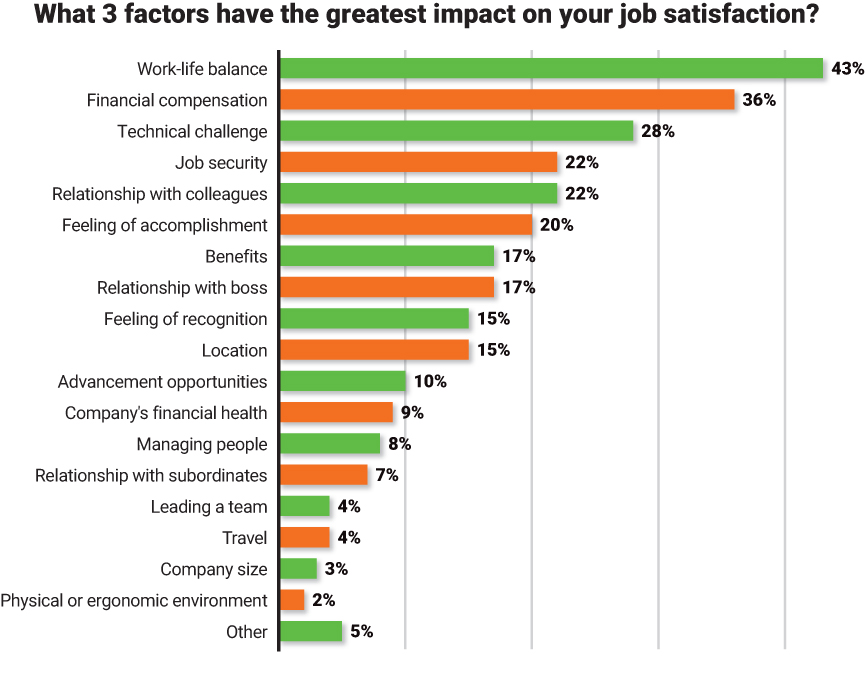
Most important among job satisfaction factors was work-life balance (described as “workload, flexible work hours, ability to work from home, etc.”) and financial compensation. Plenty of other criteria make a career in automation and controls worth considering, such as technical challenge, job security and relationship with colleagues, among a list of 11 double-digit job satisfaction reasons on Figure 6.
Among respondents, 66% performed some work remotely, with the largest grouping, 34% in the 1% to 20% range. Interestingly, 14% performed more than 60% of their work remotely.
Hours worked nearly equaled respondents from 2025 research.
9% worked fewer than 40 hours (9% in 2025, 11% in 2024, 9% in 2023)
46% worked 40 to 44 hours (46% in 2025, 48% in 2024, 42% in 2023)
20% worked 45 to 49 hours (17% in 2025, 19% in 2024, 24% in 2023)
15% worked 50 to 54 hours (13% in 2025, 13% in 2024, 14% in 2023)
3% worked 55 to 59 hours (same in 2024, 2023)
7% worked 60 or more (6% in 2024, 8% in 2023).
Help from a stunning diversity of automation-related technologies
Control Engineering subscribers develop, integrate and use a wide diversity of controls, automation and instrumentation. In 2026, survey respondents selected from among 28 technologies when asked: “What technologies are most likely to help you in the coming year? Check all that apply.” Twenty ranked in the double digits.
Survey methods for 2026 career and salary report
Research for the 2026 Control Engineering Career and Salary Report resulted from an emailed survey to subscribers, producing 218 qualified responses from March 11, 2026, to May 7, 2026, for a margin of error of +/-6.6% at a 95% confidence level. Survey respondents were invited to anonymously provide their annual compensation information and opinions on the current state of their facilities and industries as well as submitting advice for peers. (See related article online.)
Engineering salary, bonus details
In Figure 1, 51% expect a salary increase of up to 3% in 2026 (45% in 2025; 42% in 2024; 45% in 2023 and 2022; 51% in 2021; 52% in 2020; 63% in 2019; 56% in 2018); 17% expect an increase of 4% or more (16% in 2025; 18% in 2024; 19% in 2023; 12% in 2022; 14% in 2021; 18% in 2020; 11% in 2019; 19% in 2018); 5% expect more than 6% increase (7% in 2025; 6% in 2024; 7% in 2023; 10% in 2022); 31% expect the same (30% in 2025; 31% in 2024; 28% in 2023; 32% in 2022 and 2021; 30% in 2020; 25% in 2019; 23% in 2018); and 2% expect a salary decrease (2% in 2025; 3% in 2024; 1% in 2023 and 2022; 3% in 2021; 1% in 2020 and 2019; 2% in 2018).
For base salary compensation, the minimum among respondents was $19,500 ($22,080 in 2025; $20,000 in 2024; $22,000 in 2023; $20,000 in 2022; $28,000 in 2021), and the maximum was $252,000 ($350,000 in 2025; $360,000 in 2024; $300,000 in 2023; $266,700 in 2022 and $250,000 in 2021).
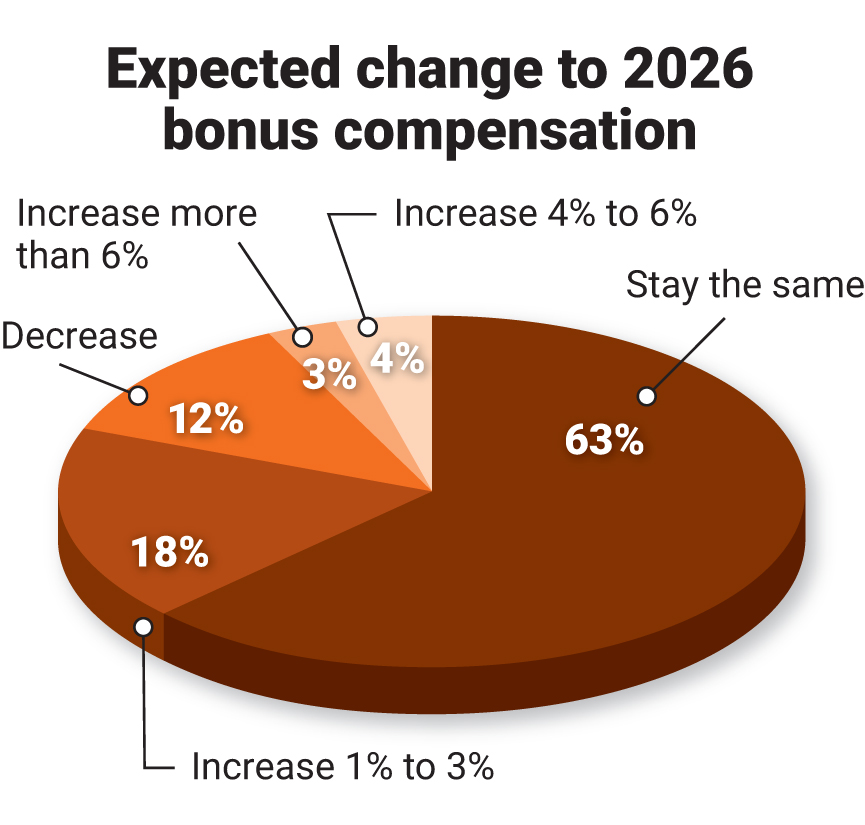
For bonus compensation (Figure 2), 18% expect an 1% to 3% increase (13% in 2025; 18% in 2024; 15% in 2023); 4% expect an increase of 4% to 6% (6% in 2025, 2024 and 2023); 3% expect an increase greater than 6% (8% in 2025; 7% in 2024; 8% in 2023); 63% expect about the same (62% in 2025; 59% in 2024; 57% in 2023); and 12% expect less (11% in 2025; 10% in 2024; 14% in 2023).
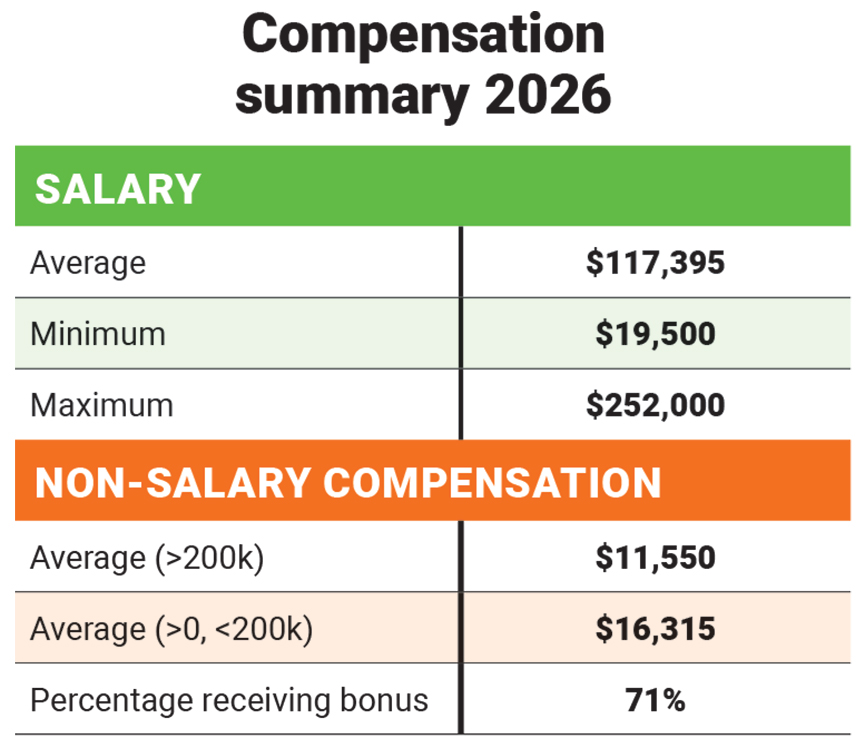
For those receiving bonus compensation (Figure 3), the average received was $16,315, compared to $18,595 in 2025, $16,125 in 2024 and $15,929 in 2023). The average across all respondents is $11,550, compared to $13,765 in 2025 and $11,840 in 2024); 29% received no bonus (25% in 2025 and 2024).

Engineering bonus criteria
Two leading criteria for non-salary compensation were statistically tied: company profitability at 49% (57% in 2025; 51% in 2024; 55% in 2023), and personal performance at 47% (53% in 2025; 51% in 2024; 43% in 2023); see Figure 4. Among other responses were: Product profitability at 21% (14% in 2025); plant or line productivity 17% (8% in 2025); quality metrics at 15% (15% in 2025); safety metrics 14% (7% in 2025); company stock performance at 12% (12% in 2025), new business/sales at 11% (18% in 2025); reducing plant costs 11% (8% in 2025); uptime/downtime 11% (6% in 2025).
Engineering job satisfaction, manufacturing threats shift
As mentioned, work-life balance ranked at 43%, a statistical tie with financial compensation at 36% (finances typically rank higher during challenging economic years), followed by technical challenge at 28%. See Figure 6 for other criteria.

Among manufacturing threats, lack of skilled workers led at 42%, up from 38% in 2025. Second was economy at 34% and taxes and tariffs at 28%. See additional threats in Figure 7.
Older engineers, years at work, education
Control Engineering research provides demographics as context, and extra figures in the report provide more information and benchmarking, examining compensation by years, education, years in industry, by hours worked by employees managed, by job function and by facility size.
Among those surveyed last year and this year, age trended older: 75% of respondents were 50 or older, up from 61% in 2025. Aging demographics and high rate of retirements in the baby boom generation creates additional concerns for lack of skilled talent and make trusted information sources more useful for younger engineers seeking answers for questions that mentors may have provided in the past.
Years working for current employer trended longer, with 30% were 9 years or less, compared to 49% in 2025 and 50% in 2024, 23% at 10 to 19 years, about the same as 2024 at 22%, 26% at 20 to 29 years up from 16% in 2025 and 21% at 30 or more years (13% in 2025).
Years in current industry trended higher, at 6% for 9 or fewer years, 15% in 2025; 18% at 10 to 19 years (18% in 2025); 22% at 20 to 29 years (20% at 2025); 30% at 30 to 39 years (27% in 2025) and 23% at 40 years or more (20% in 2025).
Highest level of education completed were: 5% high school diploma (<1% in 2025), 5% trade/technical school diploma (6% in 2025), 6% associate degree (5% in 2025), 8% college attendance (5% in 2025), 41% had a bachelor’s degree (54% in 2025), 28% had a master’s degree (22% in 2025), 3% dual bachelor’s degrees (5% in 2025) and 4% a doctoral degree (2% in 2025).
Mark T. Hoske is editor-in-chief, Control Engineering, WTWH Media, [email protected]. Amanda Pelliccione, marketing research manager, WTWH Media, conducted the research and assembled the related report available online.
More answers
For more information, see this article online and download the Control Engineering 2026 Career and Salary Report.
Consider this
On the next pages, see related articles on:
Advancement skills and advice
Keywords: 2026 salary survey, career advice
Learning objectives
Learn about trends in salary and benefits from the 2026 Control Engineering Career and Salary Survey.
Examine perceived threats to manufacturing and changes from prior years.
Compare and benchmark your career progress with peers in the online version of this study.
You also might like
Download the full 2026 Control Engineering Career and Salary Survey and Report to see more details, including benchmarking tables.
Learn more about workforce development.
https://www.controleng.com/workforce-development
See recent Control Engineering magazines:
Artificial intelligence and machine learning (AI/ML) along with automation upgrades were the leading technologies helpful to those taking the 2026 Control Engineering Career and Salary Survey.