CHIPS funding tied to equity stakes may add uncertainty for fab investment, affecting forecasts for automation and motion control demand.
The CHIPS Act, launched in 2022 under the Biden administration, was intended to encourage domestic semiconductor production by allocating $280 billion. It represented a federal effort to strengthen U.S. manufacturing capacity and reduce dependence on foreign supply chains.
Under the Trump administration, the policy changed. Intel was initially promised CHIPS Act funding in March 2024 to increase U.S. manufacturing capacity. However, by August 2025, access to those funds became contingent on the U.S. government receiving a 10% equity stake in the company. This approach, which would make the federal government a shareholder, differs from past subsidy-based program. Companies may consider the tradeoffs between financial incentives and government involvement, adding uncertainty to the long-term outlook for U.S. semiconductor expansion.
Control Engineering analysis: Growth of semiconductor supplies is important for automation, control and instrumentation users, equipment manufacturers and system integrators because logic devices are required for and embedded in the “decide” portion of the control loop. In recent decades, the trend toward smart instrumentation, smart devices, edge computing, industrial communications and smart sensors has increased the need for semiconductor devices for the other two parts of the control loop. This includes sensors and actuators (motors, pumps, fans) — as well as networks and software applications that connect and integrate controls and automation with other parts of the plant, enterprise and supply chains.
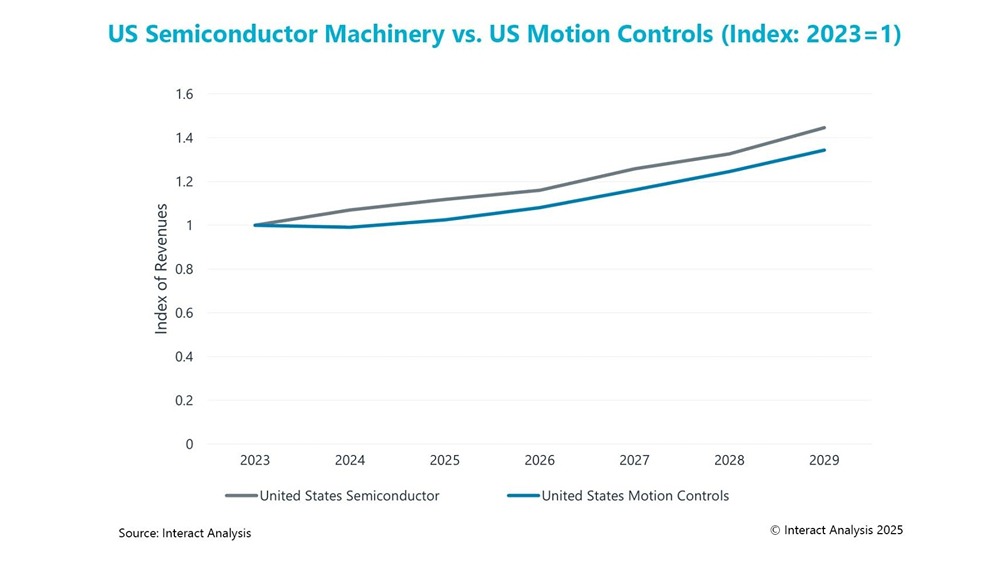
Semiconductor investment is a key factor for industrial automation and motion control. Changes to major subsidy programs affect the timing, scale and predictability of semiconductor equipment spending. New fabrication facilities often require significant investment in motion control systems due to precision requirements. When fab projects slow or stall, motion control suppliers may see effects quickly. Prior to policy changes, U.S. semiconductor and electronics machinery revenue within the motion controls market was expected to increase through 2029. Updated forecasts indicate slower growth as uncertainty may delay investment decisions.
Global policy and competition
International strategies contrast sharply with the U.S. approach.
The European Chips Act, backed by €43 billion in public and private funding, focuses on coordination rather than centralized control. It supports cross-border R&D initiatives and more flexible state-aid rules that allows member nations to fund semiconductor fabs. It does so without direct ownership or government involvement. The approach may offer a more predictable framework for investment and has drawn foreign interest, including from US and Asian firms.
In Asia, Japan’s Chip Strategy and South Korea’s K-Chips Act take a similar approach. Both aim to provide long-term policy stability, tax incentives and a defined separation between government support and corporate governance.
Compared with these collaborative models, the U.S. approach may involve more direct government involvement. The conversion of CHIPS funding into government equity has prompted questions about the line between public subsidies and government control. For investors and manufacturers evaluating multi-year investments, clarity and consistency are important in addition to incentives.
Regional investment choices for suppliers in the motion controls and automation sector are becoming more important. Regions with transparent public-private subsidy programs may capture a larger share of motion control demand linked to semiconductor expansion. This aligns with projected growth rates. South Korea, Taiwan and Japan are expected to grow revenue at 2.5%, 5.5% and 5.0% respectively from 2023 to 2029.
Impact on motion controls
The motion controls market in the U.S. is projected to see above-average growth over the next decade, linked in part to semiconductor investment. In the U.S., semiconductor and electronics sector revenue is expected to grow at a 6.3% CAGR from 2023 to 2029, compared with 3.5% overall market growth, placing it second among industries by projected growth rate. However, as federal policy in the U.S. shifts, this raises concerns that earlier forecasts for semiconductor-related growth could be reduced.
What’s next?
If current patterns persist, semiconductor manufacturers may focus expansion in other regions.
Regions that attract investments from the United States may see a larger increase in motion control demand over the coming decade. Europe, Japan and South Korea may be viewed as alternatives for semiconductor expansion due to transparent subsidy structures and more predictable long-term policy. For the U.S., the risk is less about losing capacity and more about losing pace. If investors and suppliers view the U.S. market as less predictable, they may shift resources to regions where policy frameworks are more predictable. This could have long-term effects on the global motion control market.
Edited by Puja Mitra, WTWH Media, for Control Engineering, from an Interact Analysis news release.