Voltage sags and interruptions can have a detrimental effect on manufacturing processes. Understanding how and why they happen is crucial.
Consider this familiar scenario: Manufacturing processes are up and running, the product emerges flawlessly as may happen for days or weeks at a time, and then the lights blink (or perhaps not) and things stop… perhaps for hours. The line must be cleaned and reset. The materials in process are likely unsalvageable. Schedules are affected, time is lost, product is lost, and money is lost.
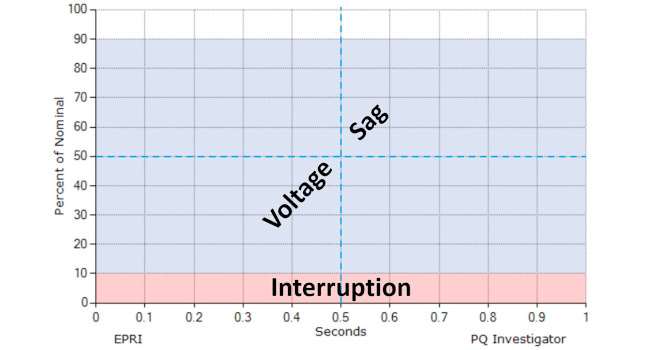
What happened? Many might think the electrical event was a power surge, or outage, a power blip, which are ambiguous terms for events with precise definitions in the power industry concerning a momentary complete loss of voltage or a momentary reduction in voltage — an interruption or a voltage sag. More than likely, however, it was a momentary reduction in voltage. Figure 1 illustrates the difference in magnitude between the two.
A voltage sag occurs when the supplied voltage briefly falls below 90% of nominal (the blue area, 108 volts for a 120-volt system, for instance). Should the voltage fall to 10% of nominal or below (the reddish area, 12 volts for a 120-volt system), an interruption has occurred. Studies by the Electric Power Research Institute (EPRI) have determined almost all voltage sags occur within 1 second — most falling within 0.5 seconds, and most having a magnitude above 50% of nominal voltage.
Voltage sags have a magnitude — how much of the nominal voltage remains, and a duration — the amount of time the voltage sag lasts. Figure 2 shows the 60 Hz, three-phase, voltage waveforms and the measured root-mean-squared (RMS) voltage traces. In the top figure, the blue line, “Channel 1” representing phase A (the others being phases B and C), shows the waveform bobbles for just over 1 cycle (out of 60 cycles per second at 60 Hz). The bottom figure shows, at its lowest point, the voltage drops to ~25% at about 68 volts in this case, and for a very brief interval of time. The whole event occurred within 0.04 seconds.
What causes interruptions and voltage sags?
Storms, as well as animal interactions with above-ground electrical systems, are common causes of interruption and voltage sag events. Multiple distribution feeder circuits connected to a substation transformer secondary may resemble a hand (the transformer secondary) and its extended fingers (the distribution feeder circuits). These distribution circuits (the fingers) could extend for tens of miles. Should a tree limb touch one of the feeders — as it might during a storm — a short circuit (called a fault) on one or more phases to ground or between phases may result on that feeder. All the other feeders (again, the fingers) connecting to that substation transformer secondary (the hand) will experience a voltage sag as well, which could fall below 10% of nominal voltage depending on the circumstances.
The circuit breaker on the shorted feeder may operate to interrupt the fault, thus disconnecting the downstream loads, which is an interruption in service. Once the circuit breaker on the affected feeder opens, however, the voltage sag ends on the other feeders. Voltage sags, however deep, may be very brief. Depending on the circuit breaker reconnection settings and the nature of the fault, the interruption on the faulted feeder could be brief, as well.
Why are voltage sags an issue for industrial equipment, and why are industrial controls sensitive to voltage sags?
Built-in sensitivity
Most electrical equipment in the United States is designed to function normally for steady-state voltage at ±10% of the nominal voltage. Thus, the operating voltage is presumed to be constant (although sometimes, it is not). Industrial controls in the United States have a long history of being designed at 120 volts ac (alternating current).
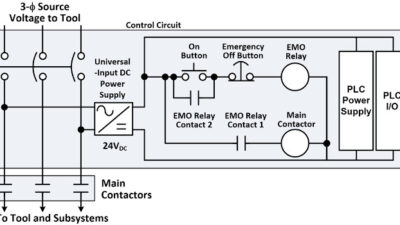
An example is shown in Figure 3 with a step-down control power transformer (CPT) connected phase-to-phase. Within the control circuit might be an emergency off circuit (EMO) with an ac “ice cube” relay supplying 120 volts to the coils of the main contactors in turn supplying the process. AC controls do not normally store energy. The ac voltage goes to zero 120 times per second at 60 Hz. Therefore, during a voltage sag, nothing prevents the control voltage from dropping as well. The process stops when the controls stop functioning.
The controls stop because of sensitivities of individual control components that are vulnerable to voltage sags. Only one is needed to halt the process. In the case above, the ac “ice cube” relay, which typically opens at around 70% of nominal voltage, has the same effect at a low-enough voltage — as if someone pushed the emergency off button.
Other potentially sensitive components include but are not limited to the programmable logic controller (PLC) power supply (or other dc power supplies), the PLC I/O, adjustable speed drives (ASDs) and other contactors. With multiple processes inside the facility, specific control circuits may be powered from different phases. Different processes may stop at various times depending on which phases experience a voltage sag.
Industrial process sensitivity to power quality events is the result of inherent sensitivities within the process controls to momentary reductions in supply voltage. These momentary reductions usually stem from events in the above-ground electrical distribution system that create phase-to-ground or phase-to-phase short circuits.
Understanding the sources of the problem of process sensitivity to voltage sags is important to identifying possible solutions to this problem, which will be addressed in part 2.
Increase uptime when power quality (PQ) issues occur
- Understand your PQ environment – prescribe solutions that fit your situation
- Don’t assume battery based uninterruptible power supply (UPS) systems are needed; there are other technologies
- Avoid use of sensitive ac components in controls
- Embed Robustness using ac- or dc-based controls that are compliant with IEEE 1668 or SEMI F47.
- Use voltage sag-ride through settings in your motor drive systems.
Visit https://mypq.epri.com or E-mail [email protected] for help in improving voltage sag robustness of your industrial automation systems.
Mark Stephens is principal project manager; Alden Wright is technical leader, Electric Power Research Institute (EPRI). Edited by Chris Vavra, associate editor, Control Engineering, CFE Media, [email protected].
MORE ANSWERS
Keywords: power quality, voltage sags
Voltage sags or interruptions can have a detrimental effect on a manufacturing’s production line and cause major downtime issues.
A voltage sag occurs when the supplied voltage briefly falls below 90% of nominal voltage.
Industrial process sensitivity to power quality events is the result of inherent sensitivities within the process controls to momentary reductions in supply voltage.
CONSIDER THIS
What has your company done to better prepare for voltage sags or interruptions?
Watch for part 2 topic coming soon: Power conditioning solutions to match the power quality environment.