Bundy Group is an investment banking and Mergers & Acquisitions advisory specialist that has specialized in the automation and control system integration markets for over 16 years.
Please note: The information and content in this article reflect conditions and data as of July 2025, the time of writing.
Heading into 2025, the mergers and acquisitions (M&A) market was positioned for a strong year, and the first quarter of this year did not disappoint. However, the broader economy and geopolitical landscape presents challenges for the overall M&A market, and it raises questions about whether there will be a negative impact on the robust control system integration M&A market for the remainder of 2025 and into 2026.
To provide clarity on this evolving market, we start with a real-time assessment of broader market conditions — offering essential context for emerging trends in the control system integration segment.
Complementing this market snapshot, I also wanted to offer an update on the control system integration M&A market as well as the broader automation solutions M&A market.
The North American M&A market
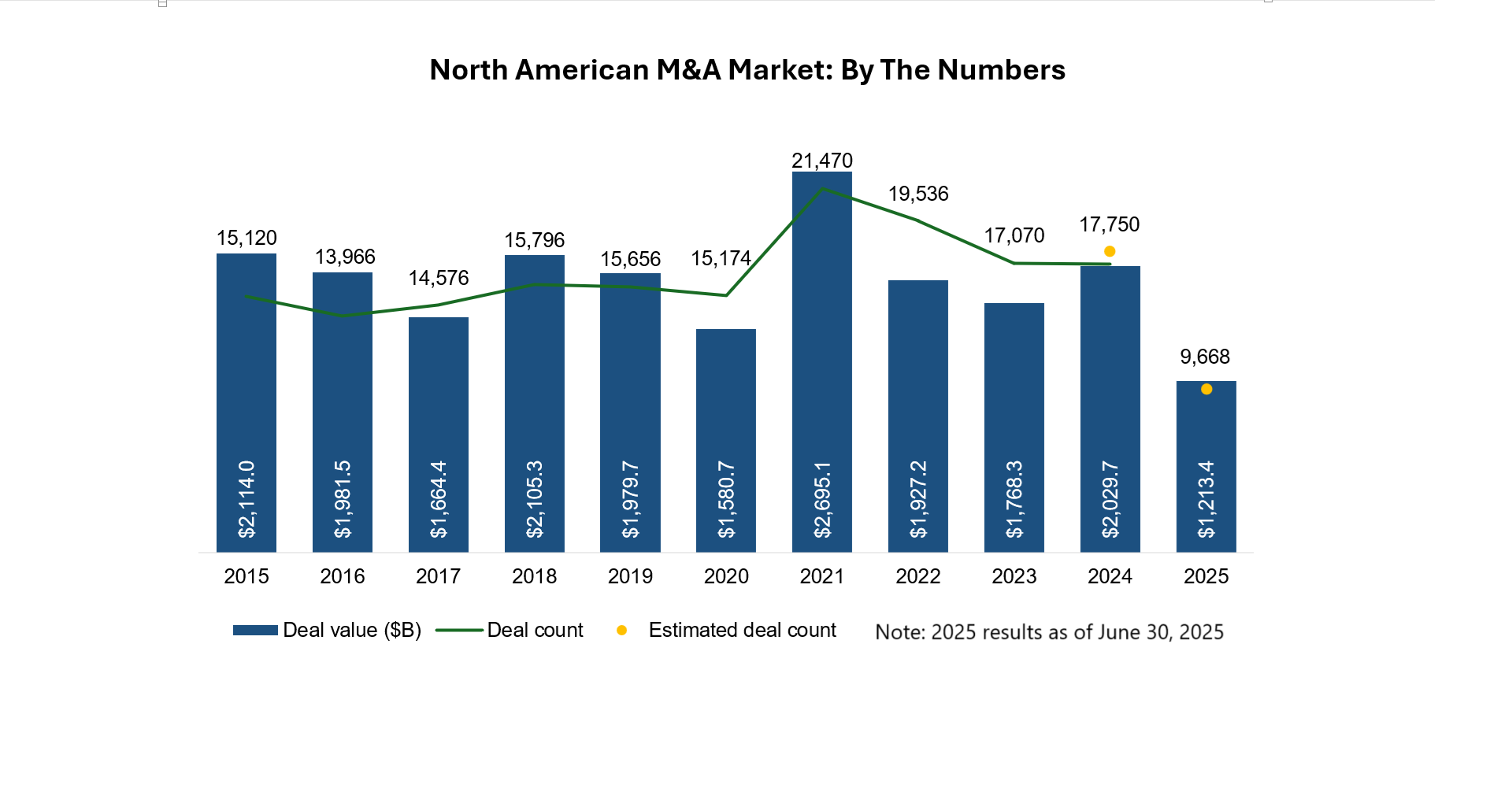
Business owners considering a sale or acquisition should understand the recent M&A market cycle. In 2021, North American M&A activity reached an all-time high of $2.7 trillion, driven by low interest rates, a backlog of deals from the pandemic, and strong buyer demand.
Activity cooled in 2022 and 2023, as rising interest rates and greater caution from buyers led to a decline in deal flow — dropping to $1.8 trillion by 2023, according to PitchBook.
Encouragingly, 2024 brought renewed momentum in terms of transaction activity. As buyers adjusted to the higher rate environment and became more active, 2024 transaction value climbed roughly 16% over the prior year, reaching $2.0 trillion (see Figure 1).
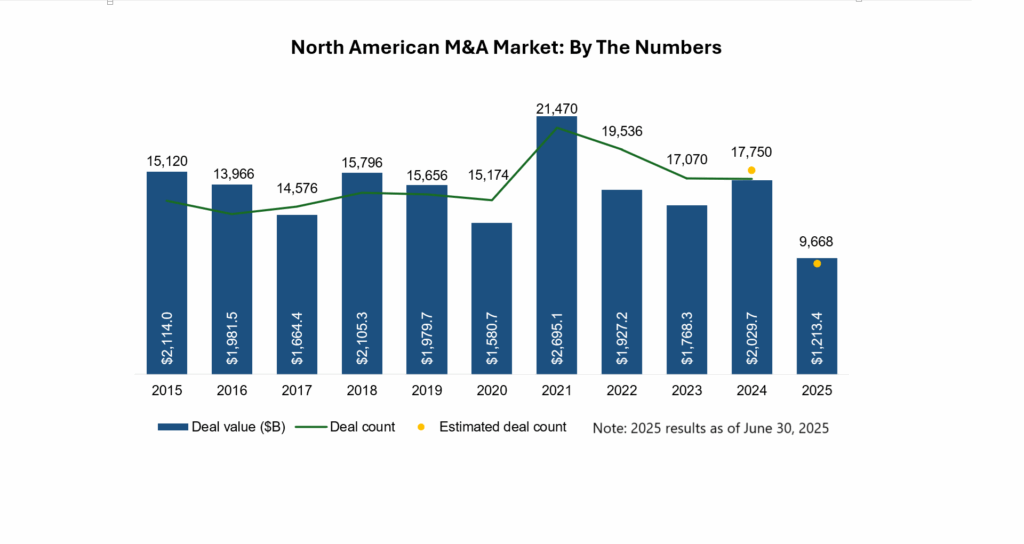
Through the second quarter of 2025, North American mergers and acquisitions (M&A) activity reached a total transaction value of $596.8 billion across nearly 4,500 deals, according to PitchBook. Although deal value dipped 3.2% from Q1 to Q2, it represented a robust 31.3% year-over-year increase.
This strong performance in the first half of 2025 was largely driven by several factors:
- A resurgence of large-scale corporate transactions
- Continued momentum in the technology sector and related sub-verticals
- Increased confidence among dealmakers that macroeconomic challenges were unlikely to trigger a near-term recession
- An increase of add-on transactions, which were approximately 76% of all deals through Q’2 2025 – a substantial difference from the five-year add-on average of 72.5%
Despite strong momentum carried over from 2024, transaction professionals remain cautious, carefully monitoring macro-level risks such as global trade tensions and geopolitical instability that could influence the M&A landscape. While Bundy Group continues to specialize in the control system integration and automation solutions sectors, we’re also observing steady buyer demand across other business services and tech-enabled services verticals. At the same time, seasoned acquirers are exhibiting heightened discipline in their evaluation of opportunities, with a clear emphasis on understanding how broader economic conditions may affect backlogs, revenue projections, and overall deal viability.
The control systems integration M&A market
As a dedicated M&A advisor to the control system integration market for over 15 years, Bundy Group has consistently witnessed strong momentum in the M&A market for control system integration companies. This growth is driven by several key factors: the sector’s inherent resiliency, ongoing market expansion, a highly fragmented integrator landscape, and the compelling investment returns achieved by groups that have acquired, scaled, and successfully exited control system integration firms.
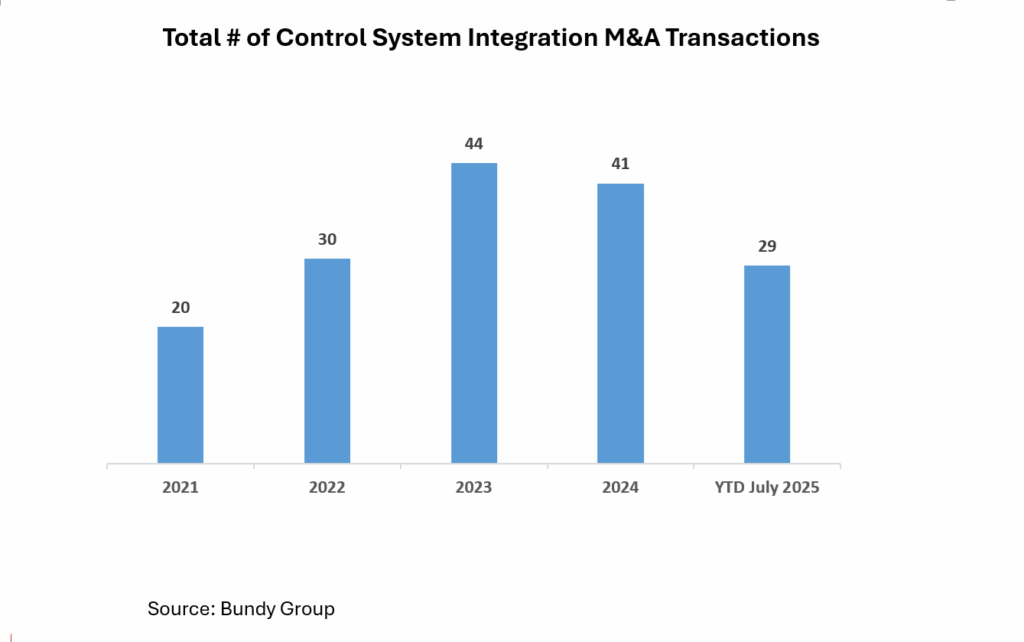
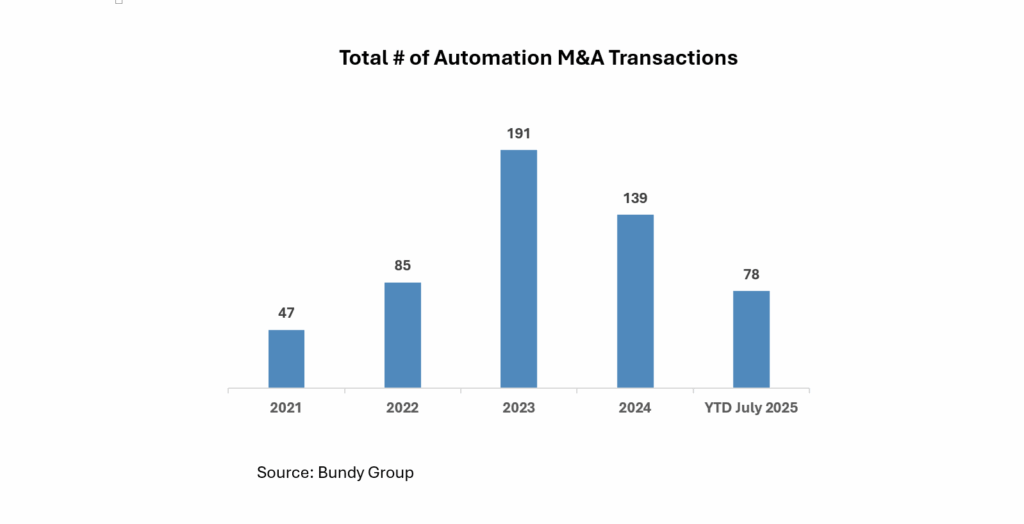
As illustrated in the two charts below (see Figure 2 and Figure 3), both the control systems integration M&A market and the broader automation solutions space continue to experience a robust pace of transaction activity — clear evidence that buyers and sellers remain highly active in these segments.
Bundy Group’s ongoing work within the control system integration sector gives us a unique vantage point to share proprietary market insights. Recent transaction experience includes the successful sale of three control system integration companies — CITI, EPIC Systems and Compass Systems — in the past eight months alone (see Figure 4). Our client engagements, along with our current mandates in the space, offer key takeaways for business owners and investors evaluating opportunities in this dynamic market.

Takeaways from the control system integration M&A market
There are quite a few takeaways from 2025’s control system integration M&A market.
- Robust buyer demand: Control systems integration firms remain highly sought after by both financial sponsors (i.e., investors) and strategic buyers (i.e., operating companies seeking add-on acquisitions). Buyer demand continues to outpace supply, particularly for high-quality control system integration businesses-creating a competitive environment that favors sellers.
- Buyer separation: Sophisticated financial sponsor and strategic buyers in the control system integration market seek to thoroughly understand a company before submitting a letter of intent (LOI) or offer. In contrast, opportunistic buyers often bypass early diligence, which can signal a higher likelihood of re-trading on terms or walking away during due diligence. Inherent knowledge of the pool of buyers, and how they perform when the “rubber meets the road,” is critical.
- International buyer presence: Today’s geopolitical and macroeconomic conditions are accelerating strategic and financial sponsor buyer interest in the North American market. Bundy Group had one control system integration client sell in 2025 to a European-based strategic buyer, and we had another industrial client sell this year to a Japanese-based publicly traded conglomerate. Both buyers were aggressive in their pursuit of the opportunities and in their value / structuring on the respective transactions.
- Competition translates to value: We specialize in representing running competitive processes on behalf of our clients in a sale process. We continue to see that no two buyers value a company the same way, and that a competitive process yields the best results.
The percentage spread between the highest offer and the lowest offer on five recent control system integration transactions have been as follows:
Automation Client 1: 108%
Automation Client 2: 91%
Automation Client 3: 198%
Automation Client 4: 143%
Automation Client 5: 148%
To illustrate with sample math using a 198% spread: if the lowest offer was $20 million, the highest would be approximately $59.6 million — a $39.6 million difference that highlights just how impactful buyer competition can be in a sale process.
- Financial and KPI Preparation: Seasoned buyers are more willing to compete and pay higher valuations for companies that are deemed lower risk investments. A significant factor in determining risk is the depth of financial details and systems that a company has implemented. Further areas of focus include:
- Revenue recognition: An area of great focus and scrutiny in due diligence by buyers. We encourage owners to seek advisor advice (transaction accounting firm; investment banking advisor) on critical items and potential missteps with revenue recognition, including percentage of completion accounting, owners make that can impact value in a sales process.
- Backlog conversion: Since buyers are acquiring the future, they focus mightily on conversion of pipeline to backlog according to company projections. If the company is consistently missing its backlog conversion, then that can create doubt about the company’s future performance.
- Financial controls: Lack of financial controls and systems, which can’t support detailed financial requests, increase riskiness of a company in eyes of a buyer.
Clint Bundy is the managing director of The Bundy Group, a CSIA member; CSIA is a WTWH Media content partner. Edited by Sheri Kasprzak, executive editor, Automation & Controls, Control Engineering, WTWH Media, [email protected].