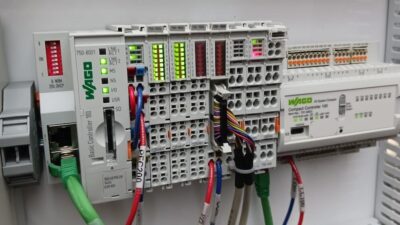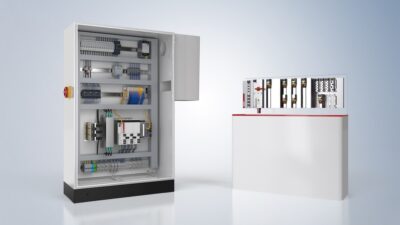
Industrial automation projects rarely fail because of bold architectural decisions. More often, they slow down because of repetition, inconsistency and preventable variability at the component level.

Remote I/O for automation insights
- Remote I/O can serve as reusable platform – designed once and deployed everywhere.
- Standardizing the remote I/O station provides advantages for automation applications.
- A distributor perspective on modular I/O offers customers easier automation installations and use.
Faced with balancing scalability of production systems with compressed timelines, engineering teams are under pressure to execute faster without sacrificing reliability. At the same time, sourcing teams must manage inventory complexity, mitigate supply risk and control lifecycle cost across distributed assets.
Remote I/O is deeply embedded in this dynamic. While it might not define the system architecture, it connects nearly every sensor and actuator to the control layer. It is deployed repeatedly across machines, across facilities and across years of operation. How it is selected and standardized can either reinforce efficiency or quietly undermine it.
In today’s environment, further complicated by elevated uptime expectations and supply conditions that can shift unexpectedly, remote I/O deserves strategic attention.
The goal is no longer simply to install it. Instead, the goal should be to treat it as a reusable platform – designed once and deployed everywhere.

Hardware diversity can lead to fragmentation, inefficiencies
Distributed automation has become the norm. Warehouses rely on remote I/O stations throughout expansive conveyor systems. Manufacturing organizations replicate similar production lines across multiple sites. Machine builders deliver comparable architectures into varied customer ecosystems.
In every industry, execution speed directly affects revenue timelines. Commissioning delays can be caused by wiring errors, inconsistent documentation or controller substitutions that push projects off schedule.
At the same time, organizations operating multiple facilities face long-term maintainability challenges. Over years of incremental projects, hardware diversity accumulates.
Different PLC brands introduce different I/O families. Different integrators apply slightly different wiring standards. What organizations are left with are fragmented spare inventories, broader technician training requirements and longer troubleshooting cycles.
Small inefficiencies at this layer multiply quickly. But remote I/O sits directly in the heart of those challenges and offers a path to ease and even eliminate those pressures.
Moving beyond controller-centric I/O
Historically, I/O selection followed PLC selection. If a project specified a particular controller brand, the matching I/O family was typically chosen. This simplified integration and maintained alignment within a one-vendor ecosystem.
However, this approach resulted in long-term complexity. Organizations supporting multiple controller platforms ended up maintaining multiple I/O ecosystems, often exacerbated over multiple site operations. With each of those ecosystems came separate spare part inventories to maintain, extensive documentation and broader technician training requirements, not to mention longer troubleshooting cycles.
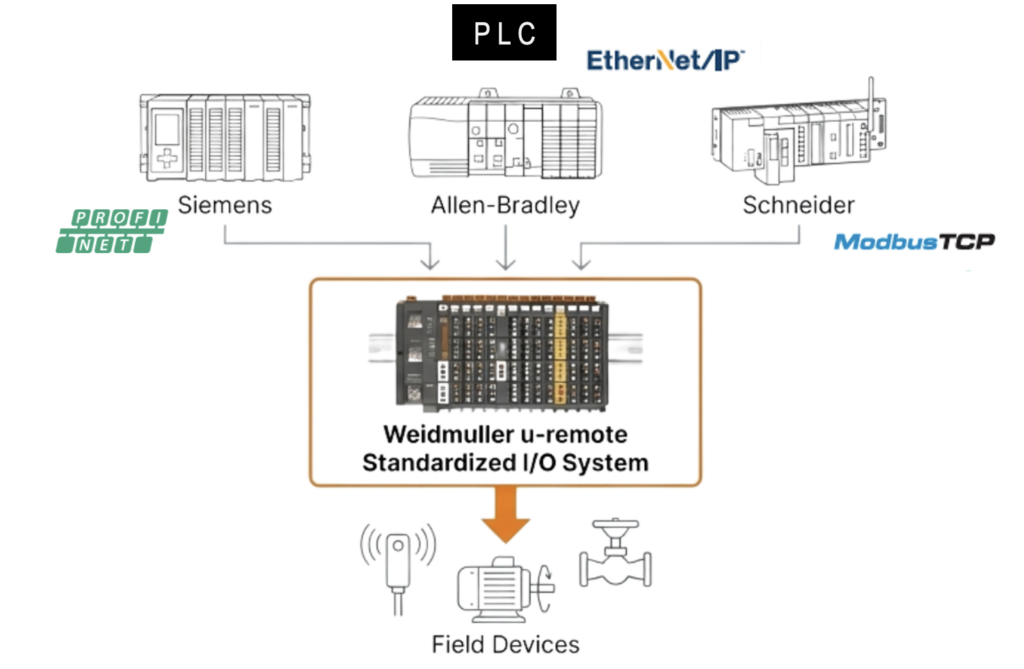
Modern universal remote I/O platforms open up smarter strategies. Instead of tying I/O hardware to a controller brand, engineers can standardize the I/O module platform itself and select communication interfaces that match the required industrial protocol.
If the controller changes, the I/O layer does not need to be redesigned – only the coupler selection adapts. This shift transforms remote I/O from a project-specific component into a repeatable, reusable subsystem.
Standardizing the remote I/O station
Taking a closer look at remote I/O stations is the first step in moving toward standardization and smarter automation.
A remote I/O station performs two essential functions:
- It connects physical field devices – including digital inputs and outputs, analog signals and specialty measurements – to I/O modules.
- It then bridges those modules to the control system through a fieldbus coupler or gateway.
The coupler translates between the industrial network used by the controller and the internal system bus used by the I/O modules. The modules gather process and diagnostic data and transmit it through that interface.
When the I/O module platform and communication interface are structurally separated, it becomes possible to standardize one without locking into the other.
A scalable standardization strategy typically addresses three areas: module configuration, control power distribution and the network architecture. Using a consistent module configuration across projects allows drawings, wiring diagrams and configuration templates to be reused. Consistent power segmentation and protection strategies reduce design variability.
Standardized ethernet topology and addressing conventions further reinforce repeatability.
When aligned, the remote I/O station becomes a modular building block rather than a custom assembly.
What could be considered a high-functioning remote I/O
When considering a remote I/O platform, first look for:
- A modular approach with feature-rich and future-proof architecture that separates the I/O slice construction from the communication layer
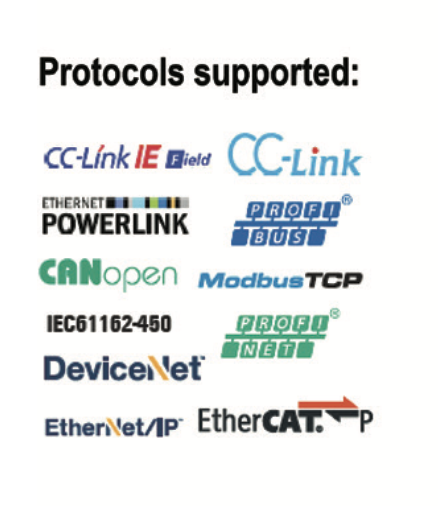
- Compatibility across major industrial protocols commonly used in North America – including EtherNet/IP, Profinet, Modbus TCP and EtherCAT as well as additional global variants.
In practical terms, the same I/O modules should be able to be deployed across projects even when controller brands vary. A change in PLC does not require a wholesale change in I/O hardware. Only the coupler selection should need to be adjusted to match the network protocol. For engineering teams, this reduces rework and protects design effort. For sourcing teams, it reduces the proliferation of parallel I/O families tied to specific controller ecosystems.
When designing a standardized remote I/O platform, be sure to incorporate several approaches that will translate into high performance, including significant operational gains:
- Modularity that extends into maintenance: Standardization delivers value only if it simplifies the full lifecycle – not just at installation. Selecting a system where each is constructed in layered fashion means that a DIN-rail mounted base provides the mechanical and electrical foundation, and a removable wiring interface connects to the field. An electronics module defines the I/O function. These layers are separable. If and when an electronics module fails, that component can be replaced without removing the base from the DIN-rail or disturbing field wiring. In fact, electronics often can be swapped without powering down the entire station.
- Installation consistency and commissioning reliability: Commissioning variability often stems from physical wiring differences rather than software complexity. If a system generally follows the same 4×4, single-row terminal layout, then technicians can quickly build familiarity across deployments. Color-coded termination points and push-in connection technology supports rapid, repeatable installation. Signal definitions printed directly on the module wiring interface for each termination point reduce reliance on external documentation during panel build.
- Compact design for retrofit and expansion: Physical constraints frequently influence design decisions, particularly when an organization faces retrofit environments. Modular systems can deliver slim widths that allow high I/O density within limited DIN-rail space. Engineers can design spare capacity into panels without significantly increasing enclosure size. In upgrade scenarios where replacing cabinets is undesirable, compact modules provide flexibility that can reduce hardware and engineering cost.
- Visibility and diagnostic depth: Operational efficiency depends on how quickly problems can be identified and resolved. Effective next-stage I/O platforms should offer integrated visual health indicators at the module and signal level, allowing technicians to assess system conditions immediately. A built-in web interface then would enable detailed device status review through a standard browser. Diagnostic information can be transmitted alongside process data, allowing system designers to expose meaningful condition information to the control system, which can be communicated within HMI or SCADA environments.
A distributor perspective on modular I/O use
From a sourcing standpoint, platform independence and modularity influence long-term cost structure. To recap, a single I/O modular family generates consolidated parts inventories, narrower training requirements and a streamlined footprint to support future growth and reduce downtime. Plus, the new solution must be compatible with most global industrial protocols, as well as flexible to meet the rapid advance of AI capabilities.
Across one project, the reduction resulting from a modular system might appear modest. Across repeated deployments and multiple facilities, it becomes structural and leads to a meaningful operational advantage, including faster time to market and higher revenues.
When remote I/O is standardized as a reusable building block, engineering becomes more predictable, procurement becomes more streamlined and maintenance becomes more efficient.
“Design once, deploy everywhere” becomes not a slogan, but an operational discipline – one that aligns engineering execution with sourcing strategy and long-term reliability.
James Black is application sales engineer with Weidmuller USA’s Automation Solutions Network. Edited by Mark T. Hoske, editor-in-chief, Control Engineering, Arrowfly, [email protected].
Keywords
PLCs, I/O control modules
Consider this
Are you deploying modern remote I/O to help your automation architecture?
You also might like
Also from Control Engineering, see:
Introducing simpler backup power for industrial control systems
Automate 2024 Interview: Ken Crawford and John Spence, Weidmuller, discuss u-OS, interoperability