Tutorial: Six-axis robots have been employed by Gü Indulgent Foods to automate a packing line to help it expand to meet growing demand and boost productivity.
Short-term supplier contracts and a reliance on cheap labor have, traditionally been obstacles to investment for some food manufacturers. Today, however, automation systems incorporating robotics are becoming a more common sight in many food factories, where they are being used to help boost productivity, improve worker welfare and are enabling manufacturers to more quickly respond to changing consumer demands.
With their accuracy, reliability and speed, robots are well-suited to repetitive, dull or laborious tasks where humans add little value – for example packing, picking, placing and palletizing – leaving the human workforce to concentrate on parts of production where they can make a real difference.
One company that has reaped the benefits of automation is Gü Indulgent Foods. Its first chocolate soufflé pots hit the shelves in 2003, and demand quickly grew. This meant that Gü needed to expand its packing hall and so it turned to Fanuc partner, Tekpak Automation to help it find an automated answer to its productivity problem.
“Gü requested a second packing line that needed to fit into a very compact area,” said Darragh Sinnott, technical director for Tekpak Automation. “It also wanted greater cartoning and palletizing flexibility.” The new line would have to be able to handle new quad-packs as well as the existing variety of case formats – twin-packs x6 and twin-packs x4. Virtual programming software determined robots needed to meet payload, speed and reach requirements.
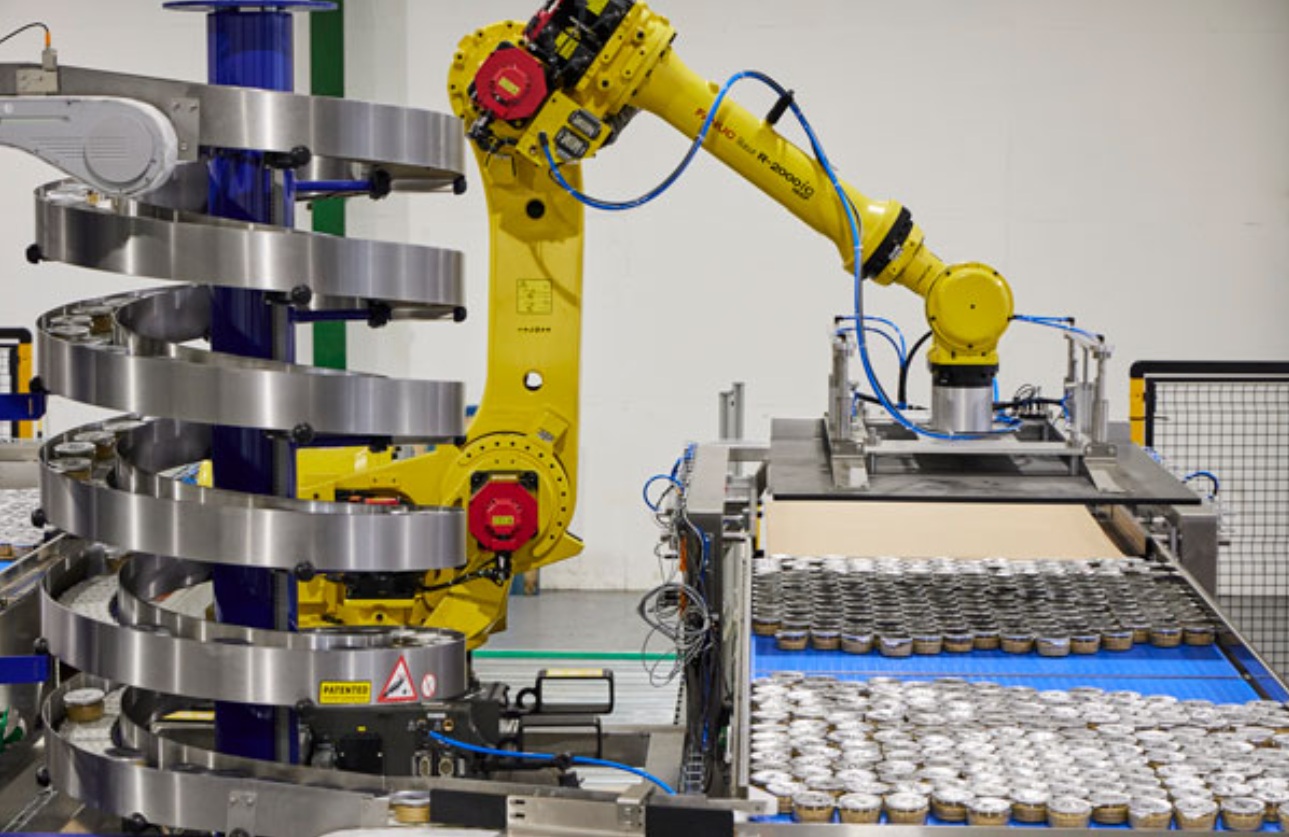
“The end-to-end packaging line begins at the depalletizing stage,” said Darragh. Gü’s filled glass ramekins are skimmed off two pallets, one layer at a time, onto a pair of receiving conveyors. A six-axis robot handles this job and removes the layer card that separates each layer. The pallets are supported and indexed up by two industrial-grade scissor lifts fitted with servo motors that feed the depalletizing robot, ensuring a seamless depalletizing process.
Automation design advice, flexibility
Application design helped with flexibility. The system collates the ramekins, loads them into cartons with integrated laser printing, and case packs with subsequent case labelling, before the final palletizing process begins. Another six-axis industrial robot is used there.
A matrix of different twin and quad-pack case formats improve palletizing flexibility. The palletizing robot can automatically change end-of-arm tooling when switching from one pattern format to another.
Robots are quick, robust and reliable in the expanded application.
Edited by Mark T. Hoske, editor-in-chief, Control Engineering, Arrowfly, [email protected], from an Oct. 9, Control Engineering Europe story.
You also might like