Unitronics new built-in AI turns control requirements into working PLC logic — without asking engineers to become AI experts, and it actually delivers.
For engineers who design and specify control systems — whether for a production line or a building’s mechanical room — the bottleneck hasn’t changed in decades: someone has to translate requirements into working control logic, line by line. It’s slow, it demands deep platform knowledge, and it’s often the reason new engineers take months to become productive. Experienced programmers don’t escape it either — even routine logic eats hours that could go toward commissioning, troubleshooting, or the next project.
AI looks like an obvious fix, until you try it. Ask a general-purpose AI model to write PLC logic and the result is usually generic, sometimes wrong for the target platform entirely. The issue isn’t the AI itself — it’s that getting a good answer requires knowing how to ask, with the right technical detail, in the right format. That’s its own skill, and it’s not one most engineers have time to learn.
Unitronics — whose UniStream PLC and HMI controllers show up everywhere from production machinery to building automation panels and data center cooling systems — built its newest capability around that exact gap. Rather than opening a blank AI chat and hoping for the best, engineers using UniLogic, now answer a short set of guided questions about their application: what it does, how it’s controlled, what I/O is involved. The software takes those answers, combines them with information already in the project, and assembles a complete, structured prompt — ready to hand to the AI platform of the engineer’s choice.
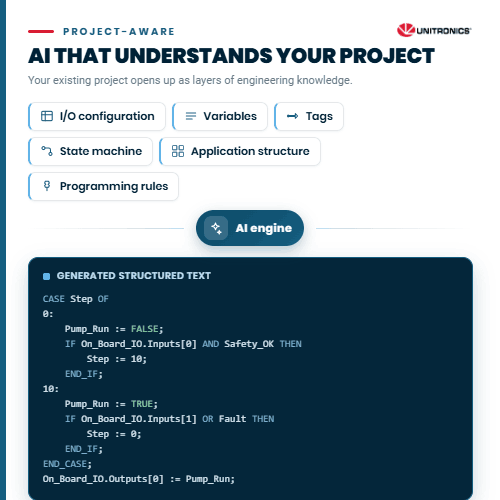
It’s not a chatbot bolted onto the software. It’s what happens before the chatbot.
That distinction matters. The value here isn’t “ChatGPT, but for PLCs” — UniLogic doesn’t generate logic itself. What it does is remove the hardest part of using AI well: knowing what to tell it. Engineers keep using whichever AI platform they already trust — ChatGPT, Claude, Gemini, or others — they just stop starting from a blank page every time.
Three things change for engineers
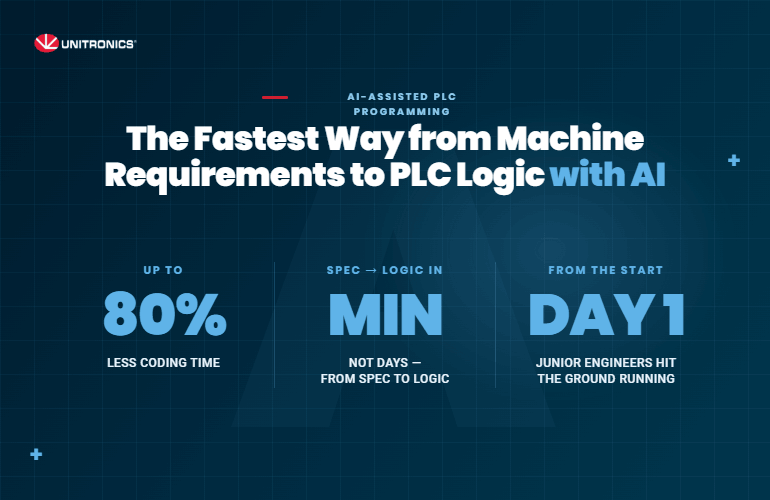
- Programming time drops. Unitronics reports up to 80% less time spent on coding — requirements that used to take days to translate into logic can now start producing working code in minutes.
- The workflow gets simpler, not more complicated. Nothing about using AI well requires a new tool or a new skill. Engineers answer questions about the application they already understand; existing tags, I/O, and project structure carry over automatically instead of being retyped.
- The learning curve flattens. New engineers can produce logic that follows platform conventions from day one, instead of spending months absorbing those conventions through trial and error — as valuable for a controls contractor onboarding junior staff as for a systems integrator standardizing across a team.
Engineers still own the outcome
None of this changes who’s responsible for the result. Generated logic still needs to be reviewed, tested, and validated before it runs anything — the same standard as logic written by hand. What shifts is where an engineer’s time goes: less spent producing a first draft, more spent on the judgment calls only an engineer can make — safety logic, edge cases, sequencing, commissioning.

That’s also the more accurate way to describe what’s happening across controls and building automation right now. The industry’s conversation about AI keeps landing in the same place: the goal isn’t replacing engineering judgment, it’s removing friction that has nothing to do with it. Lowering dependence on any one person’s experience — and helping newer engineers contribute good work sooner — is showing up as a priority across building controls in 2026. This is Unitronics’ answer to that same problem, applied to PLC programming.
Unitronics puts the shift simply: you don’t need to become a prompt engineer to use AI for PLC programming. The capability is available now in UniLogic, and a free trial of the full platform is open to anyone who wants to try it. More detail is available here.
Sponsored Content from Unitronics