By Eric J. Kim, Product Marketing Manager, Cisco
It’s 3:00 AM and the production line has gone down unexpectedly. The on-shift team has spent two hours inspecting conveyor motors, pneumatic actuators, and sensors but the root cause remains unclear. When an OT architect arrives in the morning, the diagnosis takes minutes: a degraded fiber path had introduced packet loss causing several PLCs to lose synchronization. A straightforward fix, but by then, hours of production were gone.
These types of scenarios are becoming more common as industrial networks become more critical for production uptime and the gap between network complexity and frontline expertise widens.
A growing, critical dependency
Automated assembly, machine vision, predictive maintenance, and coordinated robotics all run on network infrastructure. When that infrastructure falters, production follows, regardless of how well-maintained the physical equipment is. According to Aberdeen Research, unplanned downtime costs on average $50 billion annually across all manufacturing sectors in the U.S. alone.
The structural problem driving these costs isn’t just network complexity. It’s who is expected to manage it. Frontline OT teams like technicians and maintenance staff are becoming the first responders when network issues disrupt production. Yet most weren’t hired to troubleshoot networks, and existing tools aren’t designed to help users with limited networking expertise to quickly diagnose and resolve issues.
First responders without the right tools
When a network event disrupts production, the team on the floor notices it first, and, in most cases, is the least equipped to diagnose it. Traditional network management tools surface raw technical data: interface errors, IP addresses, protocol anomalies that require networking expertise to interpret. To add to the pain, CLI-based queries require credentials and expertise that most frontline teams do not have.
According to Cisco’s 2026 State of Industrial AI Report, surveying over 1,000 industrial professionals globally, 34% cited a lack of talent as a top concern. This is a gap that training programs alone can’t close at the pace the industry requires. The result is a predictable cycle: when a network alert fires and the frontline team cannot interpret it, the problem gets escalated up the chain. From frontline technicians to plant network engineers to IT specialists, each handoff adds critical time while the production floor absorbs the cost.
Plant network engineers sit at the center of this escalation cycle. As the first link in the escalation chain when network issues aren’t resolved at the front lines, they field the most network troubleshooting requests. Basic issues like broken cables or misconfigured parts can be easily resolved but without the right tools, they become a plant network engineers’ responsibility.
The downstream impact extends beyond isolated incidents. Every routine escalation that lands on their desk is time taken from strategic directives. Architecture improvements, security hardening, and building the infrastructure that support the next generation of connected operations are where network specialists create the most value. Instead, those priorities consistently give way to urgent, low-level escalations. Closing that gap not only reduces downtime but multiplies the speed and impact of such directives.
What effective network troubleshooting looks like
The right tool empowers frontline teams to identify and resolve network issues as they occur in real-time. Instead of escalating the chain, these teams can receive clear, actionable guidance that they can confidently follow. And when it’s communicated in natural, non-networking language, anyone can retrieve live network intel using familiar device names without credentials, CLI commands or extensive networking expertise.
The intelligence stays within the facility, minimizing cloud dependencies and helping keep sensitive data aligned with security requirements. For plant network engineers, this means fewer interruptions and more time to focus on network improvements. The question for industrial organizations is how to equip OT teams with the intelligence they need to troubleshoot networks without introducing new security exposure.
Introducing Cisco’s new digital teammate for frontline teams
As part of Cisco’s AgenticOps strategy, Cisco AI Troubleshooting for Industrial Networks combines the visibility and telemetry of Cisco Industrial Ethernet (IE) switches with an on-premises agentic AI system purpose-built for OT teams. Together they detect industrial network faults in real time, guide frontline teams to resolution in plain language, make network intelligence accessible across the organization, and keep sensitive operational data within the facility.
Coming soon to Cisco Cloud Control, this tool is more than an AI application layered on top of the network. It works natively with Cisco Catalyst IE switches, which continuously generate operational telemetry, topology, configuration, and event data that the AI uses to detect, diagnose, and recommend fixes. Rather than relying on periodic polling or disconnected monitoring tools, the tool draws directly from the industrial network infrastructure already connecting PLCs, HMIs, robots, cameras, sensors, and controllers. The richer the network intelligence, the more accurate the AI becomes, transforming Cisco IE switches from connectivity devices into an always-on source of operational insight.
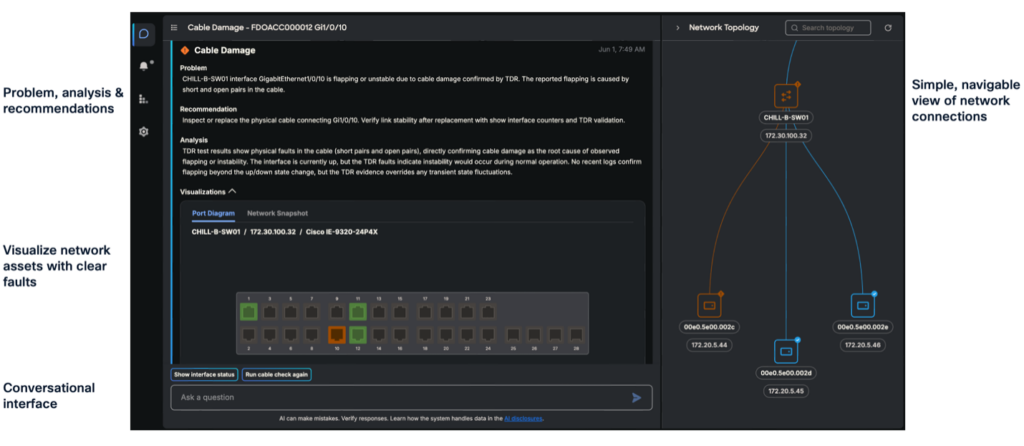
Real-time detection: Ambient monitoring runs continuously, surfacing anomalies as they occur. When configured properly, every alert includes the affected asset’s factory-floor name, its physical location, and an intuitive summary of the root cause without a manual investigation or waiting for specialist availability.
Frontline remediation: Step-by-step guidance arrives with every alert, in simple, non-technical verbiage. Many common network issues (e.g. physical layer) can be resolved at the frontline. The escalation chain remains for complex issues while routine incident escalations are curbed.
Simplified network status query: Once a device is tagged, users can query Cisco IE switches in plain language without CLI access, receiving live operational and configuration data directly. Technicians interact through smart, context-aware prompt suggestions that return clear, intuitive answers with a single selection.
Secure by design, intelligence at the edge: Runs on-premises, keeping sensitive data from being transmitted externally. Cloud connectivity is only used for keeping the solution current and performing optimally. It functions through internet and WAN outages because the infrastructure supporting it lives within the building of the network it monitors. Every alert, query, and resolution is also stored locally, supporting documentation requirements and building institutional memory that helps teams resolve issues faster over time.
How the 3:00 AM story ends differently
With Cisco AI Troubleshooting for Industrial Networks in play, the fiber path degradation is detected within seconds of the anomaly emerging. An alert reaches the on-shift team, pinpointing the affected device, location, probable cause, and recommended steps for resolution. The technician follows the steps, replaces the faulty cable, and production continues. The specialist reads through the agent’s reasoning the next day while production continues as planned.
These scenarios will not disappear from industrial operations. Networks will grow more capable, connectivity will expand, and the cost of unplanned downtime will continue to rise. What can change is how frontline teams are equipped to respond effectively. Organizations that close the gap between network intelligence and teams responsible for uptime will be the ones best positioned to manage that complexity without absorbing the cost.
Empower the frontlines to maximize uptime
Cisco AI Troubleshooting for Industrial Networks was designed for the frontline teams on the factory floor when something goes wrong in the network. It brings AI-powered detection, guided remediation, and simplified network status query to the point of failure while operating within the security perimeter of the facility.
For industrial organizations navigating the growing complexity of connected operators, it is the difference between a frontline team that waits for help and one that resolves the problem before critical production impact. The result is a more productive, higher-impact organization at every level.
To learn more about how Cisco AI Troubleshooting for Industrial Networks can be applied to your environment, read a short solution brief and schedule a personalized demo with a Cisco industrial networking expert. For more on how to build a secure foundation for industrial operations, read about how Zero Trust Policy can strengthen industrial cyber defense.
Sponsored Content from Cisco