Design Approaches for Humanoid Robots with Complex Movement Including Bending, Flexing, and Hand Gripping
As humanoid robots move from prototypes toward real-world deployment, upper-body systems create demanding connectivity challenges. Shoulders, arms, wrists, and hands must coordinate power, high-speed data, sensing, and control within compact structures that continuously bend, rotate, flex, and operate under load. These conditions create competing design constraints around space, current capacity, signal integrity, interconnect density, vibration, and flex life.
In humanoid robotics, the connector does more than connect two points. Its size, electrical capacity, mechanical stability, and ability to perform through continuous motion can influence how the entire upper-body system is architected.
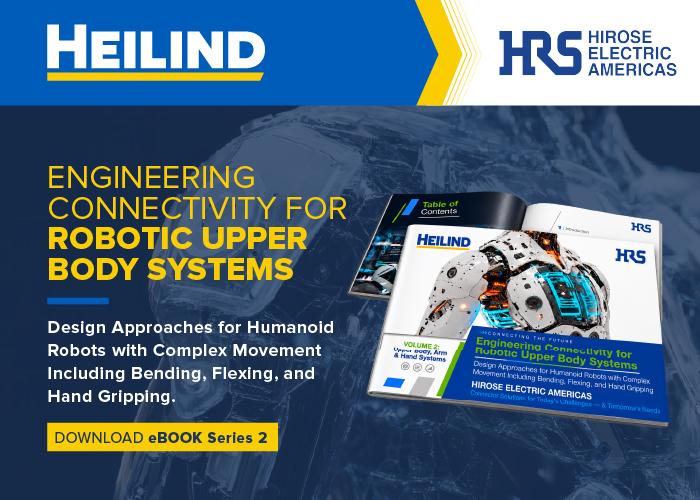
Volume 2 of Hirose’s Humanoid Robotics eBook Series explores how these mechanical and electrical constraints influence system architecture and connector selection. Engineers will learn how to approach connectivity earlier in the design cycle to maintain signal integrity, power delivery, mechanical reliability, and serviceability across complex upper-body systems.
What You’ll Learn
- Design for continuous motion and load — Understand how cyclic bending, torsion, vibration, and mechanical stress affect connectivity across shoulders, elbows, wrists, and hands.
- Integrate power, signal, sensing, and control — Explore connectivity requirements across distributed control nodes, actuators, force-torque sensors, tactile arrays, and processing systems.
- Solve space and routing constraints — See how high-density, low-profile, and hybrid connector approaches can reduce interconnect count and simplify integration in compact assemblies.
- Maintain high-speed signal integrity — Learn how connector and routing decisions affect real-time data exchange between sensors, embedded controllers, and central processing.
- Balance miniaturization with power demands — Examine the challenge of delivering actuator current while working within strict size, weight, and thermal constraints.
- Improve flex life and mechanical reliability — Discover considerations for strain relief, contact stability, positive locking, and connector placement in high-motion zones.
- Design by upper-body region — Understand the different connectivity demands of the chest, shoulders, arms and elbows, and hands, from centralized power distribution to high-density sensing.
- Simplify manufacturing and serviceability — Learn how modular, branch, and distribution architectures can reduce cable congestion, improve scalability, and make systems easier to assemble and maintain.
- Evaluate connector approaches for humanoid robotics — Review Hirose solutions for compact integration, hybrid power and signal, high-speed data, sealed connections, and localized power distribution.
As an authorized Hirose distributor, Heilind helps engineers move from design requirements to product selection and sourcing, providing access to Hirose connectivity solutions, product availability, and distribution support to help keep designs moving from development toward production.
Download the eBook to see how connector requirements change across the humanoid upper body and explore approaches for solving high-density routing, continuous motion, contact stability, power delivery, and high-speed data challenges early in the design process.
Learn more at Heilind.com
Sponsored Content from Heilind