Most plants don’t have reliability problems.
Their equipment is running. Production targets are being met. Operators aren’t responding to constant alarms. From the control room, operations appear stable.
Yet many of these same facilities are quietly losing millions of dollars each year.
The losses don’t come from catastrophic failures. They come from small inefficiencies that have gradually become accepted as normal: reactors operated farther from their optimum than necessary, distillation columns consuming excess energy due to over-refluxing that in turn requires needlessly higher steam, operators making frequent and imprecise manual adjustments to compensate for changing feed conditions, and quality giveaway that exceeds customer requirements. Individually, these issues appear insignificant. Collectively, they erode margins every day and directly impact the plant’s profit margins.
As raw material costs, energy prices, and workforce shortages continue to pressure profitability, many manufacturers are asking a different question than they did a decade ago: how do we recover more value from the assets we already own?
Why Stable Doesn’t Mean Optimized
Traditional DCS and PID control systems are designed to keep processes operating safely and within limits. They do that extremely well.
The challenge is that manufacturing rarely involves optimizing a single variable. Product quality, energy consumption, throughput, equipment constraints, feedstock variability, raw material constraints, tank inventory constraints, economic price fluctuations and environmental targets all interact continuously. Operators often respond by running conservatively, creating a safety margin that protects production but also leaves profitability behind.
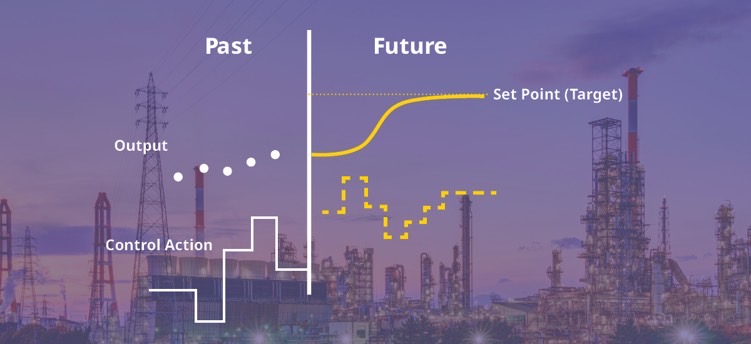
Advanced Process Control (APC) addresses this challenge by coordinating multiple interacting process variables simultaneously, allowing the plant to operate closer to its true economic optimum while remaining within operating constraints.
The objective is not simply better control. It is better business performance and optimization.
Where the ROI Comes From
For most facilities, APC is not about chasing incremental technical improvements. It is about recovering hidden margin.
Even modest improvements possible by APC can create significant financial impact:
- 2–4% higher yield from existing assets.
- 5–7% lower energy consumption.
- 3–5% higher throughput.
- 10–35% lower quality variability.
- Reduced operator intervention, rework, and process excursions.
- Reduction in the number of normal, standing and flood alarms.
- Longer life of control valves.
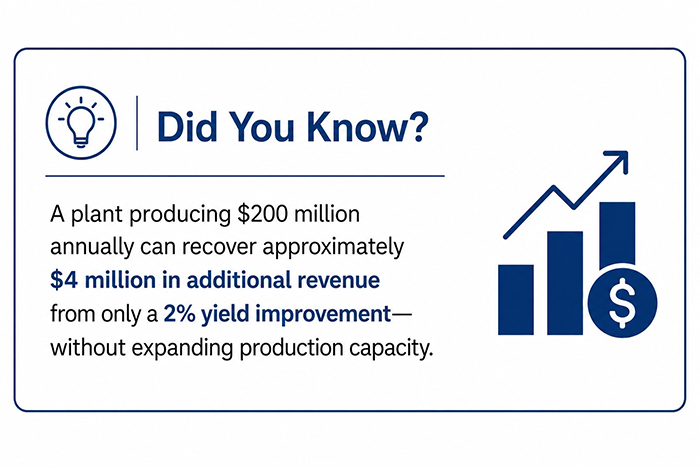
For a manufacturing facility producing $200 million annually, recovering just 2% additional yield represents approximately $4 million in additional saleable product without adding new production capacity. Typical APC projects often achieve payback in as little as two to twelve months when applied to the right processes.
Shell Deer Park Example
At Shell’s Deer Park Refining Complex in Texas (a 50/50 partnership with Pemex), Yokogawa applied Advanced Process Control to a delayed coker unit to address variability during drum switch operations, one of the most challenging and economically sensitive parts of the process. By stabilizing operations and reducing process variability, the APC application enabled recovery of previously lost product and improved overall unit performance. The financial impact exceeded original expectations by nearly three times, demonstrating how even well-run facilities can unlock significant additional margin through optimized control.
Reducing variability, improving operator consistency, recovering lost yield, and stabilizing operations all contribute directly to improved margins and profitability.
The Next Evolution of APC
Today’s leading manufacturers are looking beyond standalone APC projects.
Instead of optimizing individual process units, they are connecting Advanced Process Control with real-time optimization, process models, AI-assisted analytics, operator guidance, and performance monitoring to create a continuous optimization strategy.
This integrated approach enables plants not only to respond to disturbances faster, but also to sustain improvements over time. As operating conditions, feedstocks, and production objectives change, optimization evolves with the process instead of degrading until the next engineering project.
That long-term sustainability has become one of the industry’s biggest challenges — and one of the greatest opportunities for improving return on investment.
Turning Plant Data Into Business Decisions
Most manufacturers already possess enormous amounts of operational data from control systems, historians, laboratory systems, and maintenance platforms.
The real opportunity lies in transforming that information into operational decisions.
Modern APC platforms combine multivariable control with process models, real-time optimization, AI-assisted applications, and performance monitoring to identify opportunities that operators cannot consistently detect on their own. Rather than replacing operator expertise, these technologies capture best practices, reduce process variability, and help engineering teams maintain peak performance despite workforce turnover and changing operating conditions.
The result is a plant that spends less time reacting to disturbances and more time operating at its most profitable point.
Measuring Opportunity Before Making Investment
Perhaps the biggest misconception about Advanced Process Control is that it requires a major technology commitment before value can be demonstrated.
The first step is often a performance assessment.
By analyzing process variability, controller performance, operating constraints, and economic drivers, manufacturers can identify where hidden margin exists and estimate the financial opportunity before implementing new control strategies.
For many manufacturing plants, the findings are surprising. What appeared to be normal operating variability is often measurable lost profit.
In today’s competitive market, the question is no longer whether opportunities for optimization exist. The question is how much value is already hidden within your existing operation — and how quickly can you begin recovering it.
The Road Ahead
Many manufacturers already have the infrastructure required to achieve meaningful performance gains — modern control systems, historians, and access to extensive production data. What is often missing is an integrated approach to turning those assets into measurable business outcomes.
The opportunity is not theoretical. It already exists within the operation.
Advanced Process Control enables manufacturers to capture that value by reducing variability, improving consistency, preserving operational knowledge, and continuously optimizing performance. Leading organizations are already using APC to operate closer to process constraints; those that do not risk falling behind in both cost competitiveness and product consistency.
For plants looking to improve margins without significant capital investment, the question is no longer whether value exists, but how quickly can it be realized.
How much hidden margin is your plant leaving on the table? A variability and profitability assessment can identify the highest-value optimization opportunities and estimate the potential ROI, in a meter of weeks, before any implementation begins.
How Much Hidden Margin Is in Your Plant?
Most manufacturers already have the equipment needed to improve profitability. The question is whether process variability is quietly eroding margins.
A plant variability assessment can help identify:
✓ Hidden yield losses
✓ Excess energy consumption
✓ Operator-driven variability
✓ Capacity constraints
✓ Product giveaway
✓ Opportunities for faster payback
The result: A quantified business case that estimates the potential financial return before investing in Advanced Process Control.

Sponsored Content from Yokogawa Electric Corporation