Data from Interact Analysis shows Chinese and Korean suppliers leading Li-ion battery equipment as regional demand shifts.
Li-ion battery equipment manufacturers have benefited from recent growth in global battery production capacity. In 2023, the global Li-ion battery equipment market reached $16.3 billion. In 2024, as battery manufacturers reduced capital spending and slow capacity expansion, the market declined to $13.8 billion. This shift in demand changed competitive conditions in the industry.
For Control Engineering subscribers this is important because automation can help with battery equipment and because batteries power mobile computing, sensors, transmitters and other communications for automation, controls and instrumentation.
China-Korea dual dominance: Korean firms outperformed due to gains in overseas markets
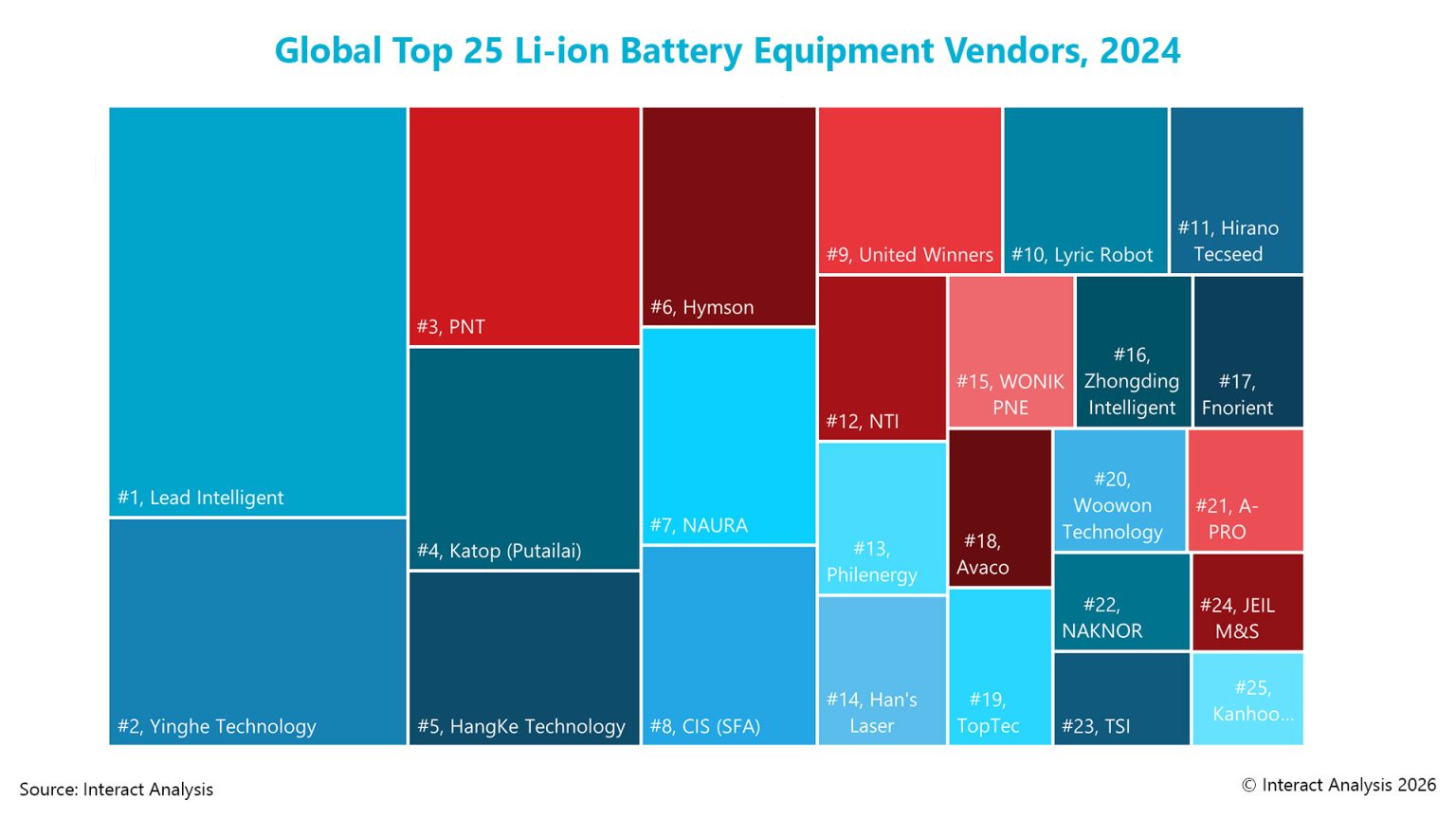
The global Li-ion battery equipment market is led by Chinese and Korean companies. In 2024, among the world’s top 25 suppliers by revenue, Chinese companies accounted for 14 and Korean companies for 10, compared with 15 and 9, respectively, in 2023.
By revenue-share, the shift was larger. Chinese companies accounted for 68% of total sales among the top 25 suppliers in 2024, down 8 percentage points year over year, while Korean companies increased their share from 22% to 29%.
One reason for this shift is the differing market focus of Chinese and Korean equipment manufacturers. Chinese Li-ion battery equipment companies still depend heavily on the domestic market. In 2024, slower battery capacity expansion in China reduced domestic equipment demand, which was associated with lower revenue for many Chinese suppliers and a smaller global market share.
By contrast, South Korea’s domestic market for Li-ion battery equipment is relatively small, and Korean companies entered overseas markets earlier. Europe and the United States now account for an important share of their revenue. Over the past two years, efforts in Europe and the US to expand Li-ion battery production capacity increased demand for Korean equipment suppliers. As a result, Korean vendors recorded revenue growth in 2024. PNT’s Li-ion battery equipment revenue rose 84% year-on-year in US dollar terms, lifting its ranking from 11th in 2023 to third in 2024.
Increasingly pronounced regional market divergence
In 2024, the global Li-ion battery equipment market showed greater regional variation, with different suppliers leading in different regions. In the Asia-Pacific market, Chinese companies were in a stronger position because of local supply chains, lower cost and nearby customer support. Among the top 25 suppliers in the region in 2024, Chinese firms held 20 positions and Korean firms held five.
In contrast, the market structure in the Americas differs sharply. As Korean battery makers such as Samsung SDI and LG Energy Solution expanded capacity in the United States, Korean equipment suppliers expanded there as well. Their business in the region is closely tied to battery cell manufacturing projects. In 2024, Korean companies accounted for 19 of the top 25 Li-ion battery equipment suppliers in the Americas.
Europe shows a more even competitive mix. Korean companies continue to gain share, supported by their technology, while Chinese companies are building their presence through local partnerships. European equipment manufacturers such as Dürr are also increasing their activity. As a result, the European market includes Chinese, Korean and local suppliers and is more diversified than other regional markets.
Divergent competitive strengths across process segments
With domestic manufacturing capacity, well-developed supply chains and ongoing R&D investment, Chinese companies have improved their capabilities across Li-ion battery production processes. In some segments, this has reduced the lead previously held by Japanese and Korean firms and contributed to a shift from imported equipment to domestic suppliers.
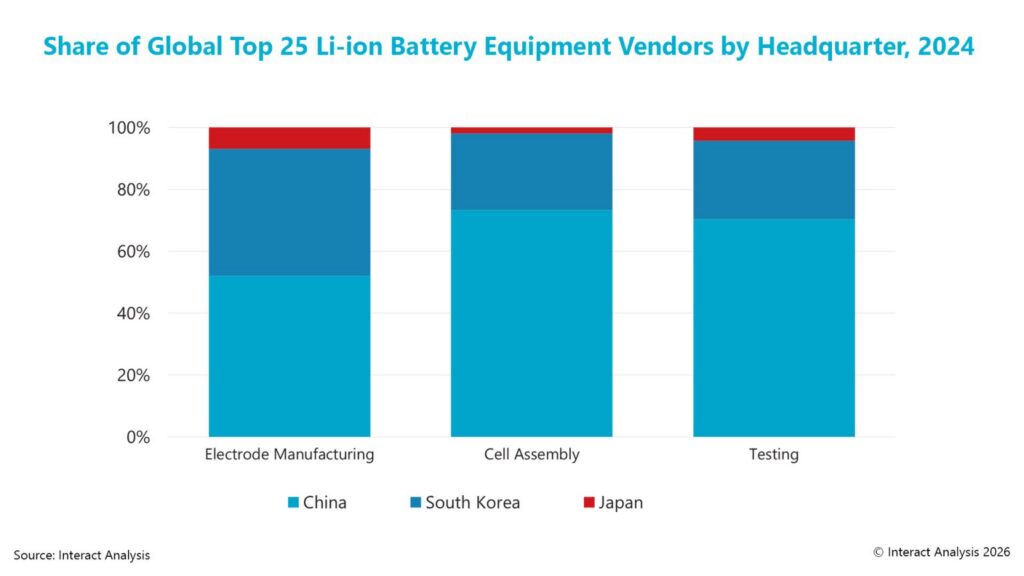
In the front-end electrode manufacturing segment, Korean companies remain in a strong position. The segment requires high precision, consistency, and process stability, and Korean suppliers benefit from long experience in technology and process development. In 2024, they accounted for about 40% of sales revenue among the top 25 suppliers of electrode manufacturing equipment, a higher share than in other equipment segments. PNT ranked second globally in this segment.
Chinese companies, meanwhile, held the largest share of the mid- and back-end equipment segments. In cell assembly, formation and testing, Chinese suppliers benefited from high-volume manufacturing, faster product development cycles and lower costs. In 2024, they accounted for 72% sales revenue among the top 25 suppliers in the cell assembly equipment and 70% in formation and testing equipment.
Factors shaping the next phase of the market
The global Li-ion battery equipment market is not limited to competition between China and Korea. Japanese companies such as Hirano Tecseed and Toray still hold positions in some specialized segments especially high-precision coating equipment.
At the same time, efforts to localize Li-ion battery production are contributing to the growth of regional suppliers. In Europe and the United States, increased policy support and investment are supporting local equipment manufacturers.
As Li-ion battery capacity expands across more regions, competition in the equipment market is likely to change further. Differences in regional policy, demand and supply chains will continue to affect competition in different regions. At the global level, Chinese and Korean suppliers are still expected to hold the strongest positions in the near term.
A key factor in the future development of the global Li-ion battery equipment market is the commercialization of next-generation battery technologies. Solid-state batteries and other emerging technologies use different materials and production processes from conventional Li-ion batteries, which may require changes in equipment for electrode manufacturing, cell assembly and testing.
This could create opportunities for established suppliers and newer companies developing equipment for these technologies. How much this changes the current competitive structure remains uncertain.
Edited by Puja Mitra, WTWH Media, for Control Engineering, from an Interact Analysis news release.