
Easier data integration will help with “Strengthening the U.S.’ competitiveness through smart manufacturing,” as explained at Realize LIVE Americas 2026. See three imperatives for CESMII smart manufacturing compliance and the Industrial Information Interface eXchange (i3X) open API.
Industrial interoperability insights
- CESMII helps manufacturers become more competitive by working with consortia, manufacturers, system integrators, machine builders, technology providers, academia and labs.
- CESMII has three imperatives for smart manufacturing compliance, an open, standards-based information model, clear platform requirements, and an interoperability API.
- The i3X API aims to make data flow across manufacturing applications easier.
Intelligent use of industrial data is a large part of “Strengthening the U.S.’ competitiveness through smart manufacturing,” requiring a consistent way to integrate data from different systems, lines, layers and devices, explained John Dyck, CEO, CESMII, the Smart Manufacturing Institute (Figure 1). More than 800 companies are contributing to open manufacturing information modeling in more than 40 active working groups, Dyck said. He addressed the need for better interoperability and faster digital transformation in manufacturing, in operations and supply chains, with a presentation at Realize Live Americas 2026 from Siemens Digital Industries Software, in Detroit on June 1-3. The digital transformation conference explores the latest trends and technologies and explains how customers are unlocking innovation with industrial artificial intelligence (AI) and digital twins.
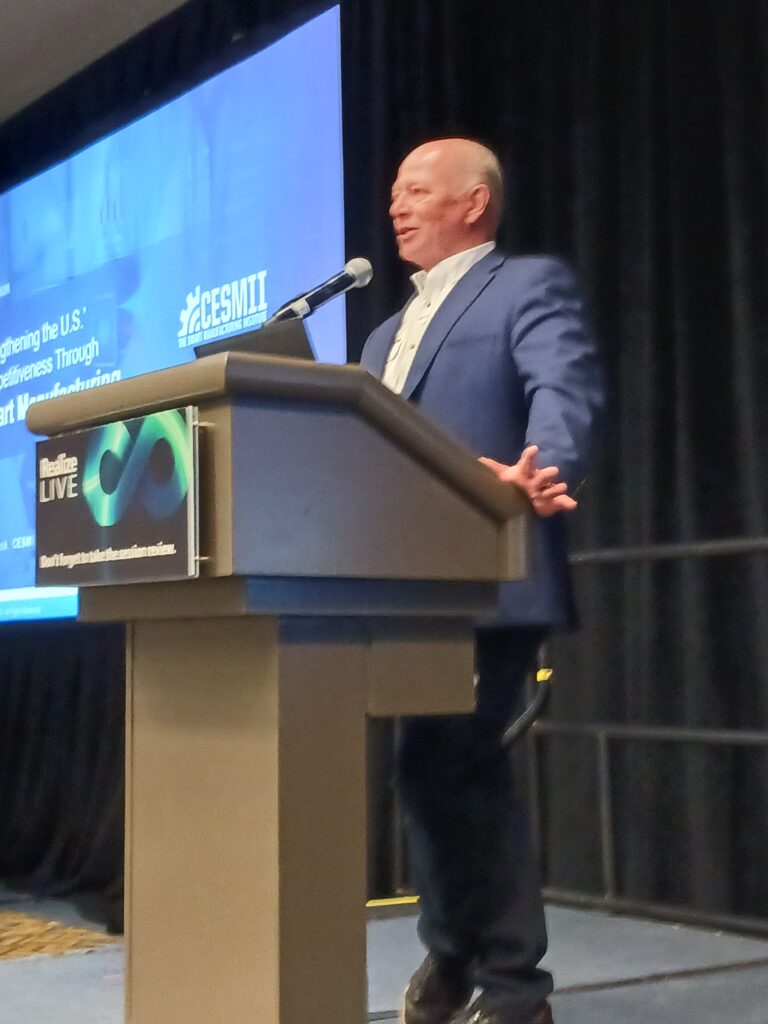
Dyck, with experience at Rockwell Automation and General Electric, has “worked with great companies in this space to how we use data to transform manufacturing operations.”
CESMII’s mission to help manufacturers
CESMII’s mandate is to help manufacturers become more competitive using taxpayer dollars working with consortia, manufacturers, system integrators, machine builders, technology providers, academia and labs. Requests for proposal (RFP) solves problems and funds investments. We’re not the government, but we are here to help (Figure 2).
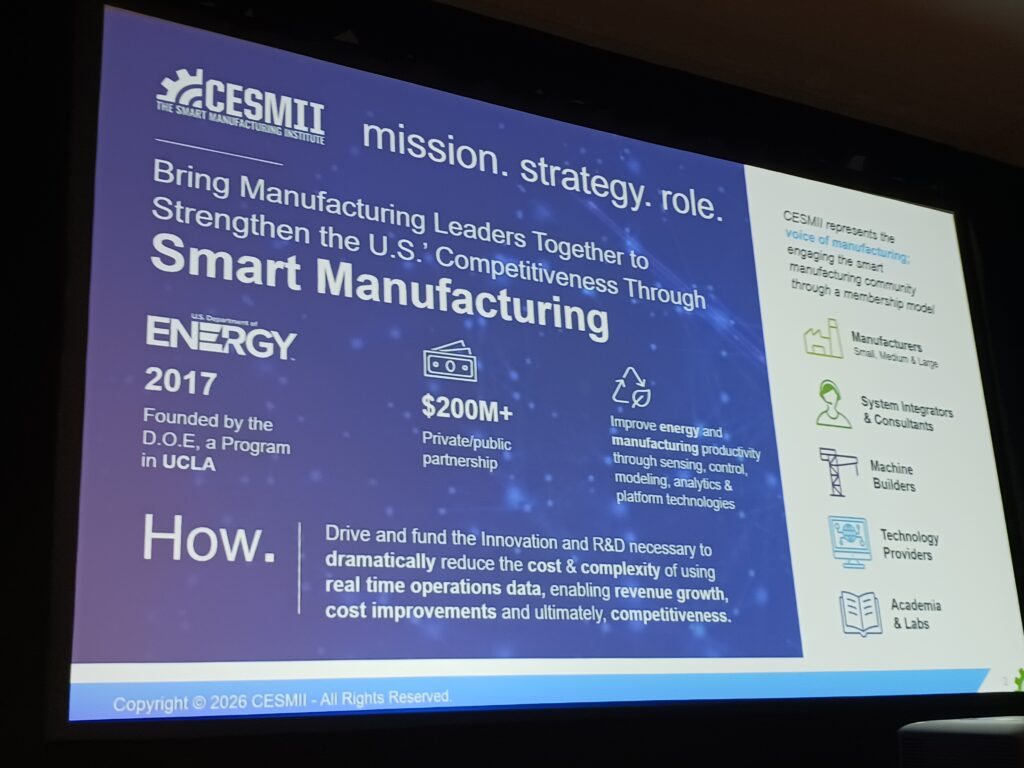
CESMII accelerates the democratization of smart manufacturing with technology (decrease cost and complexity of smart manufacturing by 50%), knowledge and ecosystem (convene relevant industry stakeholders to solve problems that no one company can solve on its own).
Economic data shows that the manufacturing sector’s productivity output per worker has plateaued. The current operational technology (OT) and information (IT) mindset that gave us four decades of productivity growth has reached its limit. How do we get more productivity growth again?
Using data to solve problems isn’t new.
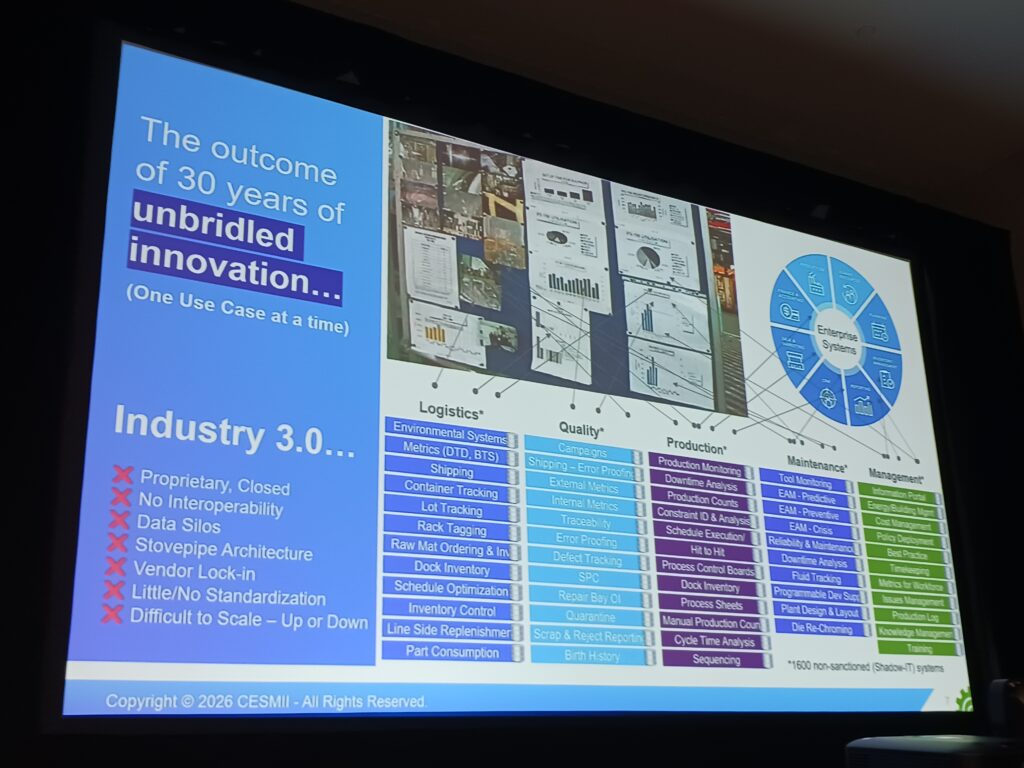
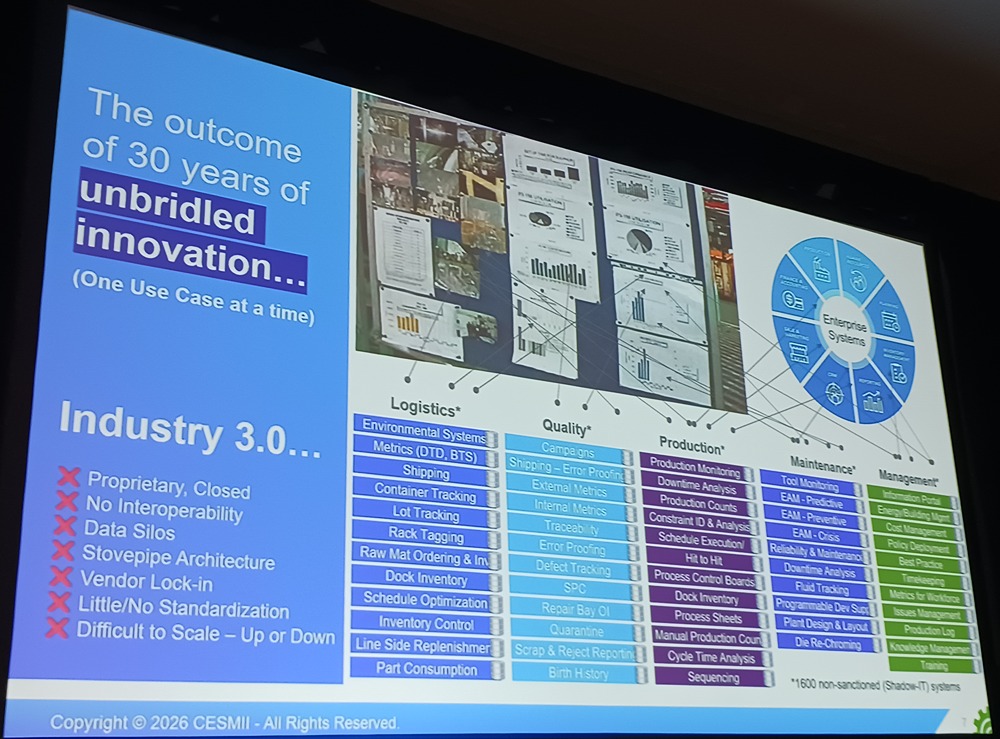
An automotive manufacturer implemented innovations for human-machine interface (HMI), overall equipment effectiveness (OEE), quality, production scheduling, and artificial intelligence and data flow, on use case at a time. Another graphic shows each box with its own manufacturing system data silo across 68 plants (Figure 3). Time is wasted moving data into and from systems. Such Industry 3.0 efforts, delivered with the best of intentions, often add cost and complexity with limited standardization, proliferation of data silos, application program interface (API) chaos, AI that doesn’t scale, extraordinary integration costs and vendor lock-in. CESMII is addressing this challenge.
“We need to fix the messy technical debt created by incompatible systems and constrained by messy operations data.” What’s needed to strengthen future outcomes?
Dyck cited nine fundamental production types with unique automation and data fundamentals, each with own workflows and business processes. Application standardization strategies for manufacturers almost always fail across production boundaries, he warned. Integrators spend too much time patching and integrating rather than creating value.
Smart manufacturing compliance
CESMII has three imperatives for smart manufacturing compliance.
1. Open, standards-based information modeling strategy for manufacturing (leverage and contribute to a global community, building information profiles with smart manufacturing profiles, OPC UA companion specifications, JSON schemas and other nodesets).
2. Clear set of platform requirements, enabling manufacturing platform and application interoperability. (Organize data using smart manufacturing profiles from the cloud library to create type-safe instance objects in smart platforms and persist instance objects and relationships, present and past, in a knowledge graph).
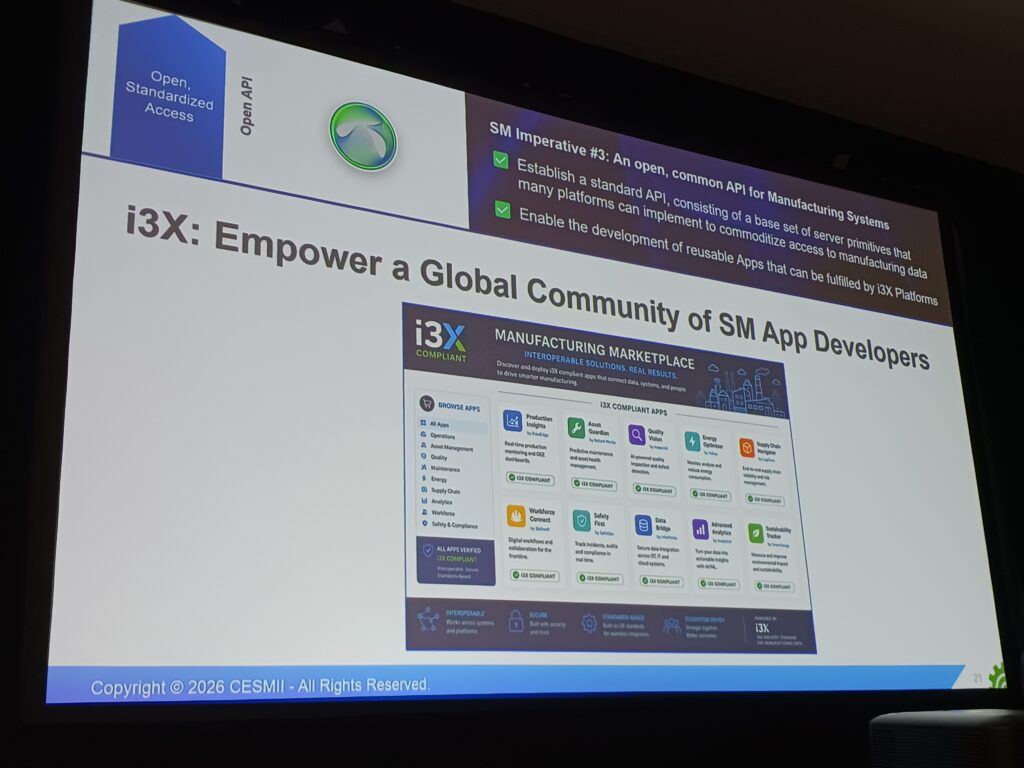
3. An open, common API for manufacturing systems. (Establish a standard API, consisting of a base set of server primitives that many platforms can implement to commoditize application access to manufacturing data.)
Cloud library of compatible software, API for manufacturing interoperability
A joint working group (JWG) of CESMII, the Smart Manufacturing Innovation Institute and OPC Foundation developed a specification for an internet-hosted database with OPC UA information models, publicly available through a RESTful interface. The cloud library is available to manufacturers seeking to leverage industrial assets containing non-standard information models for SCADA or analytics systems. This fills in areas not covered by existing OPC UA companion specifications.
On June 18, CESMII released i3X 1.0 (Figure 4), said to be a complete, implementation-ready open API specification for manufacturing interoperability. The i3X API, representing 2 years of work, can explore objects, types and relationships, query values (the latest or historical), update values (latest or historical) and subscribe for changed values. It doesn’t have vendor-specific code. Many companies involved in the related working group provided a demonstration at Hannover Fair 2026.
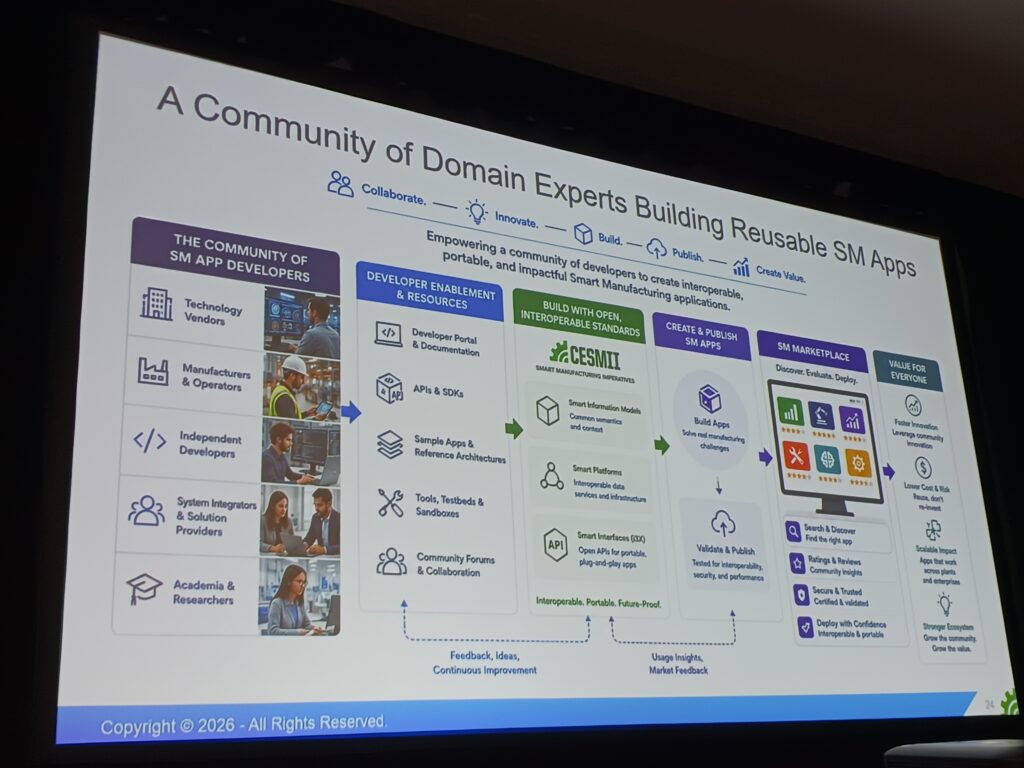
The Manufacturing Marketplace of i3X compliant applications brings the manufacturing community together without alliance to a specific vendor. The effort provides a low-cost way to harmonize data integration (Figure 5).
CESMII efforts, Dyck said, differentiates from between the status quo of Industry 3.0 (expensive to buy and sustain, build from scratch every time, data silos, vendor lock-in with difficult alignment of OT and IT) and smart manufacturing enabled by Industry 4.0 (lower cost, lower complexity, application interoperability, minimized data silos, natural standardization path and OT and IT alignment).
An Aug. 4 interoperability workshop will help enable outcomes. Learn more at www.cesmii.org and www.i3X.dev.
Industry 4.0, CESMII smart manufacturing initiatives
Dyck answered audience questions after the presentation, providing more information about open architecture efforts. He hopes for more vendor buy-in and named OT and IT software providers that could benefit. He admitted that CESMII is not a standards body, but noted that while ISA95 is a great standard, it only has a 1% adoption rate. The i3X effort bridges the gap between “design” and “make” and is an important path forward, he said. It helps when manufacturers evaluate vendors based on their support.
There have been other attempts, Dyck said. This one is supported and is easy to implement. It is about plumbing, a way to create reuseable things for manufacturing with less effort.
Mark T. Hoske is editor-in-chief, Control Engineering, Arrowfly, [email protected].
Keywords
Manufacturing software API, Manufacturing software app store, data integration
Consider this
Is easier data integration the last hurdle for increased manufacturing productivity again?
You also might like
Hear more from CESMII efforts here.