Apply automation more effectively with these tips on automation justification, collaborative robotics, industrial robots and integrating artificial intelligence (AI).

Automation justification insights
- Automation 2026 trends and tips included artificial intelligence (AI) to accelerate robotics use, data effectiveness and digitalization.
- Smarter automation justification needs to extend beyond traditional return on investment calculations.
- Automation and robotics create jobs, as explained in multiple conference sessions organized at Association for Advancing Automation (A3).
Robotics, industrial artificial intelligence (AI) integration, and automation justification advice were among tips and trends from Automate 2026 from Association for Advancing Automation (A3). Think again about how to apply automation more effectively.

AI framework to accelerate robotics use: ARM Institute
To help U.S. manufacturers better use AI for robotics, the ARM Institute is working on an ARM modular AI framework (Figure 1), according to Matthew Powelson, senior robotics software engineer, ARM Institute (Figure 2). Powelson, during day three of Automate 2026, presented on “Accelerating AI-enabled robotics for manufacturing: Bridging R&D and commercialization.” The ARM Physical AI Framework is an agent-ready structure to provide a trusted, safe, structured way to build systems without unrestricted access to source code or machines, Powelson said.

AI with trusted engineering tools, helps industrial robotics
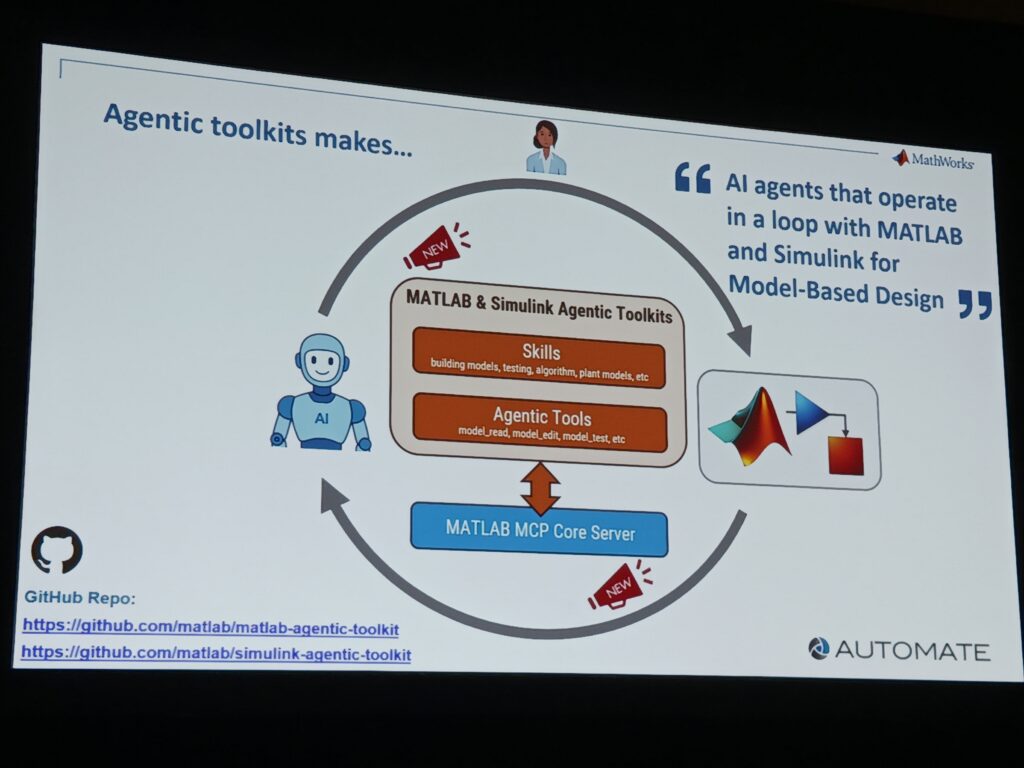
AI can accelerate use of industrial robotics, and integration with trusted tools can check AI validity to lower risk and increase safety (Figure 3), according to YJ Lim, principal technical robotics product lead, MathWorks (Figure 4). Lim showed how AI can be integrated to shorten time to implementation, in one case reducing what would have taken weeks to hours. He spoke on day three in the Automate 2026 session, “Accelerating Industrial Robotics with AI and Generative Models.” GenAI is powerful but not perfect, Lim said. Focus is combining with trusted and validated tools from MathWorks to improve results with copilots, integrate with external generative AI agents, develop generative-AI-powered applications and other gen-AI capabilities. Key is to use trusted software using a known internal dataset to check for accurate results, while iterating faster, Lim said.


Need automation justification? Consider more than ROI
Automation needs more than a traditional ROI calculation (Figure 5), and a member of the A3 Motion Control and Motors committee wants the group to develop a ROI+Plant Vitality Index to help get more automation projects justified and approved. The suggestion was part of the day two Automate 2026 session, “Making automation ROI practical and achievable,” from Christine Bush, Robotics Center of Excellence Leader, Schneider Electric (Figure 6), expanding the business case for automation. Other considerations might include asset health modernization, automation levels, agility, digital integration and digital transformation, workforce readiness, sustainability performance and maintenance maturity, she said.


Data to help train industrial robots
How much data do industrial robots need to learn to respond to variable challenges without specific, traditional programming for each? (Figure 7) That’s among questions Erin McColl, director, Robotics Technology Adoption, Toyota Research Institute (Figure 8) and her team are considering. The presentation, to a standing-room-only room, discussed: “Bridging the gap: Toyota Research Institute’s approach to real-world robotics in manufacturing,” part of day two of Automation 2026. “Our strategy is to build robots as tools to learn in the field to add value in short-term,” she explained.

Time to jump into automation?
Automate 2026 day one keynote panel was moderated by Robert Huschka, A3 vice president of education strategies. He asked: “When is right moment to jump into automation?” (Figure 9)
Michael Cicco, president and CEO, Fanuc America Corp., said automation is poised for an explosion of growth: You don’t see it on the evening news, but many mom-and-pop shops are installing several robots, which hasn’t happened before.
Andre Marino, senior vice president industrial automation North America, Schneider Electric cited an 8% productivity loss because of multiple vendors’ automation systems, suggesting a need for better interoperability.
Matt Moschner, president and CEO, Cognex Corp., said: AI tools today help automation, machine specifically, to incrementally train and improve on the fly.
Wendy Tan White MBE, CEO, Intrinsic, said internet changed the world but not immediately. AI, in use for some time, is now being used to enable robots to do things that weren’t previously possible.

Collaborative robot justification: Labor availability, operational continuity
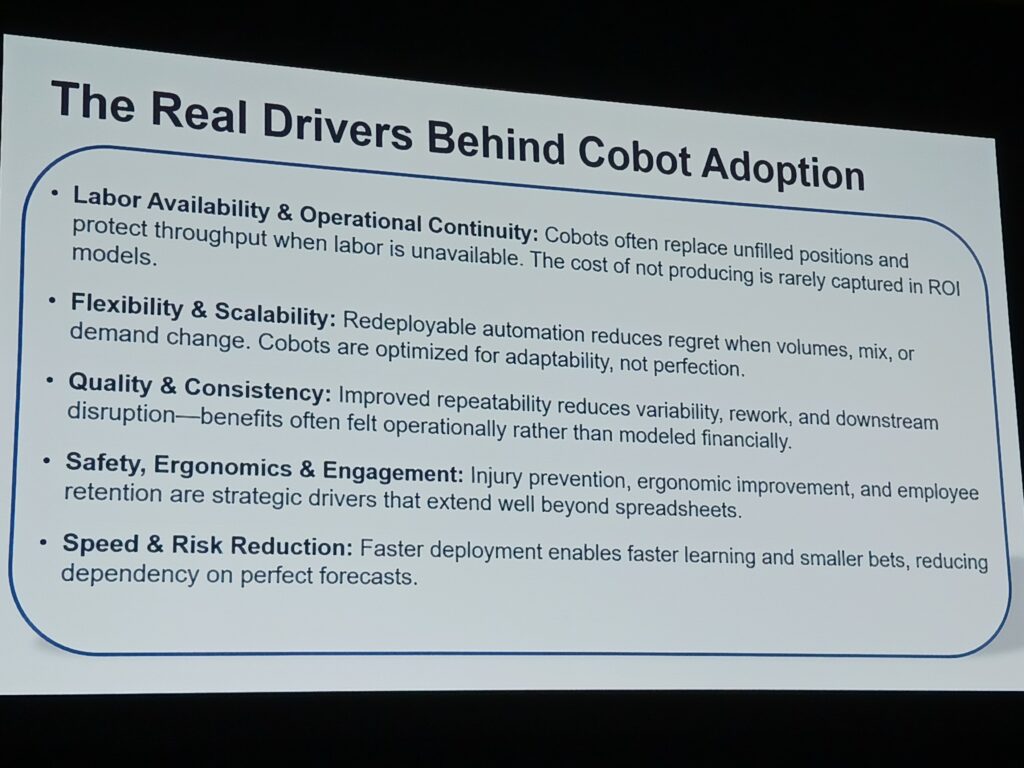
“I didn’t say ROI wasn’t important. I said it isn’t one of the top reasons collaborative robots are justified by businesses.” Manufacturing leaders increasingly approve cobots for reasons beyond traditional ROI calculations (Figure 10), said Michael Mahfet, president, GCG Automation & Factory Solutions (Figure 11), at an Automate 2026 conference session, “Why ROI is not one of the top reasons collaborative robots are justified by businesses.” Other considerations, not in traditional ROI calculations, include labor availability and operational continuity (getting product out the door), reliability and scalability, quality and consistency, safety ergonomics and engagement, and speed and risk reduction.

Digitalization adds automation efficiency
Tools that enable concurrent development can accelerate automation applications. Chris Stevens, president, U.S. Automation, Siemens Digital Industries, in a day two keynote, Pepsico used 15% less capital, saw a 20% throughput increase and identified 90% of potential issues before physical plant implementation. Annemarie Breu, senior director – automation software deployment and incubation, Siemens Digital Industries, said having a digital enterprise enables AI and other high-value automation. Roland Joseph, senior technical director at P&G (Figure 12), said it’s not just data collection, but data at the right granularity. Joseph warned that data gathered once a minute or once a second won’t help with a process that cycles in milliseconds.
Robots create jobs
Across 8,000 firms, robot adopters posted 150% more jobs compared to non-adopters, according to a University of Minnesota study cited by Evan Beard, co-founder and CEO, Standard Bots, in the day three keynote. On stage, Beard helped demonstrate an easier-to-use AI-enabled robot to automate what couldn’t be automated previously.
Mark T. Hoske is editor-in-chief, Control Engineering, WTWH Media, [email protected].
Keywords
Automation justification, collaborative robots, AI and robotics
Consider this
Justify more robots, collaborative robots, other automation; use AI to help.
You also might like
See more AI and machine learning and robotics coverage from Control Engineering at