Industrial organizations cited benefits from industrial AI-enabled planning, design, engineering and operations software at Realize Live Americas 2026 from Siemens Digital Industries Software. Engineering design software can operate 1,000 times faster with geometric deep learning, rapid design exploration and real-time multi-disciplinary simulation.

Engineering software insights
- Advice from Siemens Digital Industries Software at Realize Live Americas 2026 included the need to integrate industrial artificial intelligence (AI) throughout the product lifecycle.
- The soda giant offered examples of industrial AI applications along with the benefits of new software that uses geometric deep learning.
- Software helps from concept to manufacturing, as detailed by Pepisco in facility modernization and greenfield site projects with workflow software implementations.
How can industrial organizations benefit from digital transformation without retooling entirely? Creating value with integration of digitalization, artificial intelligence and software tools were among topics discussed at Realize Live Americas 2026 from Siemens Digital Industries Software, in Detroit. The digital transformation conference explores the latest trends and technologies and explains how customers are unlocking innovation with industrial intelligence, AI and digital twins.
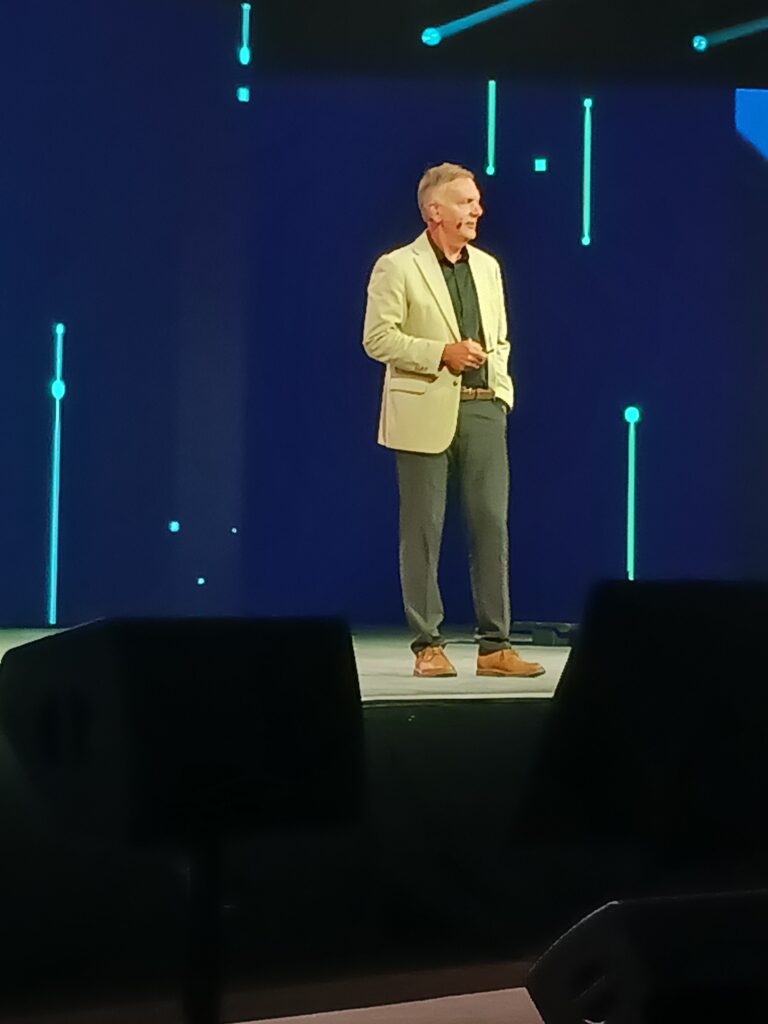
Tony Hemmelgarn, president and CEO, Siemens Digital Industries Software (Figure 1), and Steven Hoinka, vice president, PepsiCo global manufacturing strategy, PepsiCo, part of the June 1 keynote presentation, talked about challenges, tools, workflows and benefits of digital transformation and AI acceleration.
Hemmelgarn said industrial intelligence is the future of engineering and manufacturing. Advanced tools help users learn, predict and optimize before building physical products or the automated factory that makes the products. Such tools create greater value more quickly.
Integrate artificial intelligence (AI) throughout the product lifecycle
AI implementations throughout the product lifecycle require trusted data with contextualization to help, Hemmelgarn said. Outdated data or data without context can be dangerous, especially with challenges such as broken supply chains, regulatory requirements, material changes and factories relocations. Organizations need plans that change with reality. Digital enterprises, grounded in AI, respond more quickly to how enterprises function.
“Siemens Xcelerator software is the backbone of what we do,” Hemmelgarn said. A comprehensive digital twin operates in real time to help speed decisions.
Lifecycle intelligence is provided in Siemens Teamcenter software and not just for large organizations. For small and medium-sized businesses, 54% have data on their desktops, Hemmelgarn said. Modern software offerings allow customers to participate in AI across applications no matter the organization’s size, with the same data fidelity.
Configurable, extensible and evolving software is adaptive, senses changes and automatically responds in real time.
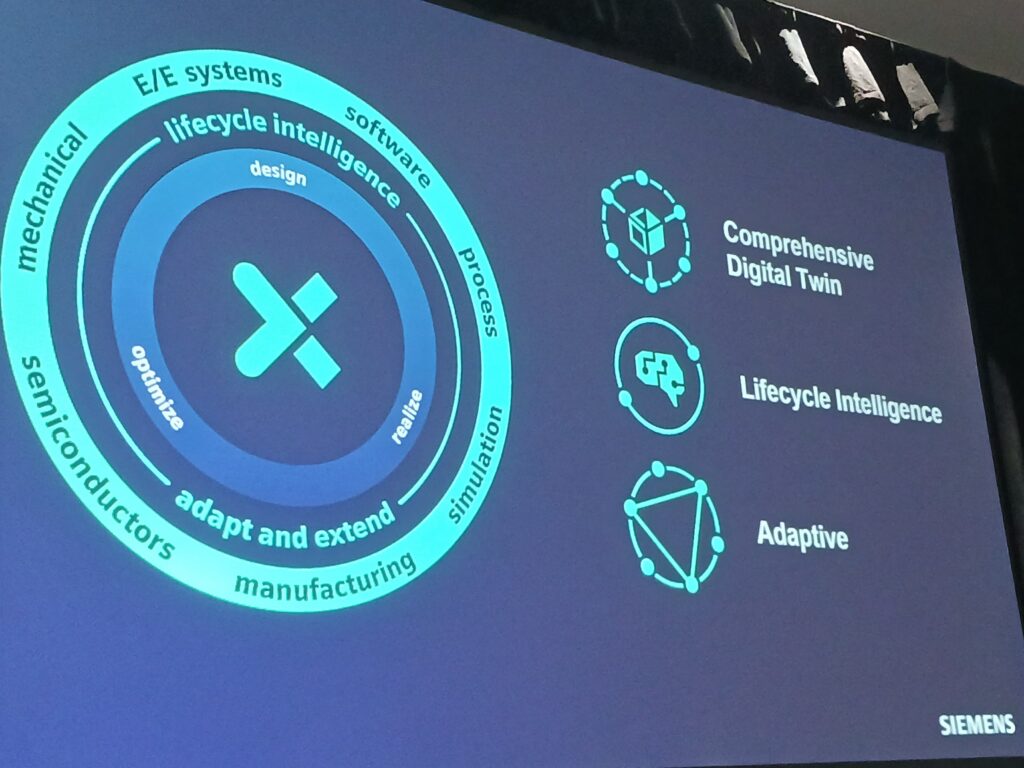
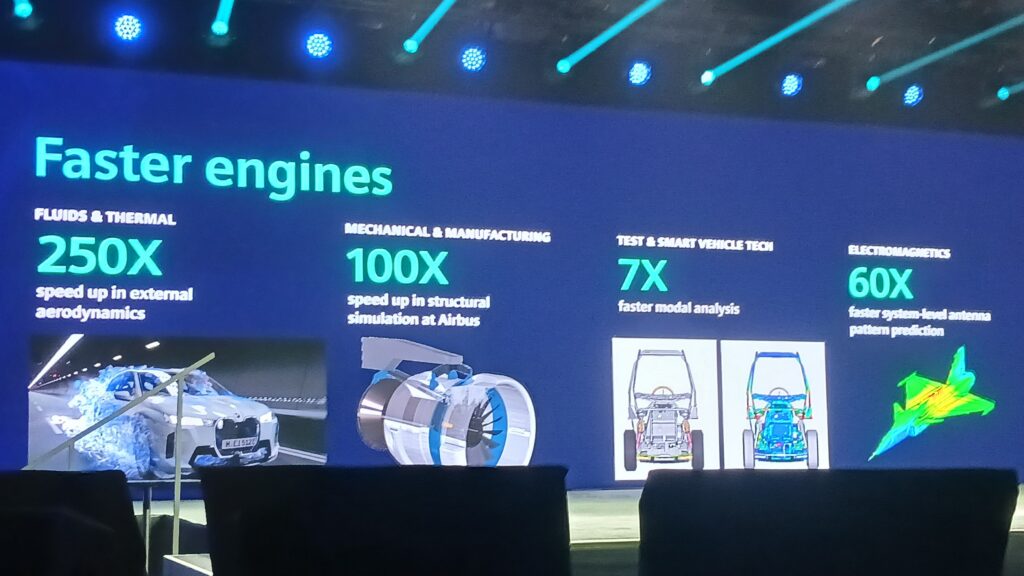
Recent AI offerings advancements include faster engines, smarter execution and trusted outcomes with embedded AI intelligence in workflows (Figure 2), Hemmelgarn said. Embedded AI helps ensure the right decisions. The strategy is to use AI on real-world plant data to learn what data matters and to avoid data that doesn’t improve compute efficiency. Better aiming on data relevancy makes AI more scalable and faster (Figure 3).
Industrial AI application examples
Moore’s Law, the doubling of chip capabilities every 18 to 24 months, is reaching its physical limits, leading to 3D integrated circuit (IC) design, bringing with it thermal, electrical and mechanical design and manufacturing challenges, Hemmelgarn said. Smarter execution is needed to avoid IC manufacturing losses as high as 50% by predicting IC failures before manufacturing starts.
With 200 billion transistors in a Nvidia chip, verification is the bottleneck in manufacturing workflow. Missing something increases waste and lowers productivity. The Solido chip design project increases the chip evaluation speed by seven times, Hemmelgarn said, decreasing time to hours. Smarter execution requires a deterministic approach, Hemmelgarn said, because probabilistic systems have too much variance.
Traditional computer-aided engineering (CAE) that takes 15 days, Hemmelgarn said, can be reduced 30 times to 0.5 day with AI applied, without geometry simplification or meshing that can lower accuracy. A project now can move from computer-aided design (CAD) to CAE in minutes. Enabling software tools are Siemens Simcenter and Simsolid.
New software uses geometric deep learning
Siemens Simcenter PhysicsAI Generate (new) provides generative AI-based design generation from requirements to design concepts. Simcenter PhysicsAI is 1000-times faster with geometric deep learning, rapid design exploration, real-time multi-disciplinary simulation, Hemmelgarn said; it can be 4000-times faster at 90% accuracy.
Siemens Supplyframe software provides more than 600 million components by searching more than 70 websites with more than 15 million active users. Xometry market AI software provides a real-time look at the cost of various additive and traditional machining processes by showing instant quotes on screen, Hemmelgarn said. Linked to DesignCenter, it provides feedback on the cost of designs or design changes. The Siemens acquisition of Volition integrates the ability to find and compare designs, providing real-time updates automatically by integrating component design, costing and supply chain.
Software changes allow industry to unite software, validate changes and use virtual ARM processors to validate integrated circuits, Hemmelgarn said, performing thousands of tests in real-time evaluation.
Hemmelgarn said that part of providing trusted outcomes is to avoid data lakes that see only a snapshot in time without configuration, design intent or product contextualization. Engineering requires more dynamic tools to produce insights from data.
An aircraft manufacturer by using an AI-driven analysis dashboard learned that turbulence affected landing gear doors system that was causing aircraft downtime, Hemmelgarn. If AI is to work, connected data must provide context.
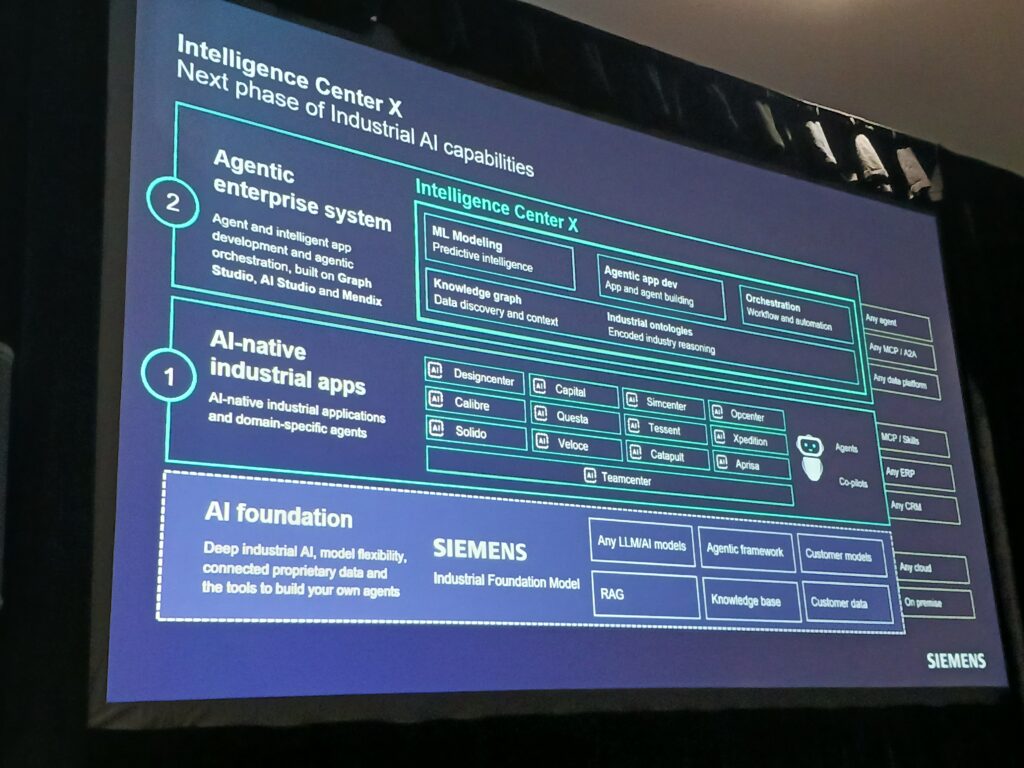
Siemens Intelligence Center X (Figure 4) provides the next phase of industrial AI capabilities, Hemmelgarn said, by connecting native industrial applications and an agentic enterprise system.
Software helps from concept to manufacturing
The 2025 Siemens Dotmatics acquisition, a life sciences R&D software company, helped gProms create a biologic injectable treatment for cancer, Hemmelgarn said.

Pepsico used the Siemens Digital Twin Composer to quickly refined and optimize layout options for two running plants and integrate and optimize with a third new facility by using an executable digital twin on edge devices, Hemmelgarn said. In many environments conditions change faster than plants can adapt. AI-enabled software helps humans decide what changes mean and what happens next, reducing risk before it becomes cost.
Hoinka, PepsiCo (Figure 5), described how a project used the Industrial Metaverse powered by Siemens.
Consistent return on investment (ROI) requires a connected digital foundation, Hoinka said; capital decisions must be based on reality not assumptions.
System-level transformation requires executive sponsorship, Hoinka said, and a digital twin provides long-term operating capabilities. Applied to multiple brownfield applications, digital twin software revealed new opportunities for improvements, “skeletons in the closet” at existing sites.
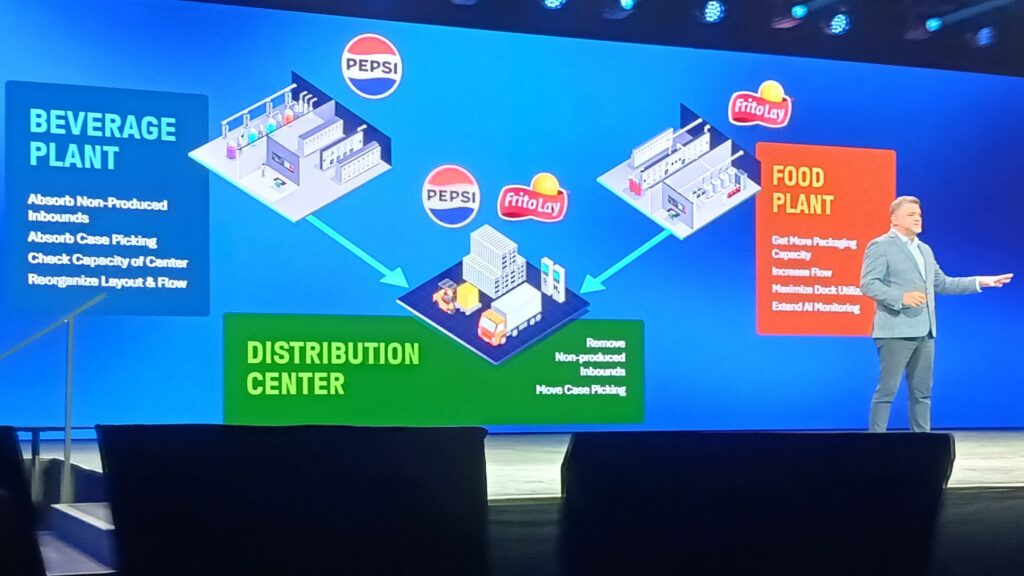
A beverage plant and food plant, both brownfield plants, needed to be improved and connected to a new mixed-use distribution center to feed suppliers and direct customers (Figure 6).
Siemens said they could do it in 12 weeks. A digital representation of sites increased the flow from brownfield operations and with greater understanding of distribution options meeting more demand, with new layout flow, optimized external loads and validation of greenfield locations.
Details of Pepisco facility design, workflow software implementation
Scan were taken of the existing facilities and operations information added to facilitate “what if” decisions across the enterprise, Hoinka said. The software brings simulations to life, helping to move more quickly to the desired outcomes. Digital Twin Composer explored many designs and quickly moved through five to seven design iterations, providing benefits (Figure 7).
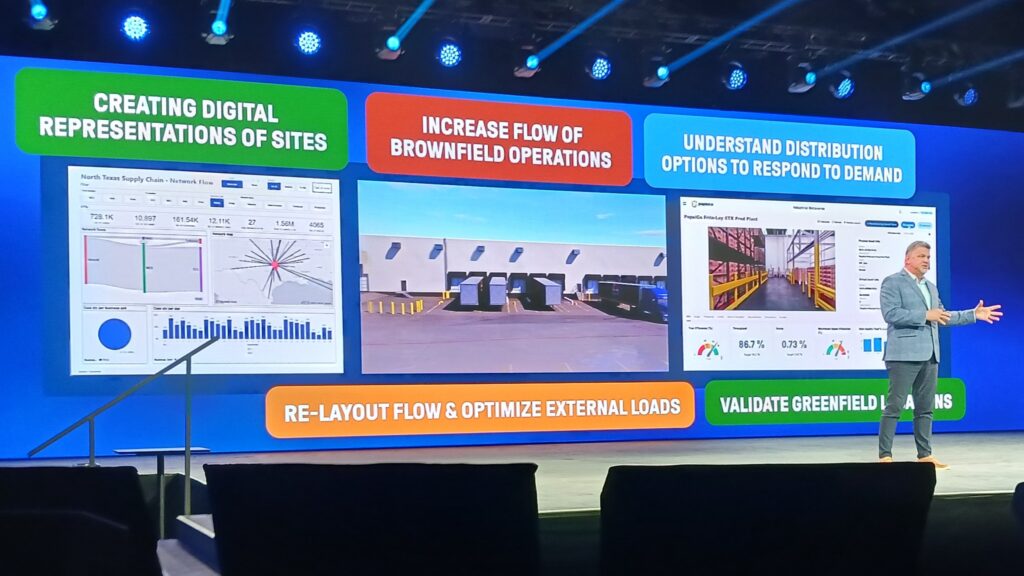
Planning cycles for the project compressed from months to 12 weeks, Hoinka said. About 90% of operational issues were identified before deployment when addressing them costs less with lower risk. The software enabled up to 20% throughput improvement along with a 10% to 15% capital expenditure (CapEx) reduction compared to traditional methods.
This is how the software delivers value, Hoinka said, but “you have to get started. Think big, start small, go fast. We’re winning with twinning.”
Figure 8: A video clip of Pepsico palletizing using Universal Robots and Robotiq also operate as a digital twin with Siemens Digital Industries Software on the screen behind the application, as shown at Realize Live Americas 2026. Courtesy: Mark T. Hoske, Control Engineering
“Important to operations is that data is accurate, of high quality and maintained. Secondly, we cannot go fast enough. We have to provide solutions quickly. We must keep foot on the accelerator,” Hoinka said. (Figure 8, a video clip, shows a collaborative robot palletizing in the Pepsico booth with Siemens digital twin software showing the same behind the application.)
Mark T. Hoske is editor-in-chief, Control Engineering, WTWH Media, [email protected].
Keywords
Engineering design software, industrial AI software
Consider This
Are industrial AI tools accelerating your speed to profit?
You also might like