
Columbia researchers engineered a technique to exploit the tunable symmetry of 2D materials for nonlinear optical applications, including laser, optical spectroscopy, imaging, and metrology systems, as well as next-generation optical quantum information processing and computing.
Nonlinear optics, a study of how light interacts with matter, is critical to many photonic applications, from the green laser pointers we’re all familiar with to intense broadband (white) light sources for quantum photonics that enable optical quantum computing, super-resolution imaging, optical sensing and ranging, and more. Through nonlinear optics, researchers are discovering new ways to use light, from getting a closer look at ultrafast processes in physics, biology, and chemistry to enhancing communication and navigation, solar energy harvesting, medical testing, and cybersecurity.
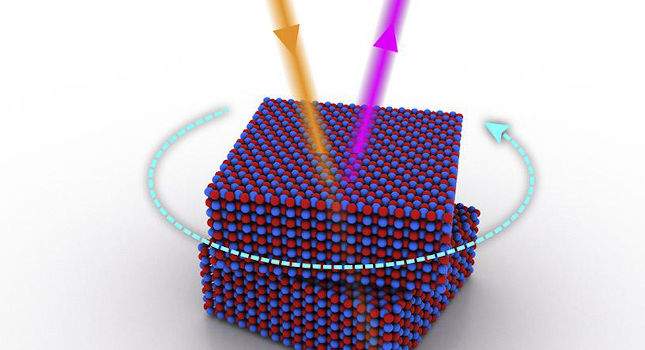
Columbia Engineering researchers have developed a new, efficient way to modulate and enhance an important type of nonlinear optical process: optical second harmonic generation—where two input photons are combined in the material to produce one photon with twice the energy—from hexagonal boron nitride through micromechanical rotation and multilayer stacking.
“Our work is the first to exploit the dynamically tunable symmetry of 2D materials for nonlinear optical applications,” said James Schuck, associate professor of mechanical engineering, who led the study along with James Hone, Wang Fong-Jen Professor of Mechanical Engineering.
A schematic of the experiment. Boron nitride crystals are etched into micro-rotator shapes and pushed by AFM tips. In this way, symmetry of the interfacial lattice structure (the zoom-in inset) is dynamically tuned, resulting in modulated efficiency of optical frequency conversion. Courtesy: Nathan R. Finney and Sanghoon Chae, Columbia Engineering[/caption]
“We showed that the nonlinear optical signal actually scales with the square of the number of twisted interfaces,” said Kaiyuan Yao, a postdoctoral research fellow in Schuck’s lab and co-lead author of the paper. “So this makes the already large nonlinear response of a single interface orders of magnitude stronger still.”
The group’s findings have several potential applications. Tunable second harmonic generation from micro-rotators could lead to novel on-chip transducers that couple micromechanical motion to sensitive optical signals by turning mechanical motion into light. This is critical for many sensors and devices such as atomic force microscopes.
Stacking multiple boron nitride thin films on top of each other with controlled twist angle demonstrated greatly enhanced nonlinear response. This could offer a new way to manufacture efficient nonlinear optical crystals with atomic precision. These could be used in a broad range of laser (such as the green laser pointers), optical spectroscopy, imaging, and metrology systems. And perhaps most significantly, they could provide a compact means for generating entangled photons and single photons for next-generation optical quantum information processing and computing.
This work was a collaboration carried out at the Energy Frontier Research Center on Programmable Quantum Materials at Columbia, with theory collaborators at Max Planck Institute for the Structure and Dynamics of Matter. The device fabrication was partially done in the cleanroom of the Columbia Nano Initiative.
“We hope,” Schuck said, “that this demonstration provides a new twist in the ongoing narrative aimed at harnessing and controlling the properties of materials.”
– Edited by Chris Vavra, web content manager, Control Engineering, CFE Media and Technology, [email protected].