Industrial AI is ready to transform business and manufacturing operations. Implementing AI elements strategically is crucial for achieving practical and impactful results.

Industrial AI implementation insights
- Industrial AI needs a different standard and how to move from pilot phase to maximum value with AI.
- Four ways to use AI and succeed while preparing for the future of industrial AI.
- Addressing AI concerns, using AI responsibly and understanding four common branches of industrial AI.
As consumer-grade artificial intelligence (AI) becomes a routine part of daily life, the conversation around AI is shifting. The question is no longer if or when to adopt AI, but rather how to implement it responsibly, at scale and with lasting impact. AI’s potential is clear: improve uptime, reduce waste, optimize designs, close labor gaps and make better decisions, faster. But translating that potential into measurable results remains elusive for many.
AI has tremendous potential to transform complex industrial workflows. Utilizing sophisticated techniques to recognize patterns, detect anomalies, offer expert guidance and anticipate future scenarios, AI produces benefits across all phases of the industrial asset lifecycle. Today’s operations are navigating not only technological complexity but also rising volatility, workforce turnover and mounting pressure to meet sustainability and compliance goals. In this environment, deploying AI is not just about algorithms, it’s about trust, context and alignment with business outcomes.
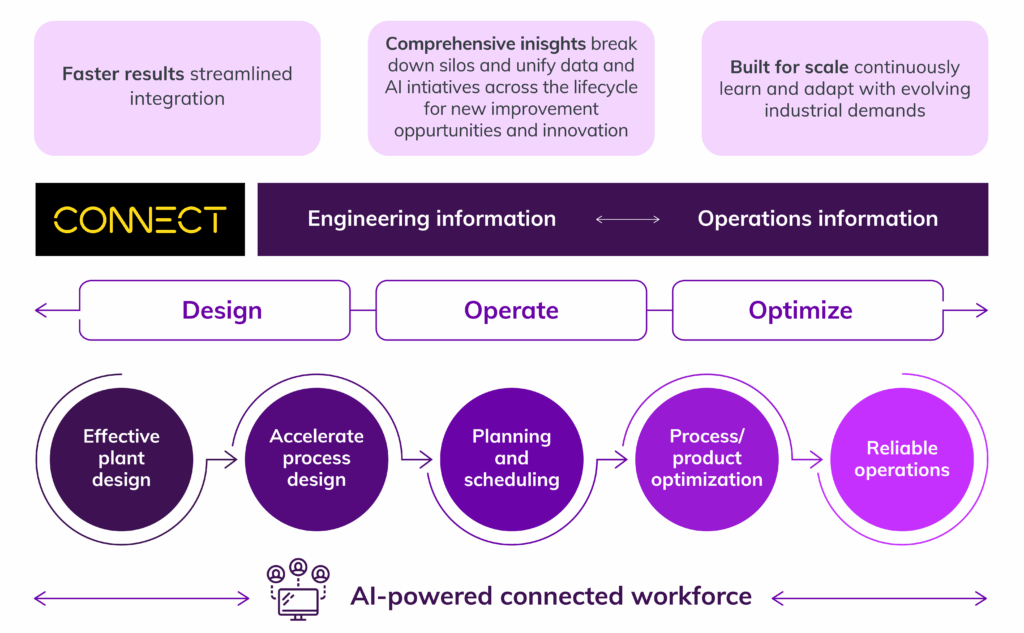
Successfully incorporating AI into industrial environments requires meeting rigorous demands and taking a thoughtful, strategic approach. Whether you are in the design stage aiming to improve productivity, the operations stage targeting efficiency across operations, or the optimization stage maximizing process and asset performance and reliability, thoughtfully connecting all datasets will ensure results are seamless, scalable, accessible and immediately impactful (Figure 1).
Why industrial AI needs a different standard
AI in consumer tools can hallucinate or get it “mostly right.” That may be acceptable in a general purpose chatbot. But AI in industrial operations requires more rigor, as an inaccurate prediction can lead to downtime, safety incidents, or regulatory exposure. High-stakes environments demand much more: traceability, data integrity, domain awareness and the ability to scale across production lines, plants and geographies.
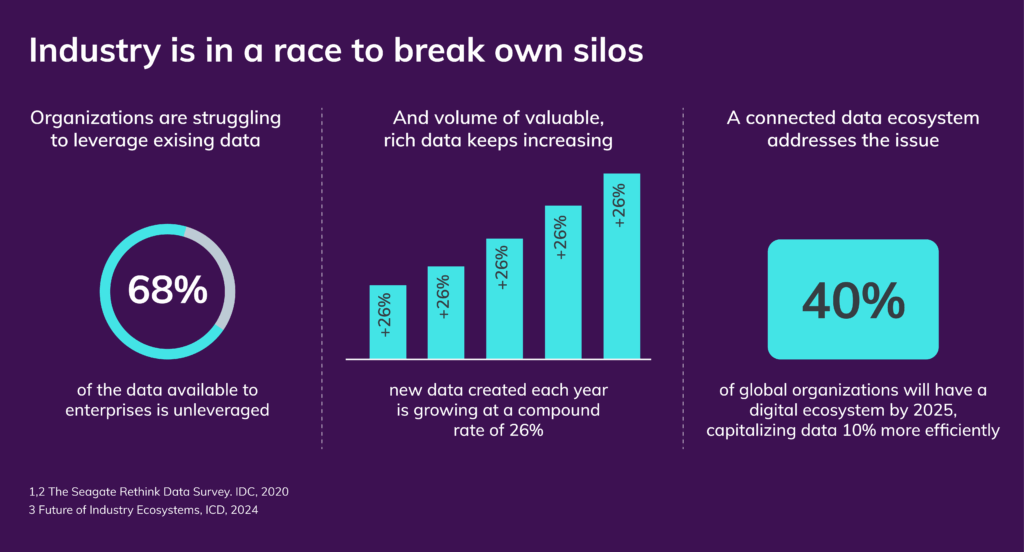
The sheer volume of sensor data available today is staggering, with both industrial and commercial sectors experiencing exponential data growth. Users are ready to unlock value from their systems (Figure 2). Leveraging AI to connect data sets—both across currently isolated silos and also throughout the industrial lifecycle—is the key. Correspondingly, data center players are expecting a massive $1.8 trillion of capital deployment globally from 2024 to 2030 to support the growing demand for data-intensive applications. (Reference: https://www.bcg.com/publications/2025/breaking-barriers-data-center-growth)
Agent-based systems, or agentic AI, are emerging that learn and adapt across the industrial lifecycle, offering a more comprehensive and deep operational intelligence. These systems evolve with operations, continuously improving without requiring constant reprogramming, which satisfies a critical need in environments with limited resources.
Moving from pilot phase to maximum value
For many companies, AI implementations stall in the pilot phase. They run isolated experiments that never scale, or struggle to prove ROI because the AI isn’t embedded into daily work processes and therefore difficult to align with real business outcomes. A better approach embeds AI into core processes and workflows from the start (design, operations, planning and maintenance), ensuring the system learns from real data, empowers the user and delivers value at every step.
The foundation for this is a connected, contextual data environment. AI draws its power from patterns, and patterns emerge from relevant data in context. That means industrial AI must operate across engineering models, real-time operations and enterprise systems, not just within one stage. The ability to draw on all of this, without rigid integration, is what separates holistic industrial intelligence from clever point tools.
AI tools are proving helpful in all aspects of the industrial lifecycle. From optimizing plant designs to streamlining workflows, AI-driven automation is increasing productivity and efficiency. Gen AI with language models is changing the way humans interact with industrial software, driving a more human-like, intuitive experience.
Intelligent scheduling built on AI technology is increasing supply chain resilience by enhancing demand forecasting, enabling smarter inventory management and analyzing logistics to minimize the impact of disruptions. Data- and AI-driven choices result in dynamic process optimization, real-time quality control and accurate predictive maintenance. Sustainability and compliance initiatives can be propelled by AI insights that optimize resource usage, achieve decarbonization goals and reduce waste.
Four ways to use AI and succeed
Organizations that succeed tend to share a few traits:
- They treat data as a strategic asset, not just a byproduct of operations.
- They choose open, agnostic systems that integrate across disciplines and vendors.
- They invest in human-AI collaboration, ensuring operators and engineers trust the insights.
- They demand explainability and governance, because trust is earned, not assumed.
The most effective AI strategies are those built with scale and sustainability in mind (Figure 3). They start with clear business priorities and use technology to amplify existing strengths. Over time, AI becomes part of the system’s DNA, quietly guiding better decisions, adapting to change and helping every team work smarter.

The future of industrial AI
The future of industrial AI will be shaped by its ability to act not just as a tool, but as a collaborator. Agentic AI represents the next leap forward, moving beyond isolated algorithms to systems of intelligent agents that can reason, adapt and work together with humans to achieve complex goals.
Instead of building and rebuilding AI for every new challenge, agentic frameworks allow multiple specialized agents to coordinate across data, systems and workflows in real time. This shift will redefine how businesses harness AI, turning software into intelligent co-workers that accelerate problem-solving, simplify complexity and unlock continuous optimization. In this future, AI won’t just analyze or predict, it will orchestrate, negotiate and deliver outcomes dynamically, creating a foundation for truly scalable intelligence.
For agentic AI to reach its full potential, the foundation must be strong. High quality, well-structured data is essential to ensure agents make accurate, trusted recommendations. Equally important are robust security and governance frameworks that protect sensitive information while enabling safe collaboration across systems. Without these pillars -data integrity, security and trust AI cannot scale responsibly or deliver reliable value.
Addressing AI concerns
As AI becomes more powerful, so do the concerns that come with it. In industrial settings, safety is paramount. Unfortunately, AI results may contain hallucinations (fabricated or misleading information portrayed with confidence), biases, data privacy issues and security concerns. Therefore, AI must support human oversight, avoid unintended automation and never compromise process integrity.
Unlike consumer-grade AI, industrial-grade systems require proactive safeguards: built-in critique mechanisms that validate AI-generated actions, transparent sourcing that ensures outputs are based only on trusted operational data and clear alerts when information is missing or insufficient. These principles create a foundation of trust, enabling AI to work as a reliable collaborator without sacrificing safety or transparency.
Energy use is another emerging challenge, especially with the rise of generative AI and large language models (LLMs), which require significant computational resources for training and inference. But here’s the reality: the kind of AI needed to solve many industrial problems isn’t a massive language model. It’s a targeted, lightweight system, like machine learning or reinforcement learning—designed specifically to optimize asset performance, reduce waste and minimize energy consumption.
These models use a fraction of the energy required by large generative models and can run efficiently even in resource-constrained environments. When deployed effectively, they don’t just consume less energy, they help reduce it across operations. From predictive maintenance to process control, these AI systems are built for purpose, delivering measurable impact with minimal overhead.
Other concerns, from cybersecurity to data privacy to workforce readiness, are also top of mind. But these are not blockers; they are basic design requirements for any modern system. The key is deploying AI that’s embedded, explainable and engineered to operate safely and sustainably in the real world.
Responsible AI unlocks potential
A data- and insight-centric approach enables businesses to better manage risk, foster collaboration and maintain focus on growth and agility, especially in volatile times. Thoughtfully seeking out AI-infused solutions that are easy-to-use, connectable and scalable will lead to a successful and growing AI implementation, increasing value across operations. Responsible implementations include procedures for verifying data before acting on critical actions.
When AI is embedded throughout operations and infrastructure, adopters see powerful transformations, with positive results on efficiency and profits. Whether facing design delays, supply chain challenges, labor gaps, unplanned downtime, inefficient production processes, sustainability or compliance issues, or simply seeking improved decision making, end users everywhere are looking for AI that delivers practical outcomes they can trust.
Industrial AI is not about replacing people; it’s about unlocking their potential. With the right foundation, AI becomes an amplifier of expertise, a driver of efficiency and a source of resilience. In a world where complexity is the norm, the ability to act on insight (instantly, intelligently and responsibly) is a true competitive edge.
Courtesy: Aveva
Four common branches of industrial AI
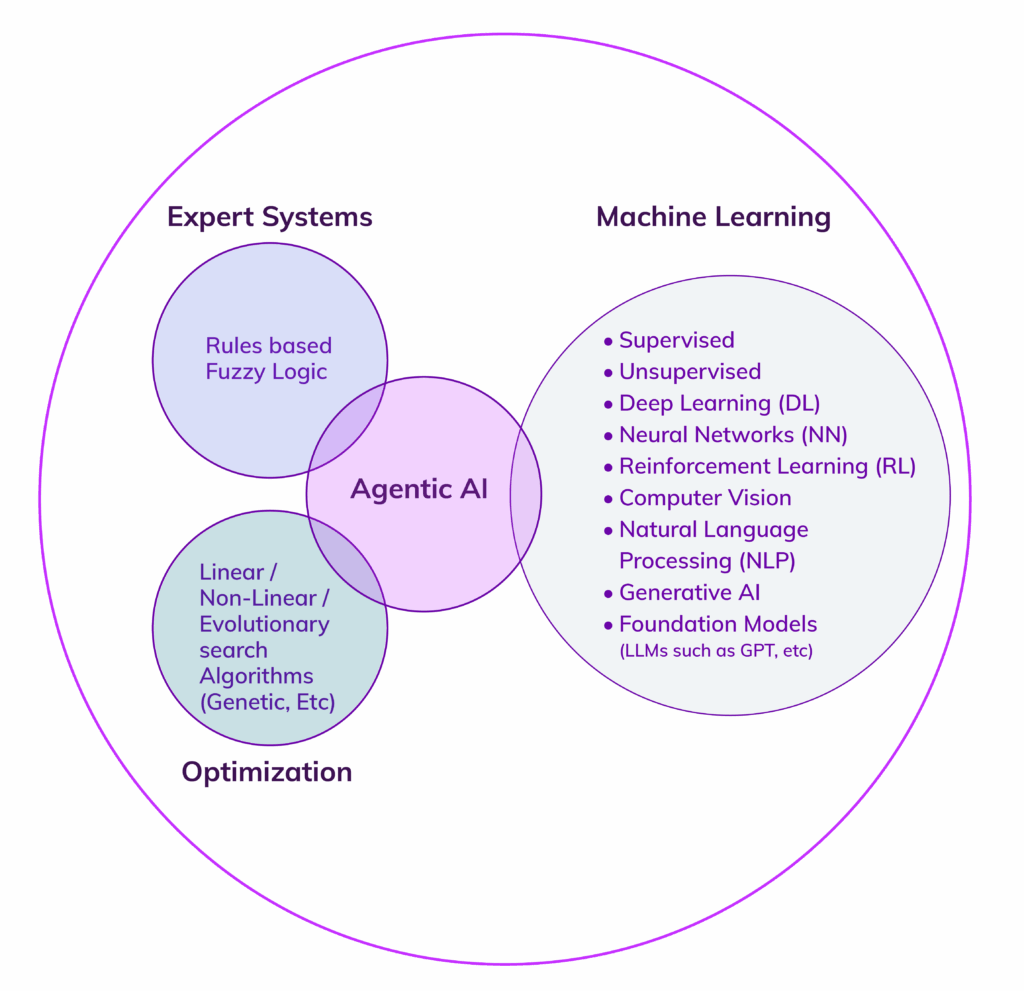
As with any technology, there are several ways to approach AI. Some of the most commonly used AI methodologies in the industrial space include (Figure 4):
- Expert systems: Probably the oldest form of AI, but nevertheless useful for collating knowledgebase facts and rules to solve specific problems. Rules-based systems mimic the decision-making ability of a human expert via explicit programming.
- Generative AI (Gen-AI): Generates new content (text, images, audio, etc.) based on user prompts, greatly multiplying human efforts. Often powered by deep learning transformer models (e.g. GPT) and trained on large datasets. Part of the larger machine learning (ML) system domain.
- Machine learning (ML): Systems that learn from historical data to make predictions or decisions without the need for explicit programming. ML is further classified into supervised, unsupervised and reinforcement learning. Examples of ML include regression, clustering, neural networks (NN) and natural language processing (NLP). In industrial settings, ML can be used to analyze numerical, textual and even images to provide helpful.
- Optimization: AI used to find the best solution from many possibilities under given constraints. By utilizing advanced algorithms, multiple factors are considered simultaneously to solve complex, real-world problems (such as scheduling, resource allocation, route optimization, etc.) to optimize and streamline existing processes.
Petra Nieuwenhuizen is a senior marketeer in Aveva’s portfolio team.
Edited by Mark T. Hoske, editor-in-chief, Control Engineering, WTWH Media, [email protected].
Keywords
Industrial AI, machine learning, AI implementation
Consider this
Is your control system data available to help AI help your processes?
You also might like
Control Engineering provides more on industrial AI.