Data from supervisory control and data acquisition (SCADA) and industrial internet of things (IIoT) offers tremendous value for water and wastewater utilities by unlocking efficiencies in processes, operations, maintenance and materials.
SCADA data for machine learning insights
- Learn differences in operational technology and information technology (OT and IT) data including sources, management and security
- Find hidden value in OT data using artificial intelligence (AI) and machine learning (ML) including time-series data for ML analyses to support utilities.
- See examples of real efficiencies gained using AI/ML tools with OT data.
In the field of water and wastewater engineering, daily operations increasingly rely on managing vast amounts of data generated by supervisory control and data acquisition (SCADA) systems and Industrial Internet of Things (IIoT) devices. Utility staff are increasingly recognizing significant value in these data by leveraging technologies such as machine learning (ML) and artificial intelligence (AI) that deliver operational efficiencies, achieve substantial cost savings and improve infrastructure reliability.
Time series data: A key asset
Many water and wastewater utilities continuously monitor system performance through SCADA and IIoT devices, thereby producing large and high-value time series datasets. Time series data are characterized as a sequence of data points recorded over time. These data capture critical trends and patterns essential for automation, control, performance monitoring, anomaly detection and predictive analytics. Common examples include flow rates, tank levels/storage, water consumption, pressures, energy consumption, chemical dosing, water quality parameters and treatment process data.
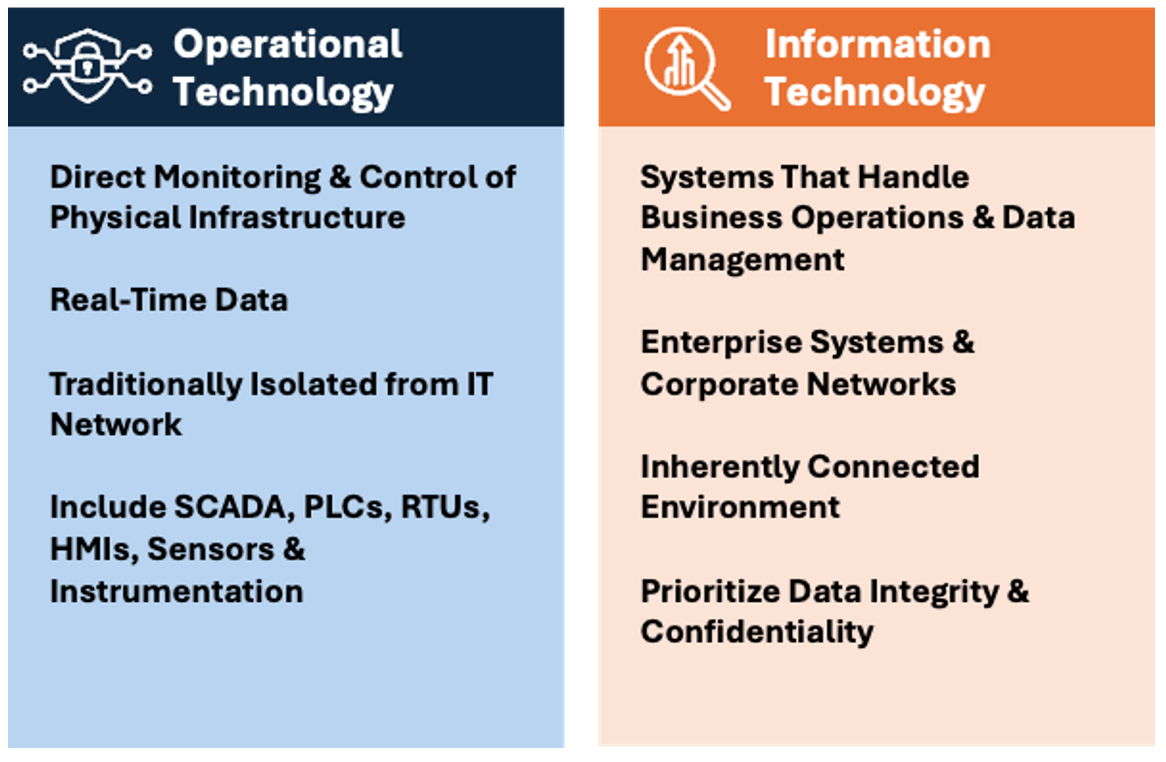
Effective management of time series data requires strategic collaboration between operational technology (OT) and information technology (IT) teams. OT involves systems and hardware used to monitor and control physical processes, such as SCADA and IIoT sensors, pumps, valves and actuators. Maintaining data integrity, accuracy, and real-time availability is paramount for OT teams to ensure reliable system monitoring and rapid response to anomalies. Critically, OT systems must maintain continuous operation even when other systems are offline for support, maintenance, or emergencies. Conversely, IT encompasses systems related to data storage, processing, software applications and cybersecurity. The IT perspective focuses on secure data storage, robust infrastructure, accessibility for advanced analytics, integration with enterprise systems and data governance. Data security is a critical consideration, especially given the sensitive nature of utility infrastructure. Utilities must adopt robust cybersecurity protocols, including secure data transmission methods, stringent access controls, network segmentation, encryption standards and continuous monitoring practices.
Beyond time series data, utilities also handle other data sets that may be beneficial for ML and AI analyses, such as:
- Geospatial data: Geographic information systems (GIS) map infrastructure assets that aid in asset management and operational planning.
- Operational data: Includes historical performance logs, maintenance records and incident reports crucial for assessing efficiency.
- Customer data: Billing and consumption information that helps improve customer relations and service quality.
- Regulatory and compliance data: Documentation critical for maintaining compliance with environmental and public health standards.
- Financial data: Budgeting, cost management, and financial analyses essential for informed decision-making.
Integrating these data sources with time series data information can provide utilities with a comprehensive operational picture, greatly enhancing decision-making capabilities.
Achieving operational efficiencies through ML
Optimizing energy-intensive processes—such as pumping, aeration, and chemical dosing—is a high-value use for ML techniques because these analyses can be effective when identifying correlations within operational data, thus helping utilities predict and optimize resource use.
For instance, ML-driven optimization of pump scheduling (based on historical energy tariffs and demand data) has demonstrated energy savings as high as 25%, significantly reducing operating costs.
Aeration control: A direct impact for utility operations
Wastewater aeration is the largest energy consumer in wastewater treatment plants, typically accounting for 40% to 60% of total energy usage, according to the U.S. Department of Energy. Traditional manual or fixed set-point control methods fail to respond to changing conditions. In contrast, ML-driven models provide real-time predictive control, thus allowing the operator to dynamically adjust aeration based on dissolved oxygen levels and incoming wastewater quality.
In a recent deployment at a mid-sized treatment plant, implementing ML-controlled aeration resulted in more than 40% reduction in energy usage for several utilities (U.S. Department of Energy). These results underscore ML’s practical applicability for utilities focused on operational excellence and cost management.
Precision chemical dosing: Savings, compliance
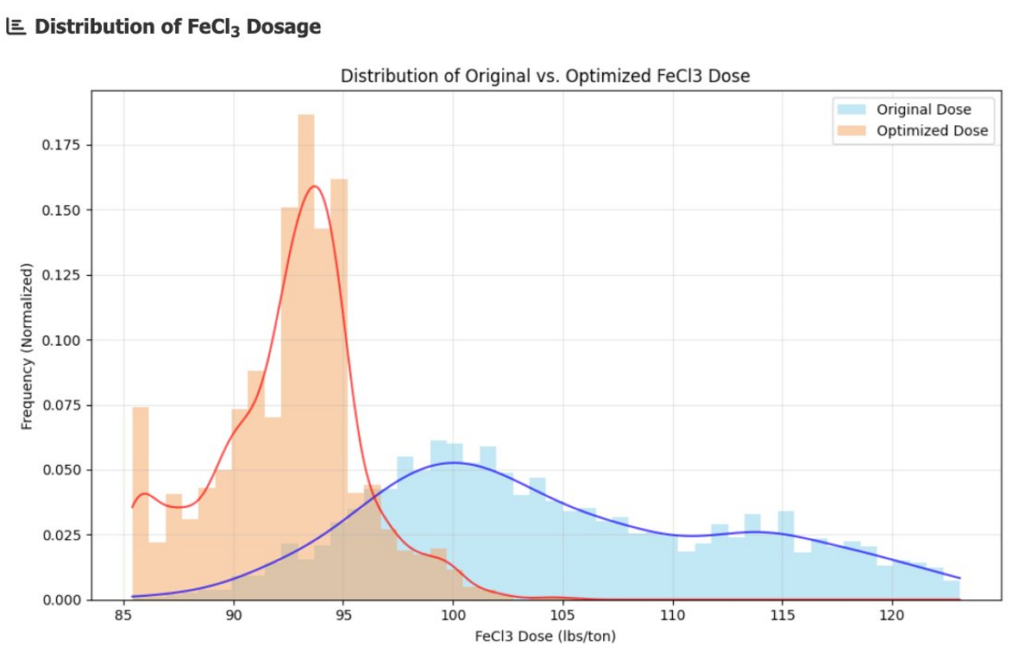
Chemical dosing is another crucial operational component for utilities that can achieve significant cost optimization. ML techniques analyze historical data pertaining to influent characteristics, thus enabling prediction and optimization of chemical usage. For example, a California-based water treatment facility employing ML-driven chlorine dosing optimization reduced chemical consumption by 18%, thus realizing significant financial savings and enhancing compliance, according to World Pumps 2024.
Predictive maintenance, asset management
For operators tasked with asset reliability, predictive maintenance is a compelling ML-use case. By analyzing vibration, temperature and operational time-series data, ML algorithms can effectively anticipate equipment failures. This predictive capability complements proactive maintenance activities scheduling, substantially reducing emergency repairs and system downtime. Utilities employing these techniques report maintenance cost reductions exceeding 30%, clearly demonstrating the value of predictive analytics in asset management, according to Blues 2024.
Expanded AI and ML applications
Additional practical ML and AI applications particularly relevant to utilities include:
- Leak detection: Advanced ML algorithms detect anomalies in pressure and flow data to identify potential leaks early, minimizing water loss and damage.
- Demand forecasting: Predictive models assist operators in accurately forecasting future water demand, enabling better planning and operational efficiency.
- Real-time water quality monitoring: AI-enhanced monitoring detects and even predicts water quality anomalies, enhancing public health protection and compliance assurance.
- Digital twins: Digital replicas of physical systems are used for scenario simulation and strategy optimization, significantly reducing risk and operational uncertainty.
Implementing ML and AI successfully: Key utility considerations
Successful ML and AI projects must addressing several practical challenges:
- Data availability, consistency, governance and standardization are crucial. Reliable ML and AI outcomes depend on accessible, high-quality and well-governed data. It is essential that clear data stewardship, requirements and flow be established.
- Investing in scalable, interoperable and flexible data infrastructure that supports integration across multiple platforms is imperative.
- Building a partnership of internal and external champions experienced in utility-specific ML/AI applications is fundamental.
By proactively addressing these areas, utilities can accelerate their organization’s digital transformation and capitalize fully on the potential benefits offered by ML and AI.
Time-series data benefits, cost savings
The water and wastewater utility sector is beginning to see the value of leveraging SCADA and IIoT time series data by using ML and AI solutions. Practical applications in energy optimization, chemical dosing accuracy, predictive maintenance and asset management demonstrate significant potential for achieving operational efficiency and substantial cost savings.
The future of utility management will continue to be increasingly digital, predictive and proactive. Operators, engineers and leaders who strategically adopt and integrate these advanced technologies today will position their organizations for sustained operational efficiency and resilience in the future.
Travis B. Wagner, PE, leads Trinnex’s digital solutions. Edited by Mark T. Hoske, editor-in-chief, Control Engineering, WTWH Media, [email protected].
Keywords
SCADA data, machine learning, artificial intelligence, industrial internet of things
Consider this
Are you seeing benefits from your SCADA time-series data?
You also might like