Through teamwork between E Tech, Exotek, and CSIA leadership, the system integration industry gains a new model for enterprise-wide certification.
CSIA Certification insights
- System integrators’ rapid growth through M&A has created a need for CSIA to evolve its certification process to fit multi-location enterprises.
- E Tech Group collaborated with CSIA and Exotek to pilot an enterprise-level audit model that certifies an entire organization under one framework.
- The partnership between E Tech, Exotek and CSIA leadership modernized the certification program to better serve today’s large, integrated system integrators.
Healthy drivers, including the increasing demand from manufacturers for automation solutions, have generated overall good growth for system integrators over the past few years. This growth has been accomplished organically (e.g., by expanding geographically or into targeted industry verticals) or through mergers and acquisitions (M&A). When companies grow, they often reach a point where they must reorganize to operate and grow successfully. In addition, when growth is achieved through M&A, managers need to determine if they want to drive toward integration (full or partial) or not at all.
Growth brings new organizational and certification challenges
Regardless of how they are growing, it has been valuable for system integrators of all sizes to ensure and demonstrate that they are aligned with business best practices. It has been a core offer of the Control System Integrators Association (CSIA) to define those best practices and provide a certification to them. Since its inception, this CSIA Member Certification process has examined and granted certification to specific, single operating locations. While this approach has worked for companies with one or a small number of operating locations, the size, number of locations and underlying organizational structure that stems from the acquisition of several companies, each with multiple locations, creates increasing pressure to consider different methods of certification.
Different paths to growth and integration
One approach is for the various companies to hold high levels of independence, including retaining previous company names and cultures, but to achieve synergies through shared services (often HR and finance) or increased purchasing volume. From the perspective of the CSIA Certification program, these cases are relatively simple. If desired, those independent companies apply individually for the certification of their companies. If they pass the audit, these companies will hold the CSIA Certification for the next three years, but this certification will not extend to any parent or sibling entities of the company.
An opposite approach is for the company to complete a full merger of all its entities into a single entity with many locations, including moving to a single company name. This new company could be organized along various P&L centers covering different geographies or industry verticals while leveraging shared service centers. From the perspective of the CSIA Certification, this is a more complex situation and has caused the association to create a variation to its certification process.
Mergers are challenging not only because they involve most aspects of the business, but also because they touch the human element: the company culture, history and identity. The drive toward a common internal process framework, as defined by the CSIA Best Practices, can be a foundational catalyst for that integration. While it may take more than just an audit and certification, setting an audit target date and gaining input from an independent third-party auditor through the CSIA audit can spur the entire organization to make it happen.
Enterprise level audit pilot with e tech group
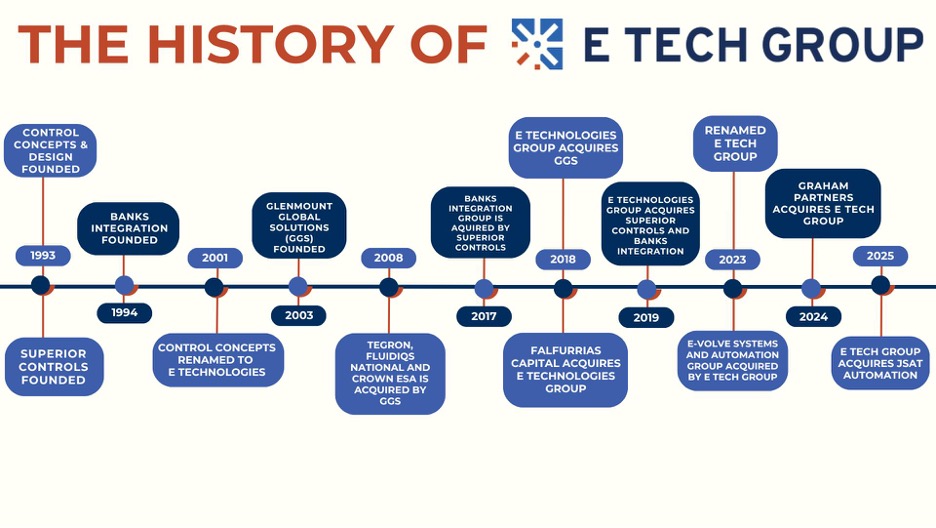
E Tech Group has undergone dramatic growth in the past few years because of both organic growth and aggressive M&A funded by private equity. The histogram below explains the evolution.
While not all companies follow the same path, E Tech Group was clear from the start that they would pursue the integration of their companies under a single brand. While this is easy to articulate, it takes significant effort to accomplish. Superior Controls, the first system integration company to receive CSIA Certification in 2000, joined E Tech Group in 2019. The benefits that Superior Controls derived from pursuing and maintaining the CSIA Certification incentivized the rest of E Tech Group to deploy the CSIA Best Practices, the base for the CSIA Certification. It is worth mentioning that the original E-Technologies received its first CSIA Certification in 2013 and retained it until 2019, at which point they let the certification lapse to lead the integration process. They intended to pursue the certification for the larger company that would emerge post integration.
How did this audit take place?
Having progressed significantly toward their integration goals, E Tech Group initiated re-certification discussions in 2024 with CSIA and Exotek, a CSIA Certified Auditor. E Tech Group previously utilized Exotek audit services for their legacy companies, and they wanted to explore a possible companywide certification. This would represent something fundamentally different and more comprehensive than what the current certification and audit process offered. The standard approach provides an audit for the “Head Office,” followed by audits of all the “Branch Offices.” This would have been challenging for E Tech with more than 25 locations nationwide. However, because E Tech Group operates as a single entity with a single brand and a clearly defined corporate headquarters, with business units separated by geography and core competencies, there was an opportunity to create an audit plan specific to E Tech Group that could ensure representativeness and properly reflect the depth and extent of their certification across the entire organization — not just a portion of it.
Exotek brought its audit expertise and a strong familiarity with several of the legacy companies that are now part of E Tech, dating back to the first CSIA certification of Superior Controls. Collaborating closely with E Tech, Exotek designed a tailored audit plan that offered valuable insights into the company’s enterprise structure. This plan was subsequently reviewed and approved by CSIA as part of the certification process.
The corporate headquarters was audited on topics like general management, human resources management and financial management. The business units were audited on specific parts of human resources management, such as “training and professional development,” as well as relevant impactful sections, such as project management, system development lifecycle, etc. All business units were audited on common topics (e.g., project management). To properly represent the level of accomplishment required with this new audit format, the company’s final audit results contained the consolidated scoring from all audited areas of the organization, reflecting the lowest score obtained with respect to each audit criterion.
Certification as a unifying framework
Most SIs pursue CSIA Certification for the value it brings in strengthening their business practices. For E Tech Group, the certification process has served as a unifying framework, helping align its portfolio of companies with CSIA’s Best Practices. CSIA extends its congratulations to E Tech Group, and especially to Gary Powell, PE, senior vice president of operations, for championing this initiative. Powell played a pivotal role in advocating for the development of this certification option and led internal efforts to prepare for the audit.
Special thanks also go to Brian Mullen, P.Eng. and senior management consultant, of Exotek, who designed, developed and executed the pilot audit plan in close collaboration with E Tech. His leadership was instrumental in shaping the process that made this achievement possible.
Finally, CSIA thanks its former CEO, Jose Rivera, for guiding the creation of the framework that allowed the CSIA Certification to adapt and meet the evolving needs of CSIA members. In addition, he was the primary author of this article, and we thank him for his contributions in providing this information.
CSIA is a WTWH Media content partner. Edited by Gary Cohen, senior editor, Control Engineering, [email protected].
LEARNING OBJECTIVES
- Understand how system integrator growth through mergers and acquisitions creates new challenges and opportunities for organizational alignment and certification.
- Learn how E Tech Group, in collaboration with CSIA and Exotek, developed and implemented an enterprise-level audit model for multi-location certification.
- Recognize how adapting certification frameworks can strengthen business practices, unify company culture and support sustainable growth.
CONSIDER THIS
How can our organization leverage the CSIA Certification process to align and integrate our business practices across multiple locations and acquired companies?