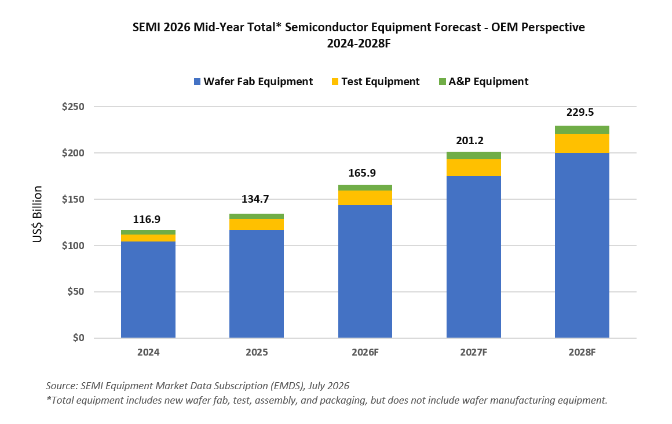
SEMI forecasts OEM semiconductor equipment sales will reach $165.9 billion in 2026 and $229.5 billion by 2028.
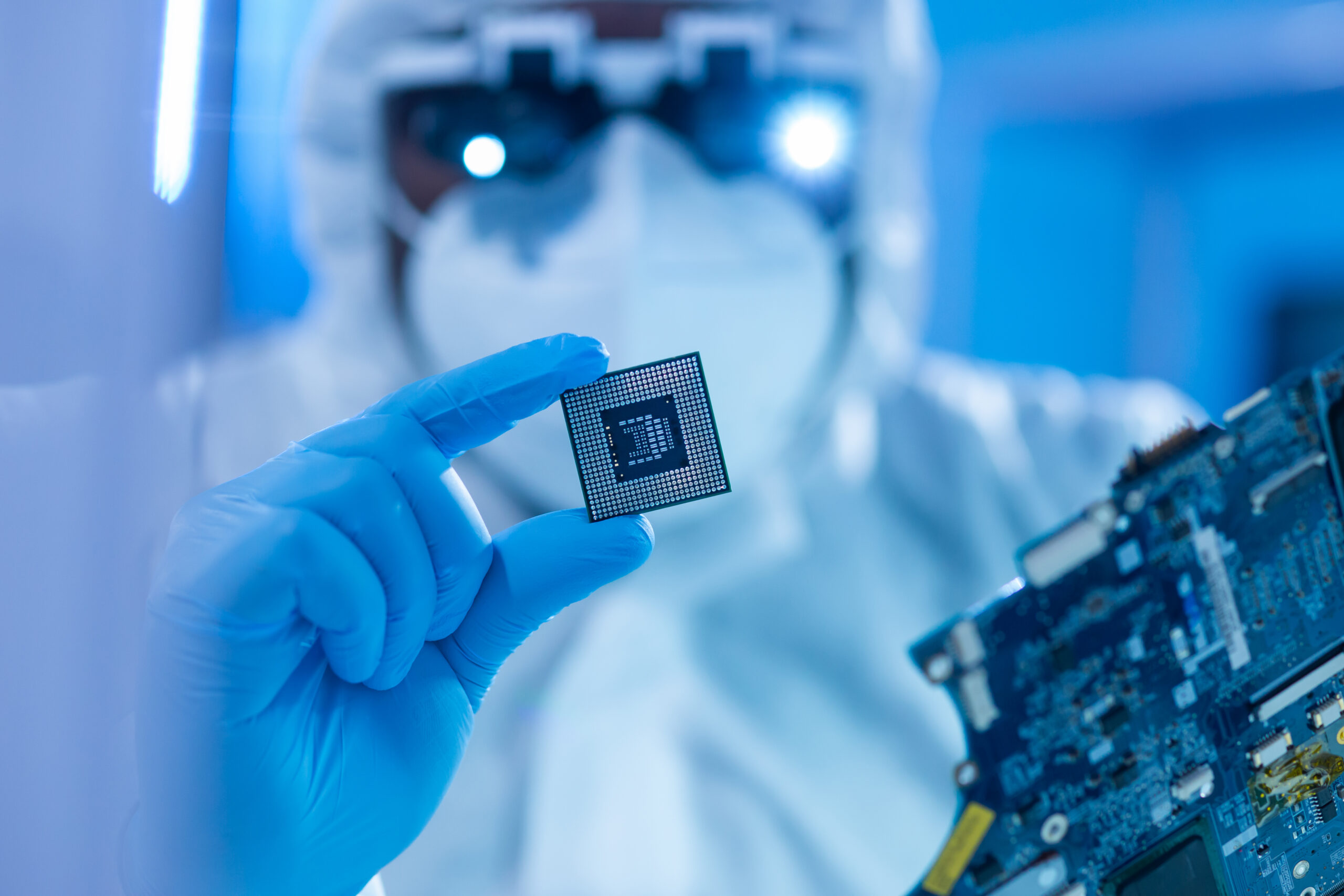
Global sales of total semiconductor manufacturing equipment by original equipment manufacturers (OEMs) are forecast to reach $165.9 billion in 2026, up 23.2% year over year, SEMI announced in its Mid-Year Total Semiconductor Equipment Forecast – OEM Perspective. Sales are expected to continue growing through 2028, reaching$229.5 billion, which would be the fifth consecutive year of growth as AI-related demand influences semiconductor manufacturing investment.
This is important for Control Engineering subscribers because automation devices and systems go into these machines, automation system integration is required as machine are installed and chips they make help power next-generation automation.
The higher forecast reflects increased investment in AI infrastructure, advanced logic, advanced memory and back-end technologies used to support higher compute density, high bandwidth memory (HBM)-related investment and more complex device architectures.
“AI is accelerating demand for more powerful and efficient chips, driving increased investment across the semiconductor capital equipment market,” said Ajit Manocha, SEMI president and CEO. “The mid-year forecast points to a higher equipment spending trajectory as chipmakers invest in the leading-edge logic, advanced memory, test and packaging capabilities required for the AI era.”
Semiconductor equipment sales by segment
After reaching $116.9 billion in sales last year, the wafer fab equipment (WFE) segment, which includes wafer processing, mask/reticle and fab facilities equipment, is projected to increase 23.1% to $143.9 billion in 2026. This is an upward revision from SEMI’s 2025 year-end forecast and reflects increased investment in advanced memory, including HBM-related DRAM technologies, and advanced logic applications. WFE segment sales are projected to grow 21.8% in 2027 and 14.1% in 2028 to reach $200 billion as manufacturers expand capacity and adopt technologies for AI-related workloads.
AI-related semiconductor demand is also contributing to growth in back-end equipment. After increasing 55.3% in 2025, semiconductor test equipment sales are projected to increase 31.0% to $15.3 billion in 2026, an upward revision from SEMI’s 2025 year-end forecast. Assembly and packaging equipment sales, which increased 20.8% in 2025, are projected to rise 9.6% to $6.7 billion in 2026, generally in line with the prior forecast. Sales are expected to continue growing through 2028, with test equipment reaching $20.8 billion and assembly and packaging equipment reaching $8.6 billion, supported by more complex devices, adoption of advanced and heterogeneous packaging and higher performance and reliability requirements for AI and HBM devices.
WFE sales by application
WFE sales for foundry and logic applications are expected to increase 18.9% year over year to $78.0 billion in 2026, supported by advanced-node capacity additions for AI accelerators, high-performance computing and high-end mobile processors. The segment is forecast to grow 18.1% in 2027 and 13.6% in 2028, reaching $104.7 billion, as manufacturers move toward high-volume manufacturing at the 2nm gate-all-around node.
Memory-related equipment spending is projected to increase through 2028, supported by demand for HBM, migration to advanced DRAM nodes and NAND technology transitions. DRAM equipment sales are projected to rise 39.0% to $38.8 billion in 2026, followed by 27.4% growth in 2027 and 15.0% growth in 2028, reaching $56.9 billion. NAND equipment sales are projected to grow 30.7% to $13.9 billion in 2026, then increase 31.1% in 2027 and 14.5% in 2028, reaching $20.8 billion, supported by 3D NAND layer migration and investment in higher-density architectures.
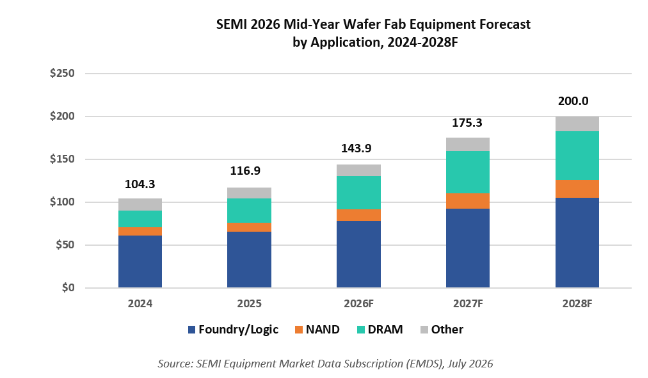
Semiconductor equipment sales by region
China, Taiwan and Korea are expected to remain the three largest regions for equipment spending through 2028. China is projected to remain the largest market during the forecast period, though growth is expected to moderate in 2026 following higher investment levels in recent years. In Taiwan, spending is supported by advanced memory technologies, including HBM. Other tracked regions are expected to see equipment spending increase in 2027 and 2028, supported by regionalization efforts, government incentives and specific specialty capacity additions.
The SEMI forecast is based on input from major equipment suppliers, the SEMI Worldwide Semiconductor Equipment Market Statistics (WWSEMS) data collection program and the SEMI World Fab Forecast database.
Edited by Puja Mitra, Arrowfly, for Control Engineering, from a SEMI news release.