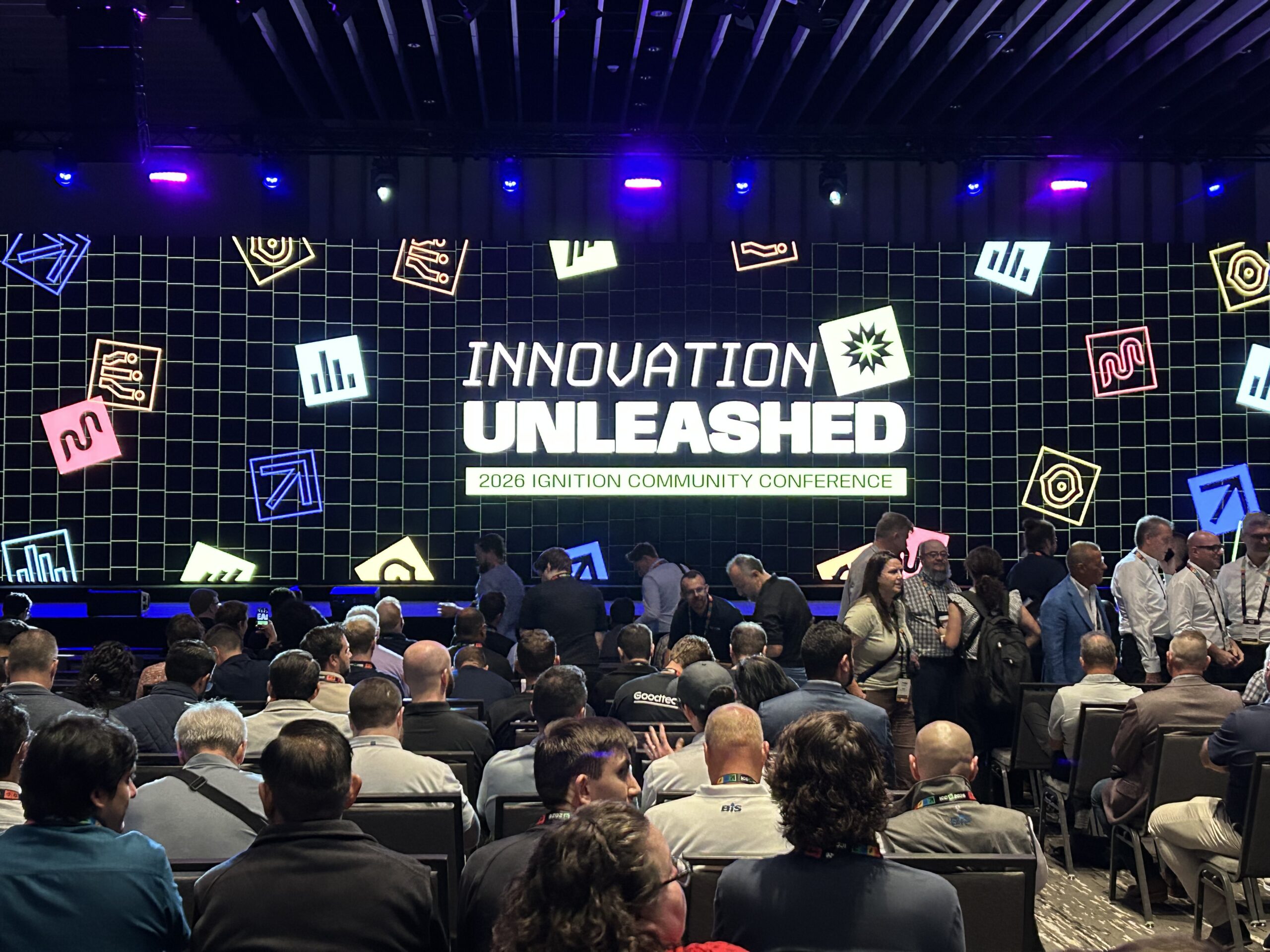
At the Ignition Community Conference, Inductive Automation previewed major architectural additions spanning connectivity, redundancy, time-series storage and embedded agent workflows.
Ignition 2027 keynote insights
- Ignition is shifting to an annual release cycle starting with Ignition 2027, delivering long-requested tools like a native Beckhoff ADS driver, automated OPC UA client failover and partial gateway hot-imports.
- A new partnership with Tiger Data brings a TimescaleDB-backed Enterprise Historian that dramatically cuts query times and storage footprint while preserving essential relational SQL context.
- The Ignition Catalyst framework integrates generative AI into the Designer and runtime applications using a flexible “bring-your-own-model” setup that keeps engineers firmly in control of changes.
Inductive Automation opened its annual Ignition Community Conference in September by outlining the product roadmap for Ignition 2027, the initial release under a newly adopted annual major-version release cadence. The vendor scheduled a public beta for November, with general availability targeted for February. Ignition 8.3 will remain the designated Long-Term Support (LTS) release supported through 2030, while Ignition 2027 establishes a predictable yearly cycle for major functional updates.
For controls engineers, operational technology (OT) specialists and system integrators, the keynote focused on engineering mechanics rather than conceptual positioning. The technical sessions addressed persistent plant-floor pain points, including the overhead of maintaining intermediate driver middleware, the risk of split-brain conditions across redundant gateway pairs, the database scaling challenges inherent to high-frequency time-series logging and the safe deployment of artificial intelligence (AI) inside industrial controls environments.
Native connectivity, cloud interfaces and fleet configuration
The connectivity updates center on eliminating custom scripting and third-party middleware traditionally used to bridge non-native devices and enterprise services. Ignition 2027 introduces a native Beckhoff ADS driver supporting TwinCAT 2 and TwinCAT 3 architectures. The driver operates without external OPC servers, offering direct address browsing from the designer, symbolic addressing and offline TTY file parsing for devices lacking active browsing support.
Cloud and enterprise integration receives a dedicated AWS connector module that provides direct communication channels to Amazon S3, DynamoDB, Simple Notification Service (SNS) and Simple Queue Service (SQS). Built around a centralized credential model supporting instance profiles and environment variables, the connector is designed to automate routine data transfers, such as dispatching scheduled gateway backups directly to S3 or populating user interface views from DynamoDB tables without writing custom Python or REST scripts.
For broader software interoperability, operational REST APIs have been expanded to provide full HTTP read, write, browse and configuration capabilities across live tags and historical archives. The Event Streams module also gains an OPC event source, allowing Ignition to subscribe directly to standard timestamped diagnostic data, audit trails and server-side notifications generated by external OPC UA servers.
Fleet management and site deployments receive two operational improvements: a formal Ansible collection providing automated installation, upgrading and API-driven configuration management, alongside native partial gateway imports and exports. The partial export utility packages specific configurations into portable files that can be hot-imported into running target gateways without requiring a software restart or overwriting broader server settings, simplifying promotions between staging environments and active production.
Plant-floor visualization and configuration workflows
On the plant floor, operator interface hardware often creates usability compromises, particularly on panel-mount touchscreens. To address situations where third-party or operating-system soft keyboards fail to trigger reliably, Perspective Workstation now includes an integrated, native virtual keyboard. The keyboard detects whether an operator is interacting with an alphanumeric field or a numerical entry box, dynamically rendering the appropriate full keyboard or number pad while remembering its screen position and dimensions across sessions.
Application builders receive 16 native charting components and a variety of domain-tailored variants, including out-of-the-box Pareto combination charts, stacked bar charts and radar plots. These components are coupled with a gateway-level chart style editor that links visual properties directly to Perspective styling themes. The existing Power Chart component has also been updated with real-time tag search and filtering, color-coordinated pen typography and explicit data quality indicators.
For offline engineering, Inductive Automation replaced legacy CSV bulk tag exports with full round-trip Microsoft Excel support. Unlike flat CSV files, the Excel integration captures complete tag definitions, including nested User Defined Type (UDT) hierarchies, parameter bindings, alarm configurations and script definitions. Security architecture has also been updated to support multiple concurrent Identity Providers (IdPs) simultaneously across Gateway, Designer and Workstation sessions to accommodate segmented corporate IT/OT trust domains.
Process redundancy and high-volume historian architecture
High-availability and mission-critical operations received specific focus through engineering collaborations and structural architectural changes. Working with the Coalition for Open Process Automation (COPA), the company introduced redundant OPC UA client connection handling. Systems can now point to a single endpoint, automatically discover the redundant server pool and manage failover without operator intervention. To mitigate split-brain risks across primary and backup Ignition gateways, an optional passive Redundancy Advisor node was introduced; a backup gateway will assume active primary status only if it verifies communication with the independent advisor while losing communication with the primary server.
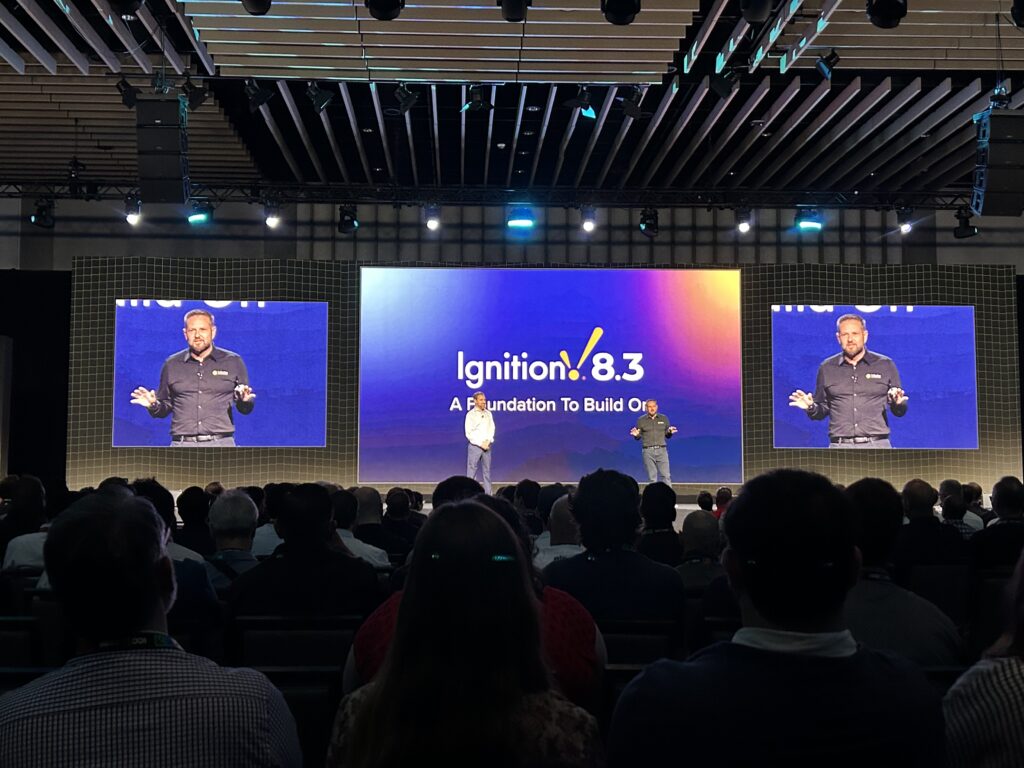
To support high-throughput operations, Inductive Automation announced an Enterprise Historian developed in partnership with Tiger Data, powered by TimescaleDB on top of PostgreSQL. The architecture uses partitioned hyper-tables, columnar storage and continuous aggregates to accelerate analytics and control data volume growth.
“Industrial data is never just time series data,” said Mike Freedman, co-founder and CTO of Tiger Data, explaining that raw sensor measurements require the contextual framework of relational data, including asset models, alarm states and operational records.
Inductive Automation reported that internal benchmark testing across 2.1 billion historical data points demonstrated more than 10 times higher ingest throughput, approximately 10 times faster historical queries and more than 10 times less physical disk storage compared to standard PostgreSQL configurations. A commercial packaging designated TimescaleDB for Ignition will be offered with unlimited tag licensing, three-node high-availability clustering and dedicated vendor support. The company also confirmed that Ignition 2027 and future releases will comply natively with the requirements of the European Union Cyber Resilience Act.
Ignition Catalyst: contextual AI and agent frameworks
The most significant architectural shift in the platform is Ignition Catalyst, an embedded artificial intelligence framework comprising two modules: Catalyst Core and Catalyst Agents. Rather than relying on external agent software to bridge into Ignition, the platform integrates model interaction directly into the engineering environment while maintaining a strict separation between software logic and underlying large language models.
Catalyst Core, which will be included in the base platform at no additional license cost, embeds contextual assistants throughout the Designer. These assistants inspect component property trees, browse tag databases and evaluate relational database schemas to assist engineers in authoring Python scripts, generating parameterized UDTs directly from PLC memory scans, creating complex named queries and repairing responsive Flex Repeater layouts. The module also introduces gateway diagnostic agents that inspect runtime thread dumps, system metrics and execution logs to help engineers isolate operational bottlenecks, such as runaway scripts or thread starvation.
Catalyst Agents, a separate commercial module, supplies an execution harness for building domain-specific autonomous agents into OT applications. Engineers define system boundaries using natural-language system prompts and grant the agent access to specific user-defined Python methods that act as tools for data inspection, tag queries or notification dispatching. A native Perspective AI chat component allows operators to interact with these agents conversationally directly from runtime operational displays. The module also incorporates full Model Context Protocol (MCP) client and server support, allowing external agents to query Ignition securely and enabling internal agents to communicate with third-party software tools.
Addressing safety concerns regarding deterministic control environments, Carl Gould, Inductive Automation’s CTO, emphasized that AI assistance in the Designer is engineered around strict human-in-the-loop oversight. The Designer provides an environment that allows “you, the human, to stay in the loop and review and test out changes” before any code or tag configuration is saved to the gateway.
Gould also stated the company’s approach regarding model governance.
“We did not build an AI model,” he said, clarifying that users must connect their own model endpoints. The software supports commercial APIs such as Claude and ChatGPT, as well as local, open-weights models running completely on-premises in air-gapped network architectures, with no application data routed back to Inductive Automation.
Practical engineering considerations
While the keynote presented an ambitious technical direction, practical adoption will depend on how effectively these additions perform across real-world industrial infrastructure. Controls engineers and system integrators evaluating the forthcoming November beta will need to validate the Beckhoff ADS driver against diverse firmware versions, verify failover reliability under induced network partition scenarios, stress-test the Enterprise Historian with plant-floor data profiles and define rigid permission boundaries around custom agent tooling before considering deployment on active production networks.
LEARNING OBJECTIVES
- Learn how the transition to yearly releases and new tools affect deployment and lifecycle planning.
- Analyze how the TimescaleDB-backed Enterprise Historian balances high-throughput ingestion and storage compression with the relational SQL context required for industrial operations.
- Identify how the Ignition Catalyst framework incorporates contextual design assistants, gateway diagnostics and custom operational agents.
CONSIDER THIS
How will your organization adapt its engineering workflows, governance policies and client maintenance strategies to leverage faster annual releases and embedded AI tools without compromising plant-floor reliability and security?