AI’s full value in process manufacturing has yet to be realized. The next advance will require a hybrid architecture that orchestrates AI deployments across cloud, edge and core control system compute environments based on use cases, performance requirements and security policies.

Process control and AI insights
- Cloud-centric approach impedes operational technology (OT) adoptions.
- OT architecture is evolving, and the future relies on an orchestrated hybrid environment.
- Process control facilities are embracing the AI journey.
In just a little over three years, artificial intelligence (AI) has come to dominate the technology landscape. It is increasingly rare to find process manufacturing professionals who haven’t engaged with generative AI tools, whether to help with crafting documents, conducting research, or general question and answer-style interactions. As a result, many teams are pursuing opportunities to deploy advanced AI techniques in operational technology (OT) environments to drive productivity in manufacturing operations.
The common force behind today’s most transformative AI tools—and the foundation that gives them their impressive capabilities—is cloud computing. Processing power and rapid scalability available in cloud environments are key factors making AI tools universally accessible and increasingly insightful.
Cloud-centric approach impedes OT adoption
The tight coupling between cloud computing and AI has slowed the pace of adoption of OT use cases as OT teams are typically reluctant to connect systems to the cloud. Cloud connectivity can be impacted by network constraints impacting performance, and in some jurisdictions data governance and regulatory requirements could limit adoption. These are critical issues for organizations focused on safety, availability, and competitive advantage. Yet, even if OT teams were more willing to connect control systems to the cloud, in many cases the latency would still be too high for real-time, mission-critical operations.
These challenges are solvable. OT technologies are advancing, and key AI tools are already available, with more on the way. Forward-thinking organizations are already deploying more high-performance computing capabilities closer to their underlying processes via edge hardware platforms.
Today, that strategy primarily manifests via deployment of edge solutions that are physically isolated from core control system components. In coming years, the OT technology stack will be further enhanced by the emergence of software-defined architectures working in tandem with enterprise operations platforms to provide a cohesive approach to AI workload orchestration.
OT architecture evolution
One of the keys to successfully deploying AI in OT infrastructure is the capability to seamlessly migrate cloud-native workloads into an on-premises environment. Today, automation solutions providers are equipping edge platforms with AI accelerators, allowing variants of models like those deployed in the cloud to run on local systems. The goal is to deliver solutions that can run on-premises—delivering the security and latency necessary for OT environments—while still providing reasoning capability and generating natural language responses that are verifiably accurate without fabrications.
Those local models are quickly demonstrating that the industrial edge is the next frontier for OT-driven productivity gains, with a strong underlying data foundation with clear context critical for success. Edge environments can seamlessly connect AI use cases with the rich data model and streaming real-time operational data that distributed control systems uniquely provide. Most importantly, that processing can be performed quickly and securely at the edge, making it possible to tie the results more directly to mission-critical, real-time goals.

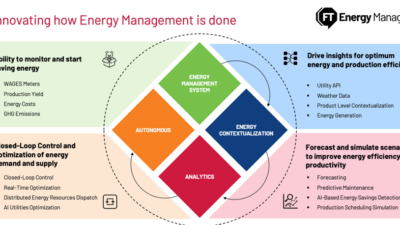
The capabilities of on-premises AI for OT environments do not end with edge deployments. As automation solution providers build out their software-defined control offerings, the AI models needing the lowest latency will be able to reside even closer to the underlying process dynamics—eventually operating in the same virtualized environment as other control system functions. With extremely low cycle times, these software-defined systems will help operators determine the best action in complex scenarios by using AI to capture and embed knowledge, making it available on demand. These systems will have the capability to automate operator-guided, multi-step workflows, dramatically reducing the time from analysis to problem resolution (Figure 1).
The future relies on an orchestrated hybrid environment
Effective deployment of AI in OT architectures hinges on a flexible technology foundation—one that aligns with the operational philosophy and the unique performance requirements of each process. Not every AI solution will need to reside on the same compute platforms as core control functions. Even when the most advanced software-defined control systems are available and running AI workloads in the same environment as core control functions, many AI applications will still be better suited for edge or cloud environments.
For example, technologies likely to run at the software-defined control layer are real-time, deterministic, low-latency applications like advanced process control, quality control, and other solutions that need to deliver results in seconds or milliseconds to be safe and effective.
In an edge environment, AI solutions that support reliability, sustainability and other operational excellence outcomes will take advantage of powerful hardware-based AI accelerators to deliver results that can be provided with slightly longer cycle times.
Scenario and planning tools, performance engineering software, and enterprise virtual advisors for a fleet of OT systems are likely to continue residing in cloud environments, where they can scale seamlessly and deliver results that are not as time sensitive.
As these compute environments continue to interconnect, OT teams will need an orchestration architecture to coordinate AI workloads across cloud, edge, and core control systems — ensuring optimal performance throughout the automation stack. The most effective solutions will not be those built piecemeal and connected via complex custom-engineered interfaces, but rather solutions designed to integrate seamlessly.
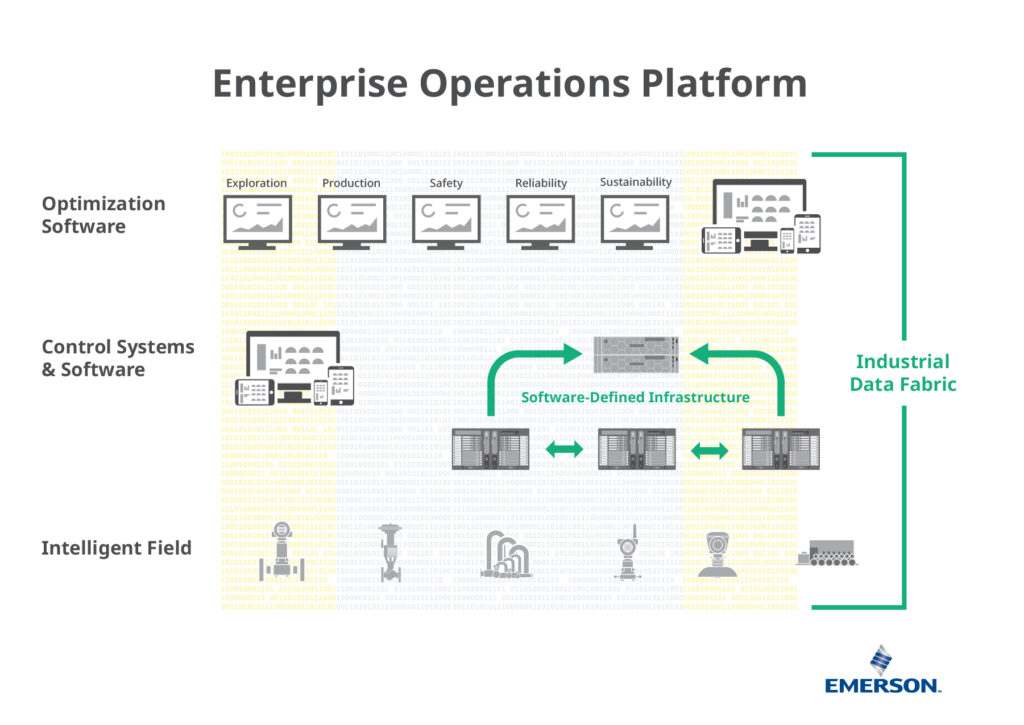
That need for orchestration is perhaps the most important element to consider as technologies continue to evolve. The very nature of technology advancement and project deployment means OT teams will be implementing AI solutions in phases. Fortunately, embedded AI agents and other enterprise operations platform technologies are already simplifying connectivity between data sources and consumers through standard protocols, bringing contextualized insights together into a cohesive whole via an industrial data fabric for ease of use and connectivity (Figure 2).
Today’s best automation technologies are part of integrated platforms designed to work together.
Embracing the AI journey
The coming years will fundamentally redefine OT environments around the globe. AI use cases will continue to proliferate, and those organizations with a clear vision and the right partners will capture significant competitive advantage. While not all the solutions that will comprise the full OT AI technology stack are available today, the tools to build the foundation for AI and to begin the journey are— and many organizations are already including them in the scope of their coming projects. There has never been a better time to start laying the foundation for the future of automation.
Sean Saul, vice president of DeltaV platform at Emerson. Edited by Mark T. Hoske, editor-in-chief, Control Engineering, WTWH Media, [email protected].
Keywords
Industrial AI, process control AI
Consider this
Do your process controls integrate elements of AI? How?
You also might like
Get more on industrial AI from Control Engineering.